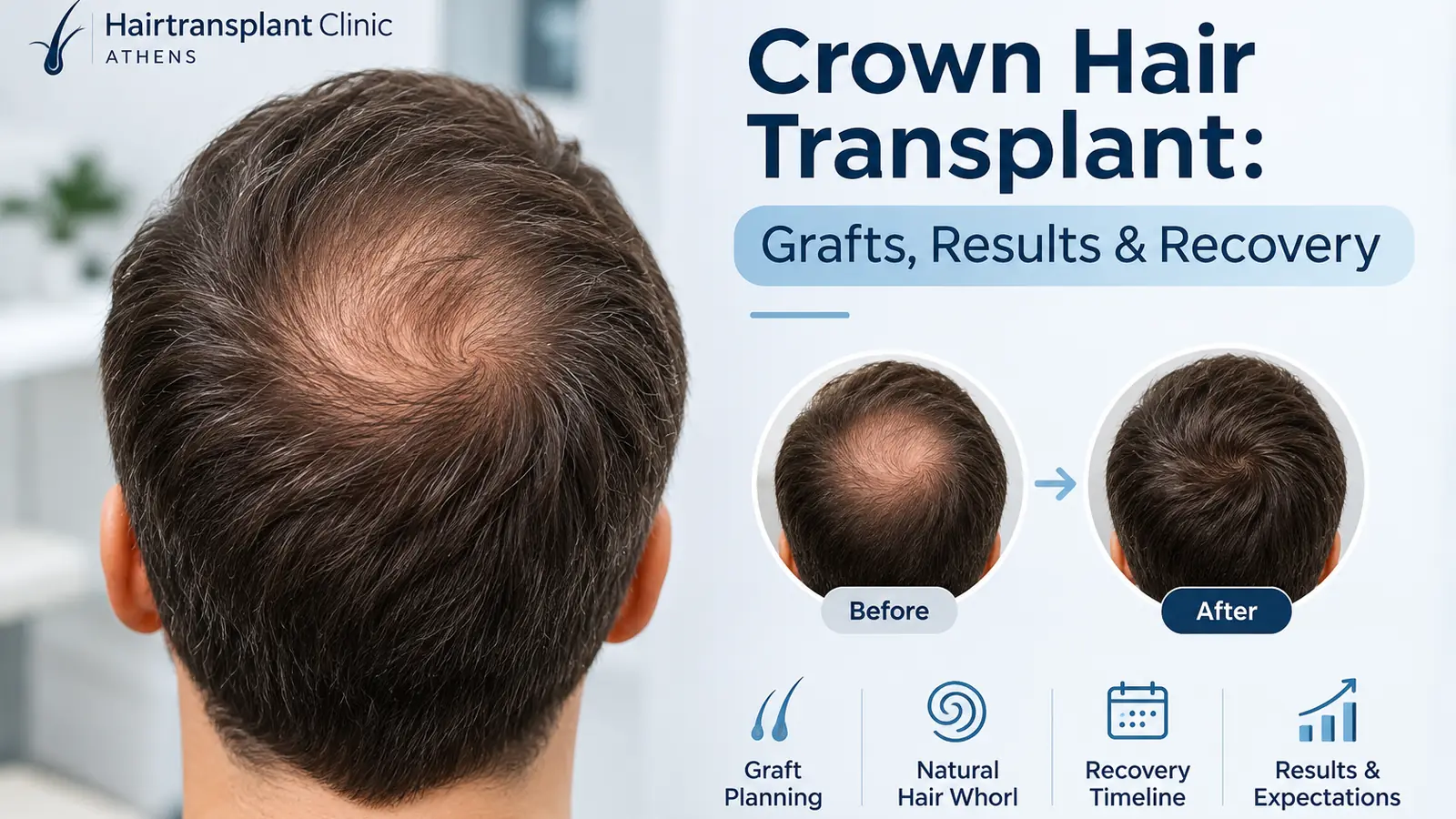
Crown Hair Transplant: Grafts, Results & Recovery
Your hairline may still look full, yet photographs taken from above reveal a noticeably thinner area at the back of your head.
For many people, thinning at the crown is particularly frustrating. It can be difficult to see in the mirror, but becomes obvious under bright lighting or when someone takes a photograph from behind.
A crown hair transplant, also known as a vertex hair transplant, may help restore coverage in this area.
However, crown restoration requires a different approach from frontal hairline surgery. The natural spiral direction of the hair, the size of the thinning area and the possibility of further hair loss all influence the treatment plan.
Understanding these differences is essential before deciding whether surgery is appropriate.
What Is a Crown Hair Transplant?
The crown, also called the vertex, is the upper rear region of the scalp.
In most people, hair in this area grows around a natural central point, creating a circular or spiral pattern known as the hair whorl.
When androgenetic alopecia affects the crown, the existing hair gradually becomes thinner. Over time, more scalp may become visible, and the thinning area can expand.
A crown hair transplant involves moving suitable follicular units from a donor area, usually at the back or sides of the scalp, into the affected vertex.
The objective is not simply to fill a bald patch with as many hairs as possible.
It is to restore visually balanced coverage while respecting the natural direction of the surrounding hair and preserving the available donor supply.
Why Is Crown Hair Transplant Surgery Different?
There are three important differences between crown restoration and surgery at the frontal hairline.
The Natural Hair Whorl
Hair at the crown does not grow in one uniform direction.
It often forms a spiral, with individual hairs changing direction as they move away from the centre.
This makes accurate placement especially important.
Grafts inserted at unsuitable angles may create an unnatural appearance even when they survive and grow successfully.
A carefully designed crown transplant should take the patient’s existing growth pattern into account.
The Area May Be Larger Than It Appears
A small thinning spot can gradually expand into a considerably wider region.
As a result, restoring the crown may require more donor resources than a patient initially expects.
The surgeon must assess the entire affected area rather than focusing only on its most visibly bald centre.
Hair Loss May Continue
Androgenetic alopecia is often progressive.
A patient who undergoes surgery to cover a small crown area may experience further thinning around the transplanted follicles several years later.
This could leave a relatively dense central region surrounded by thinner hair.
Long-term planning therefore matters just as much as the immediate result.
Who Is a Good Candidate for a Crown Hair Transplant?
A crown transplant may be appropriate for selected patients with established pattern hair loss and enough suitable donor hair.
A medical assessment should consider several factors.
Confirmed diagnosis: Not every visible patch at the crown represents androgenetic alopecia. A normal hair whorl, temporary shedding, alopecia areata or certain scalp disorders can produce different appearances and require different management.
Donor hair availability: A transplant can only redistribute existing follicles. The donor region must provide sufficient suitable grafts without becoming excessively depleted.
Hair loss progression: Rapidly changing or poorly defined hair loss may require further investigation, treatment or observation before surgery.
Realistic expectations: The achievable appearance depends on hair thickness, colour, texture, the area requiring coverage and the available graft supply.
Age may also influence planning, especially when the eventual extent of pattern hair loss remains uncertain.
Our guide to the best age for a hair transplant explains why surgical timing should be individualised.
How Many Grafts Are Needed for a Crown Hair Transplant?
There is no standard number of grafts suitable for every crown transplant.
Consider two patients.
The first has a relatively small region of thinning at the vertex, with substantial existing hair remaining.
The second has advanced hair loss extending from the crown towards the mid-scalp.
Although both want to restore the crown, the size of the treatment area and their surgical requirements are different.
The graft plan depends on:
- The surface area requiring restoration.
- The density of existing hair.
- The diameter and texture of the hair shafts.
- The number of hairs within each follicular unit.
- The contrast between hair and scalp colour.
- The amount of stable donor hair available.
- The possibility of further hair loss.
Importantly, one graft does not necessarily contain just one hair. Follicular units can contain several hairs, and their characteristics affect the appearance of coverage.
A surgeon may sometimes recommend distributing grafts across a larger area at a more conservative density rather than concentrating them in one location.
In other cases, a smaller and more targeted procedure may be appropriate.
The safest graft count is determined by medical examination, not an advertised package or a fixed online estimate.
Read more about why the hair transplant donor area must be protected during surgical planning.
How Is a Crown Hair Transplant Performed?
The process begins before the operation itself.
1. Medical Assessment
The physician examines the pattern of hair loss, the scalp and the donor region.
This may involve magnified examination of the hair and scalp to assess density, hair shaft characteristics and miniaturisation.
The examination also helps identify whether there is a medical reason to postpone or reconsider transplantation.
2. Crown Design
The surgeon evaluates the position and direction of the natural hair whorl.
If enough surrounding hair remains, its growth pattern can provide important guidance for planning the recipient area.
The objective is to create a natural arrangement that blends with existing hair.
3. Donor Hair Harvesting
Suitable follicular units are harvested using the technique chosen for the individual patient.
Options may include FUE, FUT/Strip or another appropriate approach.
No technique should be selected automatically without considering the donor area and the overall restoration plan.
4. Graft Placement
The harvested follicular units are placed into carefully planned recipient sites.
At the crown, the direction and angle of placement require particular attention because the hair changes orientation around the whorl.
5. Recovery and Follow-Up
After surgery, the patient receives individual instructions for protecting the grafts, washing the scalp and gradually returning to normal activities.
Follow-up allows the physician to assess healing and the development of the transplanted hair.
Crown Hair Transplant Recovery: What to Expect
Results develop gradually. The visible appearance during the first few months should not be confused with the final outcome.
The First Two Weeks
The scalp may show redness, sensitivity, swelling or small scabs around the implanted grafts.
The transplanted area needs careful protection during the initial healing period.
Patients should follow their surgeon’s instructions regarding washing, sleeping positions, exercise and avoiding friction or trauma.
Weeks Two to Eight
The visible shafts of transplanted hairs commonly shed during the weeks after surgery.
This is an expected part of the hair growth cycle and does not necessarily mean that the transplanted follicles have failed.
Months Three to Six
New growth may begin becoming visible.
Initially, the hairs may appear relatively fine, short or unevenly distributed.
The visual density can still be limited at this stage.
Months Six to Twelve
Many patients experience increasingly noticeable coverage as the new hairs grow longer and mature.
However, the degree of improvement varies.
Months Twelve to Eighteen
Further changes in hair length, calibre and overall appearance may occur.
According to NHS guidance, the full results of hair transplantation may take approximately 10–18 months to become apparent.
An individual crown transplant should therefore not be judged solely by its appearance after a few months.
Crown Hair Transplant Before and After: What Makes a Natural Result?
When reviewing before-and-after photographs, it is important to compare more than the visible amount of hair.
Look at the overall pattern.
Does the transplanted region blend with the surrounding hair? Does the direction of growth follow the natural whorl? Is the result balanced from different viewing angles?
Photographic conditions are also important.
A crown photographed under strong overhead lighting may look less dense than the same scalp photographed in softer light.
Hair length, styling and camera angle can further influence the appearance.
For meaningful comparisons, photographs should ideally use similar lighting, hair length, positioning and camera angles.
A successful outcome should be judged against the original treatment plan and the patient’s individual characteristics, not the expectation that every scalp will regain its original density.
Crown vs Hairline Transplant: Which Should Come First?
This is one of the most important decisions in patients with extensive hair loss.
Someone may have a receding frontal hairline, thinning through the mid-scalp and a visibly affected crown.
If the donor supply is limited, attempting to restore every region at high density may not be realistic.
The surgeon must decide which areas offer the most meaningful cosmetic improvement while preserving sufficient grafts for possible future needs.
For some patients, restoring the frontal region may take priority.
For others, crown restoration may be particularly important.
There is no universal order that applies to every case.
The decision should reflect the patient’s concerns, the distribution of hair loss, the available donor hair and the anticipated long-term progression.
Can You Have a Crown Hair Transplant After a Previous Hair Transplant?
Yes, in selected cases.
A patient may initially undergo restoration of the frontal hairline and later consider treatment for crown thinning.
However, the second procedure depends on how much suitable donor hair remains.
The surgeon must review the previous harvesting pattern, existing scars, current donor density and the likely benefits of further surgery.
Another operation should not be planned simply because the crown remains thin.
It may be necessary to allow the first result to mature, address ongoing hair loss or reconsider the desired coverage.
Our article on a second hair transplant explains these decisions in more detail.
Can Hair Loss Continue After a Crown Hair Transplant?
Yes.
Transplanted follicles are usually obtained from regions that are relatively resistant to the typical progression of androgenetic alopecia.
However, natural hair surrounding the transplanted follicles may continue thinning.
A successful crown transplant therefore does not mean that the underlying hair-loss condition has stopped.
Where appropriate, a dermatologist may discuss medical treatments designed to help manage further hair loss.
The suitability of any medication depends on the patient’s medical history, potential adverse effects and individual treatment goals.
Hair restoration should be viewed as a long-term strategy rather than a one-time solution that automatically prevents future thinning.
How Much Does a Crown Hair Transplant Cost?
The price depends on the individual treatment plan.
Relevant factors include the extent of crown thinning, the grafts required, the available donor supply, the selected surgical technique and the complexity of the procedure.
Some patients need a relatively limited intervention.
Others may require a more extensive restoration strategy, potentially involving more than one treatment stage.
A meaningful cost estimate should follow medical assessment rather than rely on a fixed graft package that may not suit the patient’s needs.
Frequently Asked Questions
Does a crown hair transplant work?
Crown transplantation can provide an improvement in coverage for suitable candidates. The outcome depends on the cause of hair loss, donor availability, surgical technique, graft placement and individual healing.
Is the crown harder to transplant than the hairline?
The crown has a distinctive circular growth pattern and may involve a relatively large treatment area. These characteristics make natural graft placement and donor allocation especially important.
How many grafts do I need for a bald crown?
The number varies according to the size of the affected area, remaining hair, donor capacity and desired coverage. A clinical examination is required to estimate an appropriate graft count.
Does crown hair transplant growth take longer?
Some patients notice that their crown takes time to develop visible coverage. However, there is no universally established separate growth timetable for every crown transplant. Results should be assessed according to the patient’s individual progress.
Can a crown hair transplant look completely natural?
A natural appearance is possible with appropriate patient selection, careful reconstruction of the hair whorl and realistic density planning. No procedure can guarantee a particular cosmetic result.
Can I transplant only the crown?
Yes, if the diagnosis, donor area and long-term treatment plan support restoring that region alone. However, the surgeon should also assess the rest of the scalp before recommending isolated crown treatment.
Will I need another procedure later?
Not necessarily. Some patients achieve their desired improvement after one procedure. Others may require further treatment if hair loss progresses or if restoration was planned in stages.
Planning a Crown Hair Transplant in Athens
The decision to restore the crown should begin with a medical examination, not a predetermined number of grafts.
At Hairtransplant Clinic in Athens, Dr. Ioannis Papangelopoulos, MD, PhD, personally performs hair transplantation procedures.
The assessment considers the type and progression of hair loss, the available donor area and the individual patient’s restoration goals.
For some people, a crown hair transplant may be an appropriate option. For others, further investigation, medical management or a different treatment strategy may be more suitable.
Considering a crown hair transplant? Contact Hairtransplant Clinic to arrange an individual assessment and discuss your options.