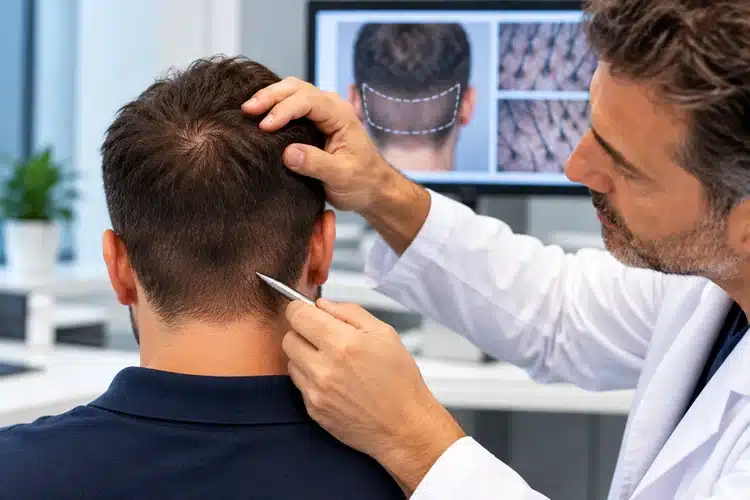
Hair Transplant Donor Area: What You Need to Know
A hair transplant can only redistribute hair that is already available.
This is why one of the most important parts of planning a hair transplant is not the bald area you want to restore, but the area from which the new grafts will be taken.
This is known as the hair transplant donor area.
For most patients with androgenetic alopecia, suitable donor hair is usually found at the back and sides of the scalp. However, not every hair in these regions can necessarily be harvested safely.
The number of usable grafts varies from person to person, and the available donor supply is limited.
A patient with extensive hair loss may require substantial restoration, but the donor area may not contain enough suitable follicular units to achieve the desired density across the entire scalp.
This creates one of the most important principles in hair restoration surgery:
A successful hair transplant is not about extracting the largest possible number of grafts. It is about using the available donor hair safely, effectively and with long-term planning.
Understanding how the donor area works can help you recognise why medical assessment matters, how FUE and FUT differ and why excessive harvesting can cause permanent problems.
What Is the Hair Transplant Donor Area?
The donor area is the region from which follicular units are harvested for transplantation into parts of the scalp affected by hair loss.
A follicular unit is a naturally occurring group of hair follicles.
It may contain one, two, three or more hairs.
During a hair transplant, selected follicular units are removed from the donor area and placed into the recipient area, such as the frontal hairline, temples, mid-scalp or crown.
In many patients with androgenetic alopecia, the donor area is located primarily along the back and sides of the scalp.
Hair follicles in these regions are often more resistant to the typical pattern of androgen-related miniaturisation than follicles in the frontal scalp and crown.
This relative resistance is one reason why suitable donor follicles can continue producing hair after transplantation.
However, the level of resistance is not identical in every individual or throughout the entire donor region.
A physician must therefore determine which areas are likely to provide sufficiently stable hair.
Where Is the Safe Donor Area Located?
The safe donor area is the part of the scalp considered most likely to retain suitable hair over the long term.
It generally includes selected regions at the back and sides of the head.
However, it should not be understood as a fixed rectangle or a standard region that looks exactly the same in every patient.
The boundaries depend on individual characteristics.
These include the patient’s age, family history, pattern of hair loss and possible future progression.
In some people, hair thinning may extend into regions that initially appear to be suitable donor areas.
This is particularly important when the patient is relatively young and their eventual hair-loss pattern is not yet clear.
Is All Hair at the Back of the Head Permanent?
No.
Although the back and sides of the scalp often contain relatively resistant follicles, it is not medically accurate to assume that every follicle in these regions will remain unaffected by future hair loss.
Certain patients may develop thinning close to the lower hairline, behind the ears or elsewhere within the potential donor region.
Some may experience diffuse miniaturisation affecting a wider area.
If follicular units are harvested from a region that later becomes significantly thinner, the transplanted hair may not have the long-term stability originally expected.
This is why identifying the safe donor area requires more than observing that the back of the head looks relatively full.
Why Does the Safe Donor Zone Matter?
The location of harvesting affects both the immediate surgical plan and the potential long-term appearance.
A transplant can look promising initially but become less satisfactory if hair taken from an unstable donor region undergoes progressive thinning.
A careful medical assessment therefore considers the possibility of future hair loss before deciding where grafts should be harvested.
The safe donor zone is a clinical estimate based on available evidence and individual findings, not an absolute lifetime guarantee.
How Is the Donor Area Assessed Before Surgery?
A proper donor-area assessment involves several measurements and observations.
The surgeon needs to determine how much suitable hair is available, how much may be removed and how the remaining hair will cover the donor scalp.
The examination may involve trichoscopy or other forms of magnified scalp assessment.
Several characteristics are particularly important.
1. Follicular Unit Density
Follicular unit density refers to the number of follicular units within a given area of the scalp.
It is commonly assessed in relation to the available donor surface.
A patient with a higher concentration of suitable follicular units may have more harvesting options than someone with a lower donor density.
However, higher density does not mean unlimited harvesting is possible.
Enough follicular units must remain to maintain the donor area’s appearance.
The distribution of the extracted grafts is also important.
2. The Number of Hairs per Follicular Unit
One graft does not necessarily contain one hair.
Some follicular units contain a single hair, while others contain multiple hairs.
This means that two patients with a similar number of available grafts may have different total numbers of hairs available for transplantation.
A graft count alone does not fully describe the potential coverage.
The composition of the follicular units also matters.
3. Hair Thickness and Calibre
Hair calibre can make a substantial difference to the visual appearance of density.
Thicker hairs may provide greater apparent coverage than finer hairs, even when a similar number of grafts is used.
For this reason, the surgeon must consider both the number of follicular units and the characteristics of the hair they contain.
A patient with relatively fine hair may require a different restoration strategy from someone with thicker hair.
4. Hair Colour, Curl and Texture
The visual effect of transplanted hair is influenced by its natural characteristics.
Hair colour relative to skin colour can affect how much of the scalp remains visible.
Wavy or curly hair may also create a different appearance of volume and coverage compared with straight hair.
These factors influence how the available donor supply can be used to create a balanced result.
They do not, however, eliminate the need to preserve sufficient donor reserves.
5. Miniaturisation Within the Donor Area
Miniaturisation is the process through which certain follicles gradually produce thinner and shorter hairs.
When significant miniaturisation occurs within the potential donor region, the long-term reliability of that region may be reduced.
A donor area can appear reasonably dense from a distance while still containing a proportion of increasingly fine hairs.
That is why an appropriate examination looks beyond the overall appearance of the scalp.
The physician needs to assess whether the available hair is likely to remain suitable for transplantation.
Is the Hair Transplant Donor Area Unlimited?
No.
This is one of the most important facts every prospective patient should understand.
The scalp contains a finite number of follicular units.
Only a portion of those units may be suitable for harvesting.
Removing grafts reduces the amount of hair remaining in the donor region.
Hair transplantation does not create additional follicles to replace those that have been moved.
This means the donor area must be managed as a limited surgical resource.
A treatment plan should consider not only the patient’s present hair loss but also the possibility that further restoration may be needed in the future.
Why Should Donor Hair Be Preserved for the Future?
Androgenetic alopecia often progresses over time.
A person who initially experiences recession at the temples may later develop thinning in the mid-scalp or crown.
If a large proportion of the available donor reserve is used during the first procedure, fewer suitable grafts may remain for future treatment.
This is especially important for younger patients, whose long-term pattern of hair loss may be difficult to predict.
Responsible planning must balance today’s aesthetic goals with the preservation of future surgical options.
Does Donor Hair Grow Back After FUE?
This question creates considerable confusion.
When an intact follicular unit is completely removed during FUE, that follicular unit does not normally regenerate as a complete new unit at the extraction site.
The remaining hair in the donor region continues to grow.
This is why the harvested area may gradually appear fuller as the surrounding hair length increases.
However, the fact that the donor area looks fuller after healing does not mean the extracted follicles have been replaced.
The appearance is maintained by the follicular units that remain.
This distinction explains why the distribution of extractions is so important.
If too many grafts are removed from a small area, the remaining hair may no longer provide sufficient visual coverage.
Why Can the Donor Area Look Normal After Surgery?
With carefully planned harvesting, extractions can be distributed across an appropriate region rather than concentrated in one small location.
The surrounding hair may help conceal the small extraction sites once healing progresses.
The final appearance depends on several factors, including initial density, hair thickness, extraction distribution and haircut length.
Even when healing is satisfactory, there has still been a reduction in the number of follicular units within the harvested region.
What Is Donor Area Overharvesting?
Overharvesting occurs when excessive follicular units are removed from the donor area, leaving insufficient hair or causing unacceptable changes to its appearance.
This may happen when:
- Too many grafts are extracted.
- Extractions are concentrated too closely together.
- The safe donor zone is not assessed correctly.
- The original donor density is overestimated.
- Previous harvesting is not properly considered.
- The surgical plan prioritises graft numbers over donor preservation.
A severely overharvested donor area may appear patchy, uneven or visibly thin.
Small scars may also become more noticeable because fewer surrounding hairs remain to conceal them.
In some cases, the cosmetic changes can be permanent.
Why Is a Very High Graft Count Not Always Better?
The largest possible graft count is not necessarily the most appropriate graft count.
A surgeon must decide whether the proposed number can be harvested safely and whether it will provide meaningful improvement in the recipient area.
Extracting more grafts than the donor region can reasonably support may damage the appearance of an area that previously looked relatively full.
The result may be an improved hairline combined with an excessively depleted donor area.
This is not a desirable trade-off.
The objective is to balance recipient-area coverage with preservation of the donor region.
Can Overharvesting Be Corrected?
Correction may be difficult.
The original extracted follicular units are no longer present in the donor region.
Some patients may be candidates for additional procedures designed to improve the appearance of the depleted area, but such treatment depends on the remaining donor supply, scarring and other individual factors.
A complete restoration of the original donor density cannot be promised.
Prevention through careful surgical planning is therefore particularly important.
How Many Grafts Can Be Taken From the Donor Area?
There is no universal number that applies to every patient.
The number of grafts that may be harvested safely depends on:
- The size of the stable donor region.
- Follicular unit density.
- The number of hairs per graft.
- Hair thickness and visual coverage.
- The selected harvesting method.
- Previous transplantation procedures.
- The patient’s age and pattern of hair loss.
- The likely need for future surgery.
Two patients with apparently similar hair loss may therefore have very different donor capacities.
A figure quoted online without an individual examination cannot reliably describe what is safe for a particular person.
Does a Good Donor Area Always Mean Thousands of Available Grafts?
Not necessarily.
A donor region that appears relatively dense may still contain areas of miniaturisation or have limitations related to its dimensions.
The physician must also consider how the remaining hair will look after extraction.
The relevant question is not simply how many follicular units exist in the donor area.
It is how many suitable follicular units can be harvested without causing unacceptable depletion.
The treatment plan must balance the number of grafts required by the recipient area with the number the donor area can safely provide.
How Does FUE Affect the Donor Area?
During Follicular Unit Extraction (FUE), follicular units are harvested individually using specialised instruments.
Unlike traditional strip harvesting, FUE does not involve removing one continuous strip of scalp tissue.
Instead, the surgeon makes multiple small extraction sites throughout the planned donor region.
This allows graft harvesting to be distributed across an appropriate area.
However, the technique still removes follicular units from the scalp.
Why Does Extraction Distribution Matter?
Imagine a donor region with good initial density.
If the surgeon removes many grafts from one small location, that particular area may become visibly thinner.
By contrast, a carefully planned distribution may help preserve a more balanced appearance.
The appropriate extraction pattern depends on the patient’s density, scalp characteristics and available donor reserve.
It is not simply a matter of using the same distance or extraction percentage for every patient.
Can FUE Damage the Remaining Donor Hair?
FUE is a surgical procedure and can affect surrounding tissues.
Potential risks include scarring, temporary changes in sensation, inflammation and visible thinning if harvesting is excessive or poorly distributed.
The technique requires careful selection of extraction sites and appropriate instrument handling.
You can read more about the surgical process on our FUE hair transplant page.
What Happens to the Donor Area With FUT?
Follicular Unit Transplantation (FUT) uses a different harvesting approach.
Instead of individually extracting follicular units throughout a wider region, the surgeon removes a strip of hair-bearing scalp tissue from an appropriate donor area.
The strip is subsequently divided into follicular-unit grafts.
The donor wound is surgically closed.
This leaves a linear scar.
Its final appearance depends on factors such as surgical technique, closure tension, healing characteristics and scalp mobility.
Is FUT Better Than FUE for the Donor Area?
Neither technique is universally superior.
FUE and FUT use the available donor region differently.
FUE creates numerous small extraction sites distributed across the selected area.
FUT removes a strip of tissue and produces a linear donor scar.
The choice must take account of the amount of available donor hair, previous procedures, donor-area characteristics and the patient’s long-term surgical needs.
In selected cases, other approaches or combinations of techniques may be considered after medical evaluation.
The decision should follow the individual assessment rather than assuming one method is always safer or more effective.
Does FUE Leave Scars in the Donor Area?
Yes.
FUE is sometimes described online as a scar-free procedure, but this is inaccurate.
Each extraction creates a small wound that heals with a tiny scar.
These scars may be difficult to notice, particularly when the procedure has been appropriately planned and the surrounding hair provides good coverage.
However, their visibility varies.
Factors include the size of the extraction instrument, the concentration of extraction sites, skin characteristics, individual healing and the length of the remaining hair.
Someone who prefers a very short haircut may notice donor-area changes that are less visible with longer hair.
FUT typically produces a linear scar rather than numerous scattered extraction marks.
Neither harvesting method can guarantee completely invisible scarring.
How Does the Donor Area Look Immediately After FUE?
The donor scalp usually shows small extraction sites following the procedure.
Patients may also experience temporary redness, tenderness, small scabs or local discomfort.
These changes form part of the early healing process.
As the skin heals and the surrounding hair grows longer, the extraction sites often become less noticeable.
However, recovery varies according to the extent of harvesting, the patient’s skin and the postoperative care provided.
When Does the Donor Area Heal?
The small surface wounds created during FUE commonly begin healing within the first several days.
Visible redness, scabbing and tenderness generally improve progressively.
The overall cosmetic appearance may continue changing as the scalp recovers and the remaining hair regains length.
There is no single recovery day that applies to every patient.
A scalp that looks healed on the surface may still need appropriate care.
Patients should follow their surgeon’s instructions regarding washing, touching the area, exercise and other activities.
Which Signs Require Medical Attention?
Increasing pain, spreading redness, significant swelling, unusual discharge or persistent bleeding should be reported to the medical team.
A fever or other concerning postoperative symptom may also require prompt evaluation.
Patients should not attempt to manage a suspected infection or wound complication by applying unprescribed products to the surgical area.
Can Shock Loss Occur in the Donor Area?
Yes.
Some patients may experience temporary shedding of hairs around the donor area following transplantation.
This is sometimes described as donor-area shock loss.
It is different from the deliberate removal of follicular units during the procedure.
With shock loss, hairs associated with follicles that remain in the scalp may temporarily shed following surgical stress.
If those follicles remain healthy and functional, hair growth may recover.
However, not every area of postoperative thinning should automatically be considered temporary shock loss.
Persistent or unusually severe donor thinning requires evaluation to determine whether it reflects temporary shedding, overharvesting or another complication.
Can the Donor Area Become Thinner Over Time?
Yes.
The donor region is often relatively resistant to androgenetic hair loss, but this does not mean it is permanently unaffected in every patient.
Some people may develop gradual miniaturisation within parts of the back or sides of the scalp.
The extent and distribution vary.
This is one reason why the donor area must be evaluated with the patient’s future hair-loss pattern in mind.
What If Hair Loss Affects the Donor Region?
Diffuse thinning or miniaturisation affecting potential donor areas may significantly limit transplant suitability.
A follicular unit that is already affected by progressive miniaturisation may not provide the long-term reliability expected from suitable donor hair.
Some patients may have diffuse unpatterned alopecia or other conditions that reduce the available stable donor supply.
A specialist assessment is necessary to identify these patterns.
In certain circumstances, transplantation may need to be postponed or may not be recommended.
What If You Have a Weak Donor Area?
A weak donor area does not necessarily mean surgery is impossible.
However, it can place important limitations on the available options.
A patient with advanced hair loss and a small donor reserve may not have enough suitable grafts to provide high-density coverage across every affected region.
The surgeon must therefore establish realistic priorities.
Some patients may benefit from a limited restoration focused on selected areas.
For others, non-surgical management or a different strategy may be more appropriate.
If the donor supply cannot support a meaningful and acceptable result, the responsible decision may be not to operate.
The available donor area is a major factor in determining whether someone is a suitable candidate for transplantation.
Can You Use the Same Donor Area for a Second Hair Transplant?
Sometimes, yes.
The possibility of additional harvesting depends on the amount and condition of the donor hair remaining after the first procedure.
A second assessment should consider:
- The number of grafts removed previously.
- The locations of earlier extractions.
- Remaining follicular unit density.
- Existing scars.
- Hair thickness and miniaturisation.
- Any progression of hair loss.
- The number of grafts required for further restoration.
A patient with a well-preserved donor reserve may have options for additional transplantation.
Another patient whose donor area has already been heavily harvested may have very limited remaining capacity.
Why Is the First Hair Transplant So Important for Future Surgery?
The first procedure can affect what is possible later.
Using an excessive proportion of the available grafts for the initial restoration may leave insufficient donor hair if natural hair loss continues.
This is particularly important when planning a very low or densely populated hairline in a younger patient.
Long-term donor management aims to preserve flexibility for future needs.
That does not mean every patient will require a second procedure.
It means the surgeon should avoid unnecessarily limiting future options.
How Does the Donor Area Influence the Final Hair Transplant Result?
The donor area establishes important limits on what the surgical procedure can achieve.
Its density, stability and hair characteristics influence how many grafts can be used and how much coverage may be realistic.
However, even a very good donor area does not guarantee a particular outcome.
The final appearance also depends on:
- The diagnosis and pattern of hair loss.
- The selected recipient areas.
- Hairline design.
- Graft preparation and handling.
- The angle and direction of implantation.
- Healing and individual hair growth.
- The possible future loss of non-transplanted hair.
A balanced surgical plan must account for all these factors.
For a broader explanation of the procedure, read our guide to how a hair transplant works step by step.
Does Donor Area Quality Affect Hair Transplant Cost?
Yes.
Donor-area characteristics form part of the clinical assessment used to prepare a treatment plan.
A patient with a limited donor supply may require a different approach from someone with a larger stable donor region.
The number of grafts, the selected technique and the complexity of the procedure can all influence the overall cost.
However, donor-area quality is not something that can be reliably converted into a universal price without examining the individual patient.
A responsible estimate follows a medical assessment.
Further information is available in our guide to hair transplant cost in Greece.
What Should You Ask About Your Donor Area Before Surgery?
Before agreeing to a hair transplant, it is reasonable to ask the physician how the donor area has been assessed.
Useful questions include:
- Where is my estimated safe donor zone?
- Is there any evidence of thinning or miniaturisation in that region?
- How many grafts may reasonably be harvested?
- How will their removal affect the appearance of my donor area?
- What type of scars may remain?
- Why is the proposed harvesting technique appropriate for me?
- How much donor supply might remain for possible future surgery?
- Who will personally perform the surgical stages of the procedure?
These questions can help clarify whether the recommended graft plan reflects the patient’s individual needs rather than an advertised package.
At Hairtransplant Clinic, Dr. Ioannis Papangelopoulos, MD, PhD, personally performs hair transplant procedures, supported by his medical team.
The clinic’s approach to physician-led hair transplantation in Greece includes individual donor-area assessment, surgical planning and consideration of long-term hair-loss progression.
Frequently Asked Questions About the Hair Transplant Donor Area
Where is the donor area for a hair transplant?
It is usually located at the back and sides of the scalp. The exact safe donor zone must be determined individually, as not all hair in these regions is necessarily suitable for harvesting.
Does donor hair grow back after FUE?
When an intact follicular unit is completely removed, it does not normally regenerate as a new complete unit at the extraction site. The surrounding hair continues to grow and may conceal the small extraction marks.
How many grafts can be taken from a donor area?
There is no universal number. Safe harvesting depends on donor-area size, density, hair characteristics, previous procedures and long-term restoration needs.
Can FUE permanently thin the donor area?
Yes. Excessive or poorly distributed harvesting can lead to visible and potentially permanent donor-area depletion.
Does FUE leave scars at the back of the head?
Yes. FUE creates numerous small extraction scars. They are often subtle, but their visibility varies according to surgical technique, extraction density, healing and haircut length.
How long does the donor area take to heal?
Small FUE extraction sites generally begin to heal within days, with redness, scabs and sensitivity improving over time. Recovery varies and the surgeon’s individual aftercare instructions should be followed.
Can the donor area develop shock loss?
Yes. Temporary shedding may occur around the surgical donor region. It differs from permanently removed grafts, and persistent thinning should be assessed by the treating physician.
What happens if my donor area is too thin?
The number of grafts available for safe harvesting may be limited. Some patients may be considered for smaller procedures, while others may not be suitable candidates for transplantation.
Can donor hair be harvested again for a second transplant?
Possibly. This depends on the amount of healthy donor hair remaining, the previous extraction pattern, scarring and the patient’s current hair-loss pattern. A new assessment is required.
Is FUT better than FUE for preserving donor hair?
Neither technique is automatically better for every patient. They affect the donor region differently and must be evaluated according to individual anatomy, previous surgery and long-term graft requirements.
Conclusion: Your Donor Area Is a Limited Resource
The donor area is one of the most important factors in hair transplant planning.
It determines how many suitable follicular units may be available for restoration and influences the amount of coverage that can reasonably be achieved.
However, the donor region is not an unlimited source of hair.
Follicular units removed during harvesting are not normally replaced at their original extraction sites.
Excessive or poorly planned harvesting can therefore lead to visible thinning, scarring and reduced options for future procedures.
The safe donor zone must be assessed individually, with attention to follicular density, hair calibre, miniaturisation and the possibility of future hair loss.
The choice between FUE, FUT or another appropriate approach should follow this examination.
A carefully planned hair transplant protects not only the area being restored, but also the donor hair that needs to remain.
If you are considering surgery and would like to understand your donor-area suitability, graft availability and possible treatment options, you can contact Hairtransplant Clinic to arrange an individual diagnostic consultation.
Phone: +30 21 0775 7700
Email: info@hairtransplant.gr
The right surgical plan begins with understanding how much suitable donor hair you have — and how to use it responsibly.