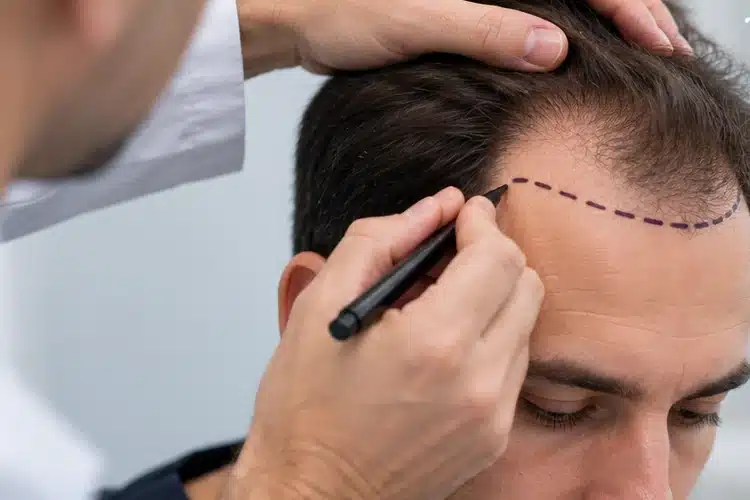
Hair Transplant Cost in Greece: What Affects the Price?
If you are considering a hair transplant in Greece, one of your first questions is likely to be: How much does a hair transplant cost?
It is a reasonable question. Hair transplantation is a significant personal and financial decision, and understanding the potential cost is an important part of choosing the right treatment.
However, there is no single price that applies to every patient.
Someone who wants to restore a receding hairline may have very different needs from someone experiencing extensive thinning across the frontal area, mid-scalp and crown.
The number of grafts required, the condition of the donor area, the surgical technique and the complexity of the procedure can all influence the final estimate.
The most reliable way to understand your hair transplant cost is to begin with a medical assessment and a personalised treatment plan.
Below, we explain the main factors that determine hair transplant pricing, why quotes can differ between clinics and what you should check before making a decision.
How Much Does a Hair Transplant Cost in Greece?
Hair transplant prices in Greece vary according to the individual patient’s needs.
There is no universal fee that accurately reflects every procedure, because the amount of hair restoration required can differ considerably.
For example, a patient with limited recession at the temples may need a smaller area treated than someone with significant thinning across the top of the scalp.
The available donor hair also matters. Two patients with similar-looking hair loss may have different donor density, hair characteristics and long-term restoration needs.
As a result, the same surgical approach or graft count may not be suitable for both patients.
A general price advertised online can provide some context, but it cannot replace a medical examination.
At Hairtransplant Clinic, the treatment plan and cost estimate are determined following an individual assessment of the patient’s hair loss, donor area and restoration goals.
Rather than beginning with a predetermined number of grafts, the process begins by identifying what can realistically and safely be achieved.
What Factors Affect Hair Transplant Cost?
Several factors contribute to the overall cost of a hair transplant. Understanding them can help you compare different proposals more meaningfully.
1. The Number of Hair Grafts Required
The number of grafts is one of the main considerations in hair transplant planning.
A graft is a follicular unit containing one or more hairs. During transplantation, suitable follicular units are harvested from the donor area and placed into areas requiring restoration.
The number needed depends on several factors, including the size of the area affected by hair loss, the desired coverage and the characteristics of the available donor hair.
A larger area may require more grafts.
However, a higher graft count does not automatically mean a better result.
The surgeon must consider where the grafts will provide the greatest benefit and how their extraction may affect the donor area.
For some patients, restoring a natural-looking frontal hairline may be the priority. For others, treatment may also involve the mid-scalp or crown.
The appropriate graft plan should reflect both the patient’s current appearance and the possibility of future hair loss.
2. The Extent and Pattern of Hair Loss
The location and extent of thinning are equally important.
Hair restoration in the frontal hairline is not planned in exactly the same way as restoration of the crown.
Each region has different aesthetic and anatomical considerations.
For example, the frontal hairline requires careful attention to its position, shape and the natural direction of the transplanted hairs.
The crown has a characteristic circular growth pattern that must also be considered when designing the recipient area.
If hair loss affects several regions, the surgeon must determine how to distribute the available grafts responsibly.
This affects the complexity of the procedure and may influence the total cost.
It also explains why two patients with similar degrees of hair loss may receive different treatment recommendations.
3. The Condition of the Donor Area
The donor area is a crucial part of every hair transplant assessment.
It is usually located at the back and sides of the scalp, where suitable follicular units may be available for transplantation.
Before surgery, the physician needs to evaluate several characteristics:
- The density of the donor hair.
- The thickness and quality of individual hairs.
- The distribution of follicular units.
- The amount of donor hair that may be safely harvested.
- The potential need to preserve donor reserves for the future.
The available donor supply is not unlimited.
For that reason, responsible hair transplant planning is not simply about extracting as many grafts as possible.
It is about using the available donor area appropriately while maintaining its appearance and considering the patient’s longer-term needs.
A patient with an extensive donor reserve may have different surgical options from someone whose donor area is more limited.
These differences can influence the proposed technique, number of grafts and overall treatment plan.
4. The Hair Transplant Technique
The technique selected for the procedure can also influence the treatment plan and cost.
One established method is Follicular Unit Extraction (FUE).
With FUE, follicular units are individually extracted from the donor area and subsequently transplanted into the recipient area.
The procedure requires careful graft selection, preparation of the recipient area and placement of the follicular units at appropriate angles and directions.
You can learn more about the procedure in our guide to FUE hair transplantation.
Other techniques, including FUT/Strip, Micro-strip or combined approaches, may also be considered depending on the individual case.
No single technique is automatically the best choice for every patient.
The most appropriate approach depends on the diagnosis, donor-area characteristics, required coverage and overall surgical plan.
Therefore, FUE hair transplant cost should not be viewed as a fixed amount that applies equally to everyone undergoing the technique.
5. The Complexity of the Surgical Plan
Some hair transplant procedures are more complex than others.
The complexity may depend on the distribution of hair loss, the available donor area, the number and characteristics of the grafts and the desired restoration.
Particular attention is required when planning the hairline or working in areas where the direction of hair growth changes.
The surgeon must also consider the patient’s age, hair characteristics and potential future progression of hair loss.
A successful plan should not focus only on filling the areas that currently appear thin.
It should also consider whether the proposed restoration will remain appropriate as the patient’s natural hair changes over time.
This level of planning is an important part of the medical assessment and can influence the overall surgical approach.
Why Do Hair Transplant Prices Differ Between Clinics?
If you compare hair transplant clinics in Greece, you may find noticeably different quotes for procedures that initially appear similar.
This does not necessarily mean that one clinic is charging the correct amount and another is not.
The differences may reflect variations in the surgical plan, the proposed graft count, the technique and the services included.
They may also reflect how each clinic organises medical assessment, the procedure itself and postoperative care.
This is why comparing only the final amount can be misleading.
Two quotes may look similar while covering different aspects of the treatment process.
Conversely, two quotes with different prices may not actually describe the same procedure.
Before making a decision, it is worth understanding exactly what each proposal includes.
What Should Be Included in a Hair Transplant Quote?
A clear quotation should help you understand what is being recommended and why.
You should be able to ask the clinic specific questions and receive straightforward explanations.
Important points to clarify include:
- Who performs the procedure? Identify the physician responsible for the surgery and clarify their direct involvement.
- How many grafts are planned? Understand how the proposed graft count relates to your donor area and treatment goals.
- Which technique is recommended? Ask why that particular technique is appropriate for your case.
- Which areas will be treated? Confirm whether the plan covers the hairline, temples, mid-scalp, crown or a combination of regions.
- How is the donor area being protected? Ask how the proposed extraction plan considers future restoration needs.
- What postoperative care is included? Clarify follow-up appointments, aftercare instructions and any additional support.
- What is included in the quoted price? Request an explanation of the services covered and whether any separate charges may apply.
These questions are particularly important when comparing offers from different clinics or countries.
A transparent quotation should make it easier to understand the complete treatment plan, rather than presenting a figure without the necessary medical context.
Is Hair Transplant Cost per Graft the Best Way to Compare Prices?
Some patients focus primarily on the quoted cost per graft.
This can be one way to understand how a clinic structures its pricing, but it does not tell the whole story.
The number of grafts is important, yet it does not independently determine the quality or suitability of a hair transplant.
A graft plan must account for the characteristics of the donor area, the needs of the recipient area and the patient’s likely future hair-loss progression.
It is also essential to understand whether a per-graft quotation covers the entire treatment process or only part of it.
A seemingly straightforward calculation may not reflect differences in surgical complexity or postoperative services.
For this reason, the overall medical plan matters more than a simple comparison of graft numbers and prices.
Does a More Expensive Hair Transplant Guarantee Better Results?
No.
A higher price does not guarantee a better result, just as a lower price does not necessarily indicate poor medical care.
Hair transplantation is a surgical procedure, and its outcome depends on several factors beyond the cost.
These include the patient’s suitability for surgery, the condition of the donor area, the surgeon’s expertise, graft handling, the design of the recipient area and the healing process.
The patient’s individual hair characteristics and future progression of hair loss also matter.
A natural-looking result requires careful planning rather than simply choosing the most expensive or the cheapest option available.
When comparing clinics, prioritise clear information about the physician, the proposed technique, the treatment plan, documented patient results and the follow-up process.
The right decision should balance medical suitability, realistic expectations and financial considerations.
Can You Estimate Hair Transplant Cost From Photos?
Photographs can be helpful during an initial consultation.
They may provide a preliminary view of the extent and pattern of hair loss, especially when they clearly show the frontal hairline, temples and crown.
However, photos alone cannot always reveal the information needed for an accurate surgical plan.
The donor area must also be assessed.
The physician may need to examine hair density, hair calibre and the available follicular units, as well as the likely progression of hair loss.
Other factors, including medical history and treatment expectations, should also be considered.
Therefore, an estimate based only on photographs should not be treated as a complete medical assessment.
A more reliable quotation follows an individual evaluation of the patient’s needs and available treatment options.
How Is Your Personalised Hair Transplant Quote Calculated?
The process begins with an assessment of the scalp and hair loss.
The physician evaluates the affected areas, considers the available donor reserve and discusses the patient’s expectations.
The examination helps determine whether hair transplantation is appropriate in the first place.
Not every type of hair loss requires surgery, and not every patient is a suitable candidate.
If transplantation is appropriate, the treatment plan can address the areas requiring restoration, the proposed graft allocation and the most suitable surgical approach.
The physician must also consider how the result may be affected by continuing hair loss in non-transplanted areas.
Only after these factors have been evaluated can the clinic provide a meaningful personalised estimate.
At Hairtransplant Clinic, Dr. Ioannis Papangelopoulos, MD, PhD, personally performs hair transplant procedures, supported by his medical team.
His direct involvement allows patients to know which physician is responsible for the procedure and its surgical planning.
For more information about the clinic’s approach, you can explore our hair transplant services in Greece.
Should You Consider Only the Initial Procedure Cost?
No. A hair transplant should be considered as a complete process rather than a single appointment.
The journey typically involves medical assessment, surgical planning, the procedure itself, postoperative care and follow-up.
The healing process and the development of new hair growth take time.
Patients need clear instructions on how to care for the scalp after surgery and what changes may be expected during recovery.
When reviewing a quotation, ask what follow-up support is available and which services are included in the proposed fee.
This is especially important for patients travelling to Greece from abroad, as they should understand how communication and postoperative monitoring will be organised after returning home.
A well-informed decision takes account of the complete treatment journey, not only the initial surgical price.
Frequently Asked Questions About Hair Transplant Cost in Greece
How much does a hair transplant cost in Greece?
There is no single price that applies to every patient. The cost depends on the extent of hair loss, the number of grafts required, donor-area characteristics, the surgical technique and the overall complexity of the procedure.
A personalised estimate is provided following a medical assessment.
How much does an FUE hair transplant cost?
FUE pricing depends on the individual treatment plan. The extent of the area being restored, the graft allocation and the condition of the donor area can all affect the cost.
The use of FUE alone does not determine a universal price.
Does the number of grafts affect the price?
Yes. The planned graft count is one of the main factors involved in calculating the cost.
However, a larger number of grafts does not automatically produce a better result. The donor supply must be used appropriately and the procedure must be tailored to the patient’s needs.
Is there a fixed hair transplant price list?
A general price list may not accurately represent the requirements of an individual procedure.
The appropriate graft plan, technique and surgical complexity differ between patients. A personal medical assessment is therefore necessary for a reliable quotation.
Can I receive an accurate quote from photographs alone?
Photographs can support an initial discussion, but they do not always provide enough information for a complete assessment.
The quality and availability of donor hair, medical history and potential future hair loss may all influence the final treatment plan.
Does the most expensive hair transplant always provide the best result?
No. Price alone cannot guarantee the quality of a surgical outcome.
Medical suitability, the physician’s expertise, careful planning, donor-area management and realistic expectations are all important considerations.
What should I ask before accepting a hair transplant quote?
Ask who will personally perform the procedure, which technique is recommended, how many grafts are planned, which areas will be treated and what postoperative services are included.
Make sure you understand the full treatment proposal before making a decision.
What to Remember About Hair Transplant Pricing
Hair transplant cost in Greece varies because every patient has different needs.
The extent of hair loss, number of grafts, donor-area condition, selected technique and complexity of the procedure all contribute to the final treatment plan.
A price alone cannot tell you whether a particular procedure is medically suitable or likely to meet your expectations.
The most useful starting point is a detailed assessment, followed by a clear explanation of the proposed approach and an individual cost estimate.
Choosing a hair transplant clinic should begin with understanding your diagnosis, your donor area and the physician who will perform the procedure — not simply comparing advertised prices.
Request a Personalised Hair Transplant Assessment
If you are considering hair transplantation in Greece and would like to understand the options available for your particular case, Hairtransplant Clinic can provide an individual assessment.
Dr. Ioannis Papangelopoulos, MD, PhD, personally performs hair transplant procedures, supported by his medical team.
To discuss your needs and obtain information about the recommended treatment plan and cost, you can contact Hairtransplant Clinic to arrange a diagnostic appointment.
Phone: +30 21 0775 7700
Email: info@hairtransplant.gr
Your treatment should be based on your individual needs, available donor hair and realistic expectations — with a clear understanding of the proposed procedure before you decide.