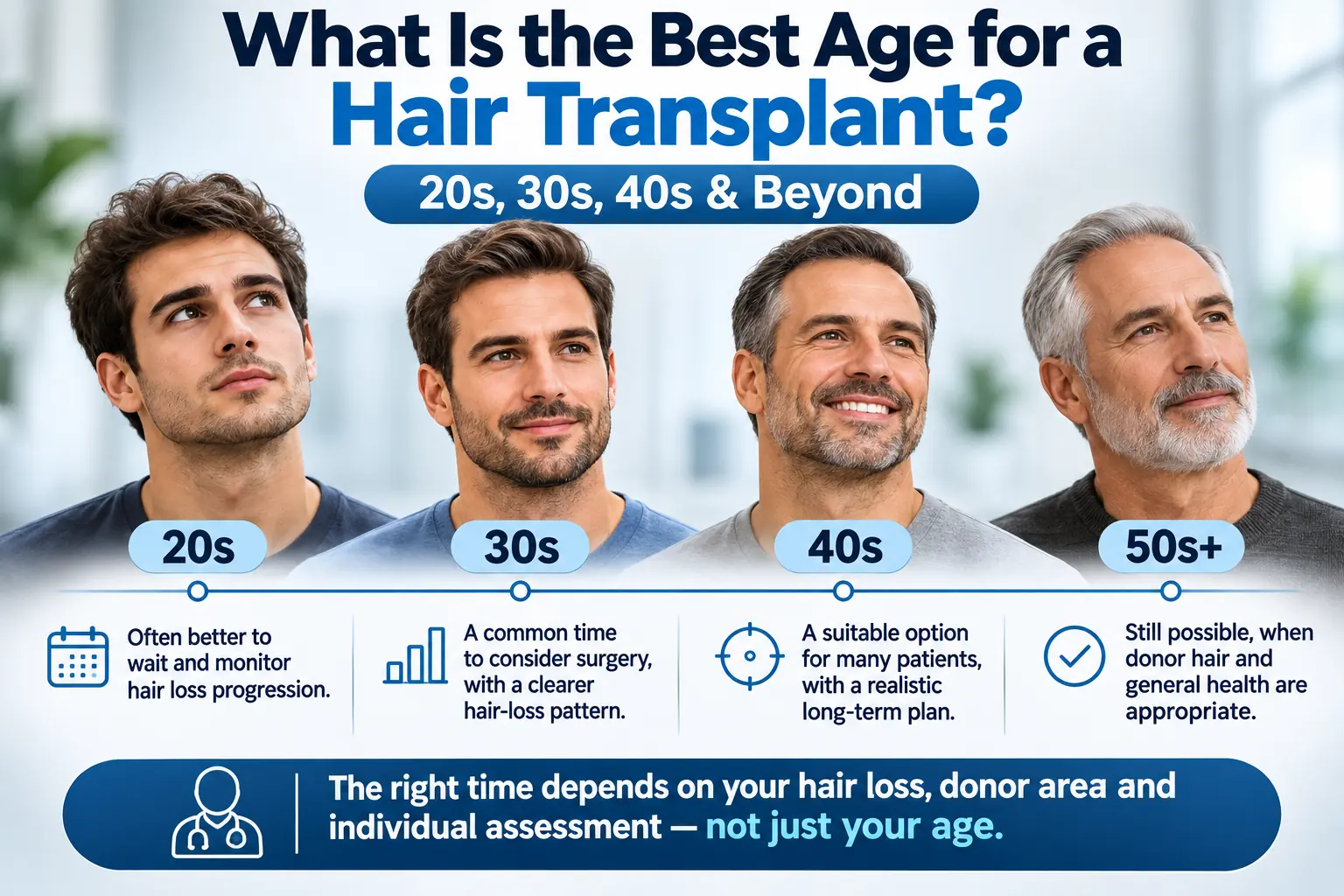
What Is the Best Age for a Hair Transplant? 20s, 30s, 40s & Beyond
You’re 24 years old, your hairline is receding, and you’re wondering whether you should get a hair transplant now or wait a few more years.
Or perhaps you’re 55, your hair has been thinning for decades, and you’re concerned that you’ve missed your opportunity.
Both situations raise the same important question: What is the best age for a hair transplant?
The answer is not as simple as choosing a number.
Hair transplantation can be appropriate for adults at different stages of life. However, age affects how reliably a surgeon can assess future hair loss, plan a natural-looking hairline, and manage the limited supply of donor hair.
A procedure that seems reasonable at 35 may be difficult to justify at 21, even when the current degree of hair loss looks similar.
In this guide, we explain when a hair transplant may be too early, what changes in your 20s, 30s, 40s and beyond, and how to determine whether you are ready for surgery.
What Is the Best Age for a Hair Transplant?
There is no single ideal age for a hair transplant.
Many patients consider surgery in their late 20s, 30s or 40s, when their hair-loss pattern may be easier to assess. However, these decades are not an official eligibility window.
For younger adults, particularly those experiencing rapidly progressing hair loss, delaying surgery may be the more appropriate decision.
For patients in their 50s, 60s or beyond, age alone does not necessarily prevent hair transplantation.
The most important factors are:
- The cause of hair loss.
- How quickly thinning is progressing.
- The stability and density of the donor area.
- The extent of hair restoration required.
- General health and medical history.
- Realistic expectations.
- The possibility of future hair loss.
An appropriate treatment plan must consider not only how your hair looks today, but also how it may change over the next 10, 20 or 30 years.
Is There a Minimum Age for a Hair Transplant?
Hair transplantation is generally discouraged in very young patients.
The International Society of Hair Restoration Surgery (ISHRS) explains that physicians do not typically recommend surgery for individuals younger than 20 because the eventual pattern of hair loss may be difficult to predict.
Some clinical guidelines suggest being particularly cautious in the early 20s and considering deferral until approximately 23–25 or later, depending on individual circumstances.
However, no single minimum age is appropriate for every patient.
The ISHRS 2025 Practice Census found that 73% of responding physicians reported using a minimum-age cutoff for younger patients. Among the reported minimum ages, the median was 23.
Importantly, these figures describe physician practice patterns. They are not a universal medical rule establishing 23 as the correct age for surgery.
A young adult’s suitability depends on diagnosis, progression, donor characteristics and long-term planning.
Can You Get a Hair Transplant at 18 or 19?
For typical hereditary pattern hair loss, transplantation at 18 or 19 is generally not recommended.
At this age, the eventual extent of androgenetic alopecia is often uncertain.
A small amount of recession around the temples may remain relatively limited or progress into substantial frontal and crown thinning over the following years.
Performing surgery before this pattern becomes clearer can create significant long-term challenges.
Young people experiencing hair loss should first seek a dermatological evaluation to establish the cause.
Hair loss caused by nutritional deficiencies, medical conditions, inflammatory disorders or other factors may require a different treatment approach.
Hair Transplant in Your Early 20s: Is It Too Soon?
Your early 20s can be a particularly difficult period for making permanent hair restoration decisions.
You may notice that your hairline no longer looks the way it did during your teenage years.
You might also compare your hair with photographs from several years earlier and become concerned about further recession.
However, a changing hairline does not automatically mean you need surgery.
Hair Transplant at 21 or 22
At 21 or 22, the pattern of hereditary hair loss may still be developing.
Even if thinning appears limited to the temples, more extensive hair loss may occur in the future.
The main concern is not whether transplanted hair could grow.
It is whether the surgical plan will remain aesthetically appropriate as surrounding natural hair continues to thin.
For many patients in this age group, medical assessment, appropriate nonsurgical treatment and observation are more useful than immediate transplantation.
Hair Transplant at 23 or 24
A hair transplant at 23 or 24 is not automatically inappropriate, but careful patient selection is essential.
Important considerations include how long hair loss has been present, whether it is progressing rapidly, and whether suitable donor follicles are available.
Some patients may have relatively established hair-loss patterns. Others may still be experiencing significant changes.
The same age can therefore lead to different medical recommendations.
Hair Transplant at 25
Is 25 a good age for a hair transplant?
It can be for selected patients.
By this stage, some individuals have a more recognisable pattern of androgenetic alopecia. Nevertheless, others continue to lose hair rapidly.
A surgeon should assess the history of thinning, the donor region and the likelihood of future loss before recommending surgery.
Turning 25 does not automatically make someone a suitable candidate.
Hair Transplant in Your Late 20s: A More Predictable Starting Point?
For some patients, the late 20s provide an opportunity to evaluate hair loss with greater confidence.
By this age, several years of photographs and clinical history may help reveal how quickly thinning is progressing.
This makes it easier to distinguish between relatively limited recession and a pattern likely to require more extensive restoration.
However, hair loss does not necessarily become stable at 28 or 29.
Androgenetic alopecia can continue progressing throughout adulthood.
The advantage of waiting is not that future hair loss becomes impossible.
It is that additional time and clinical observation may provide more information for planning.
Why Waiting Can Sometimes Improve the Treatment Plan
Waiting may allow:
- A clearer diagnosis of the type of hair loss.
- Assessment of how quickly the hairline is changing.
- Evaluation of potential treatment responses.
- More accurate estimation of donor hair availability.
- A conservative approach to hairline placement.
- Better anticipation of future restoration needs.
In certain cases, the most responsible recommendation may still be to postpone surgery.
Hair Transplant in Your 30s: Is This the Ideal Decade?
The 30s are often a practical period to consider hair transplantation, especially when hair loss has been monitored over several years.
For many patients, the extent and distribution of thinning may be more apparent than during their early 20s.
This can help the surgeon plan how to allocate available grafts.
However, age is only one part of the assessment.
Hair Transplant at 30
At 30, some patients have relatively limited recession around the temples.
Others may already have substantial thinning affecting the frontal scalp, mid-scalp and crown.
These situations require very different surgical strategies.
The physician must examine the available donor reserve and determine which areas should receive priority.
Hair Transplant at 35
By 35, historical photographs and changes over time may provide valuable information about the progression of hair loss.
A surgeon may be able to establish a more realistic long-term plan.
Nevertheless, the surrounding natural hair can continue thinning after surgery.
A patient should not assume that a transplant at 35 eliminates the possibility of further treatment.
Why Hairline Design Matters in Your 30s
An excessively low or unnaturally straight hairline may require a large number of grafts and become difficult to maintain if hair loss progresses.
A carefully designed, age-appropriate hairline considers:
- Facial proportions.
- Existing hair direction.
- Temple recession.
- Donor hair availability.
- Potential future thinning.
- The patient’s long-term appearance.
A good hairline should not simply recreate an exact photograph from adolescence.
It should suit the individual’s face and remain aesthetically balanced as they age.
Hair Transplant in Your 40s: Is It Still Worth It?
Yes. Many people in their 40s may be suitable candidates for hair transplantation.
By this stage, the history of hair loss may provide a clearer indication of its progression.
This can assist with planning the number and placement of grafts.
However, the assumption that hair loss always stops after 40 is incorrect.
Some individuals continue experiencing significant thinning well beyond this age.
Advantages of Considering Surgery in Your 40s
Potential advantages include:
- A longer history of visible hair-loss progression.
- More information about the areas requiring restoration.
- Greater opportunity to evaluate the stability of the donor region.
- A treatment plan based on realistic long-term expectations.
Challenges to Consider
The donor area may already have reduced density.
In patients with advanced hair loss, the available donor supply may not be sufficient to restore the entire affected scalp to the desired density.
In these situations, the surgeon may recommend prioritising the frontal hairline or other areas with the greatest potential cosmetic benefit.
The appropriate goal is natural-looking improvement, not an unrealistic promise of recovering the original density.
Hair Transplant After 50: Are You Too Old?
Being over 50 does not automatically make you too old for a hair transplant.
According to the International Society of Hair Restoration Surgery, hair transplantation can be considered in older patients when their medical condition and donor hair characteristics are suitable.
For many individuals, the question becomes less about age and more about health, hair quality and the extent of restoration needed.
Hair Transplant at 50 or 55
A patient in their 50s may have experienced gradual hair loss for several decades.
This history can help the surgeon understand the distribution of thinning and develop a treatment plan.
However, there is still a need to evaluate the donor region carefully.
Not all hair at the back and sides of the scalp will necessarily remain stable indefinitely.
Hair Transplant at 60
A hair transplant at 60 may be possible when the patient is medically suitable and has sufficient healthy donor hair.
The consultation should consider general health, prescribed medications and any conditions that might influence healing or procedural risk.
The surgeon may also recommend preoperative assessment or clearance when appropriate.
Hair Transplant at 70 or Older
There is no universally accepted upper age limit that automatically excludes every older patient.
However, surgical suitability becomes increasingly dependent on individual health, the proposed procedure and realistic expectations.
The ISHRS 2025 Practice Census found that 80% of responding physicians did not use a fixed upper-age cutoff.
That does not mean surgery is safe or appropriate for every older individual.
A thorough medical assessment remains essential.
Why Getting a Hair Transplant Too Young Can Be a Problem
The most important reason to avoid unnecessary early surgery is the progressive nature of hereditary hair loss.
A hair transplant moves follicles from one area to another.
It does not stop non-transplanted hair from thinning.
This creates several potential problems when surgery is performed before the long-term pattern becomes clearer.
1. An Isolated Hairline
Imagine a patient receiving a dense frontal hairline at 22.
At 35, surrounding natural hair may continue thinning.
The transplanted hairline could remain visibly denser than the area immediately behind it.
This can create an unnatural island-like appearance.
Correcting that situation may require additional surgery, and the remaining donor reserve may be insufficient.
2. Using Too Much Donor Hair Too Early
The donor area contains a limited number of suitable follicular units.
Harvesting them does not cause new donor follicles to grow in their place.
A surgical plan that uses too many grafts in a small frontal region at a young age may leave fewer options for more extensive hair loss later.
This is why donor management should be planned over a lifetime rather than one procedure.
3. Designing an Unsuitable Hairline
A low, juvenile hairline may look appealing initially but become less harmonious with age.
It can also require more grafts than a conservative, naturally positioned hairline.
The goal should be to create an appearance that suits the patient today without unnecessarily restricting future restoration options.
4. Temporary or Persistent Loss of Surrounding Hair
After transplantation, some patients experience temporary shedding of transplanted or neighbouring natural hair.
This is often referred to as shock loss.
Hair affected by temporary shedding may regrow, but severely miniaturised native follicles may not always recover.
Patients with active thinning therefore require particularly careful assessment and counselling.
Why Donor Hair Is More Important Than Your Age
Two patients who are both 32 may have completely different suitability for hair transplantation.
One may have a strong donor area, relatively stable frontal recession and realistic restoration goals.
Another may have extensive scalp thinning, reduced donor density and ongoing miniaturisation.
The first person may be suitable for surgery, while the second may need an alternative strategy.
The difference is not their age.
It is the condition of their hair and scalp.
What Does the Surgeon Examine?
A donor-area assessment may consider:
Follicular density: How many suitable follicular units are present?
Hair calibre: Are the hair shafts thick enough to provide meaningful visual coverage?
Miniaturisation: Are some donor follicles beginning to produce thinner hair?
Safe harvesting area: Which regions are most likely to retain stable hair over time?
Previous procedures: Has the donor reserve already been reduced by an earlier transplant?
Future requirements: How much donor hair may need to remain available?
Understanding these factors is essential before deciding whether surgery is appropriate.
For more information, read our guide to the hair transplant donor area.
Can You Be Too Young for Surgery but Old Enough for Hair Loss Treatment?
Yes.
Being unsuitable for immediate transplantation does not mean that hair loss should be ignored.
In many young adults, early diagnosis and appropriate treatment can be particularly valuable.
The first step is determining what is causing the hair loss.
Not every receding hairline or period of increased shedding is caused by androgenetic alopecia.
Other possible causes include:
- Telogen effluvium.
- Thyroid disorders.
- Iron deficiency.
- Alopecia areata.
- Inflammatory scalp conditions.
- Certain medications.
- Other medical or nutritional factors.
Some causes of hair loss can improve when the underlying condition is identified and managed.
Medical Treatment Before Surgery
For suitable patients with androgenetic alopecia, a dermatologist may discuss treatments such as topical minoxidil or finasteride, depending on the patient’s sex, age, medical history and individual circumstances.
These treatments have potential benefits, limitations and adverse effects that must be discussed with a qualified physician.
They are not suitable for everyone and should not be started or changed solely on the basis of information found online.
Medical management may be considered before surgery to help assess or manage ongoing hair loss.
In certain cases, a period of observation can provide a clearer picture of progression and support a more responsible surgical decision.
Does the Best Age Differ for Women?
The principles of hair transplant suitability also apply to women, but the underlying diagnosis and pattern of hair loss may differ.
Female pattern hair loss frequently involves diffuse thinning rather than the classic pattern of frontal recession seen in many men.
Some women experience thinning around the central parting or across the upper scalp while retaining their frontal hairline.
Others may develop localised hair loss or have thinning associated with medical conditions.
The donor area must be evaluated carefully because diffuse thinning may also affect follicles that would otherwise be considered for transplantation.
Age alone cannot determine whether surgery is suitable.
For women experiencing hair loss, the first priority is an appropriate medical diagnosis and assessment of treatment options.
How Do You Know Whether Your Hair Loss Has Stabilised?
One of the most common questions from younger patients is whether they have waited long enough.
Unfortunately, there is no simple home test that can establish permanent stability.
A physician may evaluate changes over time using clinical examinations, standardised photographs and scalp magnification.
Important observations include:
- Whether the hairline has changed significantly.
- Whether thinning has spread into new areas.
- Whether the crown has become more visible.
- Whether existing hairs are becoming finer.
- Whether the donor region shows signs of miniaturisation.
- Whether medical treatment has influenced the progression.
A period of monitoring may help establish the rate of change.
However, even a period of relative stability does not guarantee that hereditary hair loss will never progress again.
What Is More Important: Your Age or Your Hair Loss Stage?
Both matter, but neither provides a complete answer independently.
Hair loss severity may be described using clinical classification systems such as the Norwood scale for male pattern hair loss.
These classifications help communicate the distribution and extent of thinning.
However, a Norwood stage does not automatically determine eligibility for transplantation.
A younger patient with significant thinning may have a limited donor reserve and an uncertain long-term pattern.
An older patient with less extensive thinning may have a more straightforward surgical plan.
The appropriate strategy depends on the relationship between the recipient area, available donor follicles and possible future progression.
For a broader overview of surgical suitability, read Who Is a Good Candidate for a Hair Transplant?.
How Many Grafts Will You Need at Different Ages?
Age does not directly determine the number of grafts required.
A patient aged 28 may need more grafts than a patient aged 50, depending on the extent of thinning.
The number of grafts is influenced by:
- The size of the area requiring restoration.
- Existing hair density.
- The desired level of coverage.
- Hair thickness and texture.
- The number of hairs within each follicular unit.
- The available donor reserve.
- Long-term surgical planning.
A younger patient may require a more conservative strategy to preserve options for the future.
An older patient with extensive hair loss may need prioritisation of certain areas because the donor supply is limited.
The objective should be responsible graft allocation, not simply the highest possible graft count.
Three Examples: Why Age Alone Cannot Determine the Right Decision
The following hypothetical examples illustrate how age can influence treatment planning without determining the outcome.
Example 1: A 22-Year-Old With Rapid Hairline Recession
A 22-year-old has noticed significant changes around the temples over the previous year.
There is a family history of extensive hair loss.
In this situation, the physician may recommend diagnosis, suitable medical management and further monitoring rather than immediate surgery.
The main concern is the uncertainty surrounding future hair loss.
Example 2: A 34-Year-Old With Gradual Frontal Thinning
A 34-year-old has experienced gradual frontal recession over several years.
The donor region appears suitable on examination, and the patient understands that further native hair loss may occur.
A carefully planned transplant may be considered if the overall clinical assessment supports surgery.
Example 3: A 59-Year-Old With Established Hair Loss
A 59-year-old is medically well and wants to improve the appearance of the frontal scalp.
There may be sufficient donor hair to achieve a meaningful improvement.
The patient may be a suitable candidate despite being considerably older than the other two individuals.
The treatment plan would still need to consider general health, donor reserve and realistic expectations.
These examples demonstrate why the right decision depends on the patient rather than an arbitrary age threshold.
When Should You Schedule a Hair Transplant Consultation?
You do not need to wait until you have extensive baldness before seeking advice.
An early consultation can help determine whether your hair loss is hereditary, whether treatment is advisable, and whether transplantation should be considered now or later.
A proper consultation should answer several important questions:
- What is causing my hair loss?
- Is my condition suitable for surgical treatment?
- How quickly is my hair loss progressing?
- Is my donor region sufficiently stable?
- Should I consider medical management before surgery?
- What type of hairline would look natural as I age?
- How many grafts could be used responsibly?
- Could I need another procedure in the future?
- Which technique may be suitable for my scalp?
- Who will personally perform my transplant?
A responsible physician should also explain when surgery is not appropriate.
A Physician-Led Approach at Hairtransplant Clinic
At Hairtransplant Clinic in Athens, Dr. Ioannis Papangelopoulos, MD, PhD, personally performs hair transplantation procedures, supported by his medical team.
The decision to proceed with transplantation begins with an individual medical assessment.
Age, hair loss progression, donor hair characteristics, scalp condition and long-term restoration goals all contribute to the treatment plan.
For younger patients, this may mean discussing nonsurgical treatment or monitoring rather than recommending immediate transplantation.
For older patients, the assessment may focus on donor availability, general health and the possibility of achieving a realistic cosmetic improvement.
The objective is not to perform surgery at the earliest possible age.
It is to recommend an appropriate treatment when the clinical circumstances justify it.
Frequently Asked Questions About the Best Age for a Hair Transplant
What is the ideal age for a hair transplant?
There is no universal ideal age. Many patients consider surgery in their late 20s, 30s or 40s, but suitability depends on hair loss progression, donor density, general health and realistic expectations.
Is 20 too young for a hair transplant?
For many people, 20 is too early to make a reliable long-term surgical plan. Hair loss may still be progressing, so diagnosis, medical management and observation are often preferable.
Can I get a hair transplant at 23?
A hair transplant at 23 may be considered in selected circumstances, but age alone is insufficient. The surgeon must assess the pattern and progression of hair loss, donor reserves and future risks.
Is 25 a good age for a hair transplant?
It can be, provided the patient has an appropriate diagnosis, suitable donor hair and a realistic long-term treatment plan. Some individuals at 25 may still be better advised to postpone surgery.
Is 30 the best age for a hair transplant?
Not necessarily. The 30s may offer more information about the progression of hair loss, but some patients continue experiencing substantial thinning. Individual evaluation remains necessary.
Is 40 too late for a hair transplant?
No. Hair transplantation can be considered at 40 or later when the patient’s health, donor area and restoration goals are suitable.
Can I get a hair transplant at 50 or 60?
Yes, in selected cases. Age alone does not exclude patients in their 50s or 60s. Medical suitability and donor hair availability are more important.
Can a 70-year-old have a hair transplant?
It may be possible, but the decision requires careful medical assessment. General health, medications, healing considerations and the available donor reserve must be evaluated.
Does hair loss stop after 30?
No. Hereditary hair loss can continue progressing throughout adulthood. Turning 30 does not guarantee that thinning has stabilised.
Should I wait until my hair loss completely stops?
Not necessarily. Complete and permanent stability cannot always be established. The surgeon should assess the current pattern, progression and likely future changes to determine whether an appropriate long-term plan is possible.
Will I need another hair transplant as I get older?
Some patients may consider additional surgery if their natural hair continues thinning or their restoration goals change. Others may not require another procedure. The possibility should be discussed before the first operation.
Is there a maximum age for hair transplantation?
There is no universal maximum age. The decision depends on medical fitness, surgical risk, donor hair characteristics and realistic expectations.
Final Thoughts: The Best Age Is When You Are a Suitable Candidate
When considering the best age for a hair transplant, the most important question is not simply how old you are.
It is whether your hair loss has been properly diagnosed, your donor area is suitable, and your treatment can be planned responsibly for the years ahead.
For some patients, that opportunity may arise in their mid-to-late 20s.
For others, it may be in their 30s, 40s or considerably later.
And for certain individuals, hair transplantation may not be the most appropriate treatment at all.
There is no benefit in rushing into surgery before the necessary medical assessment.
Equally, being older does not automatically mean that hair restoration is no longer an option.
The best age for a hair transplant is the age at which your individual medical circumstances support a safe, realistic and carefully planned procedure.
If you are considering hair transplantation in Athens, contact Hairtransplant Clinic to arrange a personal assessment with Dr. Ioannis Papangelopoulos and discuss the most appropriate treatment options for your situation.
Medical References
- International Society of Hair Restoration Surgery – Early Hair Loss: The Young Patient
- International Society of Hair Restoration Surgery – Hair Transplantation After Age 50
- ISHRS – 2025 Practice Census Results
- Hair Transplant Practice Guidelines – Published Medical Review
Medical Disclaimer: This article provides general educational information and does not replace personalised medical advice. The suitability, risks and outcomes of hair transplantation vary between individuals. A qualified physician should assess each patient before recommending treatment.