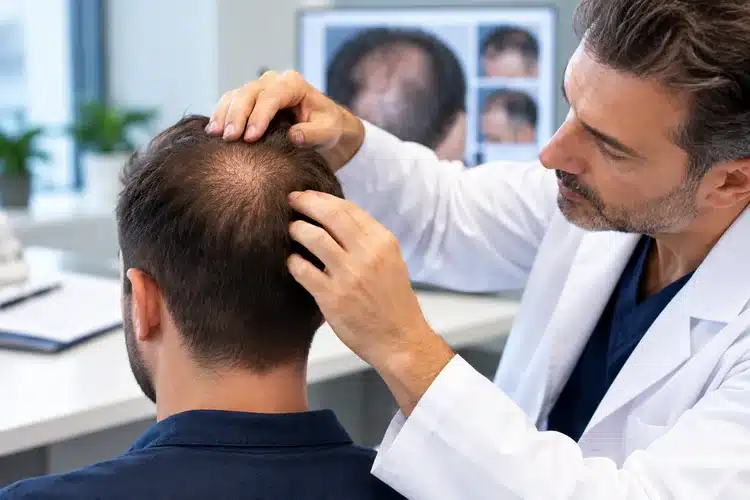
Who Is a Good Candidate for a Hair Transplant?
Losing your hair does not automatically mean that you need a hair transplant.
For some people, surgery can be an appropriate way to restore hair in areas affected by permanent hair loss. For others, medical treatment, monitoring or further investigation may be the better first step.
The difference depends on much more than how much hair is missing.
A person with noticeable baldness may have an inadequate donor area, while someone with less extensive hair loss may have suitable donor hair but an unpredictable pattern of future thinning.
Age, scalp health, the underlying diagnosis and realistic expectations all influence whether surgery is appropriate.
A good hair transplant candidate is someone whose type of hair loss, donor hair availability, general health and long-term treatment goals make surgical restoration a reasonable option.
This means that deciding whether you are suitable for a hair transplant should come before choosing a technique or calculating how many grafts you might need.
In this guide, we explain the characteristics of a suitable candidate, the situations in which surgery may need to be postponed and what a physician evaluates before recommending transplantation.
What Makes Someone a Good Candidate for a Hair Transplant?
There is no single test or characteristic that determines whether someone is suitable for hair transplantation.
Instead, the physician evaluates several factors together.
In general, a suitable candidate is more likely to have:
- A clearly diagnosed cause of hair loss that is appropriate for surgical restoration.
- Sufficient healthy and stable donor hair.
- A hair-loss pattern that allows realistic long-term planning.
- A scalp without uncontrolled inflammatory or other conditions that could compromise surgery.
- A general medical condition that permits the procedure to be performed safely.
- Realistic expectations about the density, coverage and appearance that may be achieved.
These factors are connected.
For example, a patient may have a suitable type of hair loss but insufficient donor hair to cover the affected area.
Another patient may have an excellent donor area but very early, rapidly progressing hair loss, making it difficult to design a restoration that will remain appropriate over time.
The purpose of the consultation is to assess the complete picture rather than treating one characteristic as a guarantee of suitability.
The Type of Hair Loss Is the First Thing to Consider
Not every form of hair loss can or should be treated with transplantation.
One of the most common indications is androgenetic alopecia, also known as male or female pattern hair loss.
This condition involves the gradual miniaturisation of genetically susceptible hair follicles.
Over time, affected follicles may produce shorter, finer hairs, reducing visible scalp coverage.
In many patients, suitable hair may remain in the donor regions at the back and sides of the head.
These follicular units can potentially be used to restore selected areas affected by permanent thinning.
However, having androgenetic alopecia does not automatically make someone a suitable candidate.
The extent of hair loss, donor-area characteristics and likely future progression still need to be assessed.
What If the Hair Loss Is Temporary?
Some forms of hair loss may improve without surgical intervention.
For example, telogen effluvium can cause increased shedding after significant illness, physical stress, substantial weight loss or other triggering events.
In many cases, the follicles remain capable of producing new hair.
If natural regrowth is expected, moving follicular units surgically may not address the actual problem.
The same principle applies when thinning is related to an underlying medical condition that needs treatment.
The priority is to identify the cause before considering hair transplantation.
What About Alopecia Areata?
Alopecia areata is an autoimmune condition that can cause patches of hair loss.
It behaves differently from the typical pattern of androgenetic alopecia.
Hair transplantation is not usually recommended for active alopecia areata because the underlying disease may continue to affect hair follicles.
A patient with this type of hair loss requires appropriate dermatological evaluation and management.
The correct diagnosis determines whether surgery is appropriate, whether it should be postponed or whether another treatment is preferable.
Why Is the Donor Area So Important?
The donor area is one of the most important factors in hair transplant candidacy.
It is usually located at the back and sides of the scalp.
This region may contain follicular units that are more resistant to the typical progression of androgenetic hair loss.
During transplantation, suitable follicular units are harvested from the donor area and placed into the recipient areas requiring restoration.
However, the donor supply is limited.
A hair transplant does not create an unlimited number of new follicles.
It redistributes existing follicular units.
What Does the Physician Look For?
The assessment of the donor area may include:
- The density of follicular units.
- Hair thickness and calibre.
- The distribution of the available hair.
- The extent of the potentially stable donor zone.
- Signs of miniaturisation or thinning within the donor region.
- The amount of hair that may be harvested without causing unacceptable donor-area depletion.
It is not enough for the back of the scalp to look full in an ordinary photograph.
The physician needs to determine whether the available follicular units are appropriate for transplantation and whether the remaining donor area can maintain a satisfactory appearance.
What If You Have a Weak Donor Area?
A limited donor reserve can significantly affect the surgical plan.
For example, someone with extensive baldness may need coverage over a very large area.
If the available donor supply is small, achieving the desired density throughout the scalp may not be realistic.
In selected cases, the physician may recommend prioritising the frontal hairline and other visually important regions rather than attempting uniform coverage everywhere.
For other patients, the donor supply may be too limited to make surgery worthwhile.
This is why responsible planning focuses on the effective use of available hair, not simply on extracting the highest possible number of grafts.
What Is Diffuse Unpatterned Alopecia, and Why Does It Matter?
Some patients have thinning that is not limited to the frontal scalp or crown.
Instead, the loss of density also affects areas that would normally provide donor hair.
One important example is diffuse unpatterned alopecia (DUPA).
In this condition, miniaturisation can affect hair throughout the scalp, including the back and sides.
If there is no sufficiently stable donor region, conventional scalp hair transplantation may not be appropriate.
The reason is straightforward.
Transplanting follicular units that are already susceptible to progressive miniaturisation may not provide the expected long-term benefit.
The physician must therefore examine the donor area rather than assuming that all hair at the back of the head is suitable.
In uncertain cases, additional examination, medical management or a period of monitoring may be necessary before a surgical decision is made.
Does Hair Loss Have to Stop Before a Transplant?
Hair loss does not necessarily have to stop completely before a patient can be considered for transplantation.
However, the speed and pattern of progression are extremely important.
Imagine a patient who has a receding hairline today but is also losing natural hair rapidly across the mid-scalp.
If surgery is designed only around the current appearance, the non-transplanted hair may continue to thin over the following years.
This can leave transplanted regions surrounded by new areas of hair loss.
The result may no longer look balanced, even if the grafts themselves continue to grow.
Why Long-Term Planning Matters
Before recommending surgery, the physician considers:
- How quickly the hair loss has progressed.
- The patient’s age and family history.
- Whether the donor area appears stable.
- Which regions may be affected in the future.
- Whether medical management may help preserve existing hair.
- How much donor hair should be retained for potential future needs.
A patient with rapidly progressing hair loss may benefit from further assessment or non-surgical treatment before proceeding.
In some cases, surgery may be appropriate even when androgenetic alopecia is continuing, provided the treatment plan accounts for future progression.
The important point is that today’s hairline must be designed with tomorrow’s hair loss in mind.
Is There a Minimum Age for a Hair Transplant?
Age matters, but it is not the only factor used to determine suitability.
Two people of the same age can have very different hair-loss patterns.
One may have a relatively established pattern and a suitable donor area.
The other may be experiencing the early stages of aggressive, rapidly progressing androgenetic alopecia.
These patients should not automatically receive the same recommendation.
Why Younger Patients Need Special Consideration
In very young patients, predicting the eventual extent of hair loss can be particularly difficult.
A hairline that seems appropriate at one age may become less natural if substantial thinning develops behind it over time.
An overly aggressive or low frontal hairline can also use donor grafts that may be needed for future restoration.
For these reasons, physicians may recommend monitoring and, where appropriate, medical treatment before considering surgery.
The decision should take account of the patient’s circumstances rather than relying on a single universal age threshold.
Can Older Adults Have a Hair Transplant?
Age alone does not automatically exclude someone from surgery.
For an older patient, the physician still evaluates the donor area, type of hair loss, medical history and realistic expectations.
The ability to undergo the procedure safely is more important than age considered in isolation.
How Much Hair Loss Do You Need Before Surgery?
There is no minimum visible area of baldness that makes a person automatically suitable.
Someone with early thinning may still have substantial natural hair in the affected region.
In that situation, immediate surgery may offer limited benefit compared with monitoring or appropriate medical management.
The physician also considers the potential for continued miniaturisation of the surrounding natural hair.
Is a Hair Transplant Suitable for Early Hair Loss?
Not always.
If the hair-loss pattern is still developing, it may be better to understand the likely progression before planning a permanent hairline.
There may also be situations where medical treatment can help maintain existing hair, depending on the diagnosis and the patient’s medical circumstances.
A decision to postpone surgery does not necessarily mean the patient will never become a suitable candidate.
It may simply mean that a better-informed surgical plan can be made later.
What If You Have Advanced Baldness?
Advanced hair loss presents a different challenge.
The recipient area may be extensive, while the available donor supply remains limited.
The physician must determine what level of coverage is achievable without excessively depleting the donor area.
It may be necessary to establish priorities rather than promising full density across the entire scalp.
For some patients, a carefully planned improvement in selected regions may be appropriate.
For others, the available donor reserve may not support a satisfactory surgical result.
How Many Grafts Does a Suitable Candidate Need?
There is no fixed number of grafts that applies to every patient.
The requirement depends on several factors, including:
- The size of the area affected by hair loss.
- Whether restoration involves the hairline, temples, mid-scalp or crown.
- The patient’s existing hair density.
- Hair thickness and other hair characteristics.
- The available donor reserve.
- The desired coverage and long-term surgical plan.
A patient with limited frontal recession may require a different approach from someone with extensive thinning across multiple regions.
However, the objective is not to reach the highest possible graft count.
It is to establish a safe and realistic balance between the area requiring restoration and the follicular units available for transplantation.
The appropriate number can only be estimated after evaluating the individual case.
Can Women Be Good Candidates for a Hair Transplant?
Yes.
Hair transplantation is not limited to men.
Women can also be suitable candidates when the underlying type of hair loss and the donor-area characteristics support surgical restoration.
However, the assessment can be more complex.
Female pattern hair loss frequently presents as diffuse thinning rather than the clearly defined frontal recession seen in many men.
In some women, thinning can also affect areas that would otherwise be considered for donor harvesting.
This makes a careful examination of the entire scalp particularly important.
Which Women May Be Suitable?
A woman with a sufficiently stable donor area and an appropriate pattern of permanent hair loss may be considered for transplantation.
The decision depends on the specific diagnosis and the extent of the area requiring restoration.
By contrast, widespread thinning involving the donor region may significantly limit the potential benefit.
Other possible causes, including thyroid disorders, nutritional deficiencies or inflammatory scalp conditions, may also require investigation.
You can read more about the different causes and patterns in our guide to female alopecia and hair loss.
The most important consideration is that the suitability of female patients must be determined individually, rather than assuming that all forms of female thinning can be treated surgically.
Does the Scalp Need to Be Healthy?
The condition of the scalp matters before any hair transplant.
Redness, significant scaling, persistent itching, painful lesions or unusual patterns of hair loss may indicate an underlying skin condition.
Some scalp conditions need treatment or further assessment before surgery can be considered.
What If You Have an Inflammatory Scalp Condition?
Active inflammation may affect the suitability or timing of transplantation.
The physician should identify the cause and determine whether the condition needs to be treated or brought under control first.
This does not mean that every person with occasional dandruff or scalp sensitivity is permanently unsuitable for surgery.
The decision depends on the actual diagnosis and the activity of the condition.
What About Scarring Alopecia?
Scarring alopecias can damage follicular structures and lead to permanent loss of hair.
When a scarring condition is active, surgery may be inappropriate because the disease can continue to affect the scalp.
In carefully selected cases where the condition has remained stable, surgical reconstruction may sometimes be considered following specialist evaluation.
However, the possibility of recurrence and the characteristics of the affected tissue must be considered.
A hair transplant should never be presented as a universal solution for scarring hair loss.
Does General Health Affect Hair Transplant Eligibility?
Yes.
Hair transplantation is a surgical procedure, and the patient’s general medical condition must be considered.
Before surgery, the physician should review relevant medical history, medications, previous procedures and any conditions that may influence safety or healing.
Some medical factors may affect:
- The risk of bleeding.
- Wound healing.
- The suitability of local anaesthesia.
- The management of postoperative recovery.
- The underlying cause of hair loss.
Having a chronic medical condition does not automatically mean that a patient is unsuitable for transplantation.
However, certain conditions may need to be appropriately managed before surgery.
Additional medical advice or investigations may also be required.
Patients should never stop prescribed medication on their own simply because they are considering a hair transplant.
Any necessary adjustment should be discussed with the appropriate treating physician.
Do You Need Realistic Expectations?
Realistic expectations are essential.
A hair transplant can redistribute suitable follicular units, but it cannot create an unlimited new donor supply.
A patient should understand what can reasonably be achieved with the available grafts.
This includes recognising that:
- The final density may not match the patient’s original hair density.
- Some areas may need to be prioritised over others.
- Non-transplanted hair may continue to thin over time.
- More than one procedure may be considered in selected cases.
- Hair growth and the final appearance develop gradually.
- No surgical outcome can be guaranteed.
The patient’s expectations must therefore be discussed openly before surgery.
For example, someone with extensive baldness and limited donor hair may want complete coverage at very high density.
If this cannot realistically be achieved, the physician should explain the limitations and discuss alternative goals.
A suitable candidate is not simply someone who wants more hair.
It is someone whose medical circumstances and expectations are compatible with a realistic treatment plan.
To understand the types of results that may be possible in individual cases, you can explore the clinic’s hair transplant before-and-after photographs.
Individual patient results vary and should not be considered a guarantee of another patient’s outcome.
Does FUE or FUT Determine Whether You Are a Good Candidate?
The patient’s suitability should be assessed before choosing a surgical technique.
FUE and FUT are different approaches to harvesting follicular units from the donor area.
In FUE, follicular units are extracted individually.
In FUT/Strip, a strip of hair-bearing scalp is removed and divided into follicular-unit grafts.
Other approaches, including Micro-strip or combined techniques, may also be considered depending on individual needs.
However, no technique can overcome the fundamental limitations of an unsuitable donor area or an inappropriate diagnosis.
The physician should first determine whether surgery is advisable.
Only then should the surgical method be selected.
You can find more information about one established approach on our FUE hair transplant service page.
Who May Not Be a Suitable Candidate for a Hair Transplant?
There are several situations in which surgery may not be appropriate, or where it may be better to delay the decision.
These include:
- Insufficient or unstable donor hair.
- Diffuse thinning that affects the potential donor region.
- Active inflammatory or scarring scalp disease.
- Active alopecia areata.
- Rapidly progressing hair loss without a suitable long-term plan.
- Temporary shedding that may improve without surgery.
- Medical factors that make the procedure unsafe until appropriately addressed.
- Expectations that cannot realistically be met with the available donor supply.
These are not all identical situations.
Some may require further investigation or medical treatment.
Others may lead to postponement until the hair-loss pattern becomes clearer.
In certain circumstances, surgery may not be recommended at all.
A responsible medical assessment should be able to conclude that a hair transplant is not the right option for a particular patient.
How Does a Doctor Determine If You Are Suitable?
The decision involves several stages of assessment.
1. Confirming the Diagnosis
The physician identifies the likely cause and type of hair loss.
The pattern, history and scalp findings help determine whether the condition is appropriate for transplantation.
2. Examining the Donor Area
The available donor reserve is assessed, including density, hair calibre and signs of miniaturisation.
The examination helps determine how many follicular units may reasonably be harvested.
3. Assessing the Recipient Area
The physician evaluates the location and extent of thinning.
This helps establish treatment priorities and identify the areas where graft placement may provide a meaningful improvement.
4. Reviewing the Progression of Hair Loss
The rate of change and the potential future pattern are considered.
This is particularly important when the patient is young or the hair loss is progressing rapidly.
5. Reviewing Medical History
Relevant health conditions, medications and other factors that may affect surgery are assessed.
Additional investigations may be recommended when clinically indicated.
6. Discussing the Patient’s Expectations
The physician explains what may be achievable, which limitations exist and whether non-surgical options should be considered.
Trichoscopy or other investigations may be used when necessary to clarify the diagnosis and assess follicular characteristics.
This evaluation provides the basis for deciding whether transplantation is appropriate.
At Hairtransplant Clinic, Dr. Ioannis Papangelopoulos, MD, PhD, personally performs hair transplant procedures, supported by his medical team.
The clinic’s approach emphasises medical assessment before hair transplantation, individual surgical planning and responsible use of the donor area.
Frequently Asked Questions About Hair Transplant Eligibility
Am I a good candidate for a hair transplant?
You may be a suitable candidate if you have an appropriate form of hair loss, sufficient stable donor hair, a scalp and general medical condition that permit surgery, and realistic expectations. A physician must assess these factors together.
Does hair loss have to stop completely before transplantation?
Not necessarily. Some patients with continuing androgenetic alopecia may still be suitable for surgery. However, rapidly progressing or unpredictable hair loss can make treatment planning more difficult and may justify delaying the procedure.
Can I have a hair transplant if my donor area is weak?
It depends on the extent of donor-area thinning and the amount of restoration required. Some patients may be suitable for limited coverage, while others may not have enough reliable donor hair for surgery.
Is there a minimum age for a hair transplant?
There is no single age that determines suitability for every patient. Younger people need particularly careful evaluation because their eventual pattern of hair loss may still be uncertain.
Can someone with advanced baldness have a hair transplant?
Possibly. The key issue is whether the available donor hair can provide meaningful coverage without excessive donor depletion. In advanced cases, expectations and treatment priorities are especially important.
Can women undergo hair transplantation?
Yes. Some women with permanent hair loss and a sufficiently stable donor region may be suitable candidates. The distribution of thinning and the underlying diagnosis require careful assessment.
Is androgenetic alopecia a suitable condition for transplantation?
Androgenetic alopecia is one of the most common indications for hair transplantation. However, the diagnosis alone does not guarantee suitability; donor hair, progression, general health and expectations must also be considered.
Can I have a transplant if I have alopecia areata?
Hair transplantation is not usually recommended for active alopecia areata. The condition needs appropriate dermatological assessment and management.
Does having FUE mean I am a better candidate?
No. FUE is a surgical technique, not a criterion for patient suitability. Eligibility depends on the diagnosis, donor area and overall treatment plan. The surgical method is selected afterwards.
Can a hair transplant stop future hair loss?
No. A transplant moves existing follicular units but does not automatically prevent non-transplanted hair from continuing to thin. Long-term planning remains important.
Can a doctor assess my suitability from photographs?
Photographs can support an initial discussion, but they may not provide sufficient information about donor stability, follicular characteristics or scalp health. An individual medical examination is often necessary for reliable planning.
Conclusion: The Right Hair Transplant Begins With the Right Patient Selection
A good hair transplant result begins long before the surgical procedure.
It starts with determining whether transplantation is suitable for the individual patient.
The diagnosis, donor-area quality, pattern of hair loss, general health and realistic expectations all influence that decision.
A patient with sufficient donor hair and a suitable form of permanent hair loss may benefit from an individually planned procedure.
Someone with temporary shedding, unstable donor hair or an active scalp condition may require a different approach.
Neither the number of grafts nor the choice between FUE and FUT can replace this assessment.
The most important question is not simply whether a hair transplant can be performed, but whether it is medically appropriate and realistically beneficial for you over the long term.
If you are considering hair transplantation in Greece, you can contact Hairtransplant Clinic to arrange a free diagnostic consultation and discuss the options available for your particular case.
Phone: +30 21 0775 7700
Email: info@hairtransplant.gr
An individual medical assessment is the first step towards understanding whether hair transplantation is right for you.