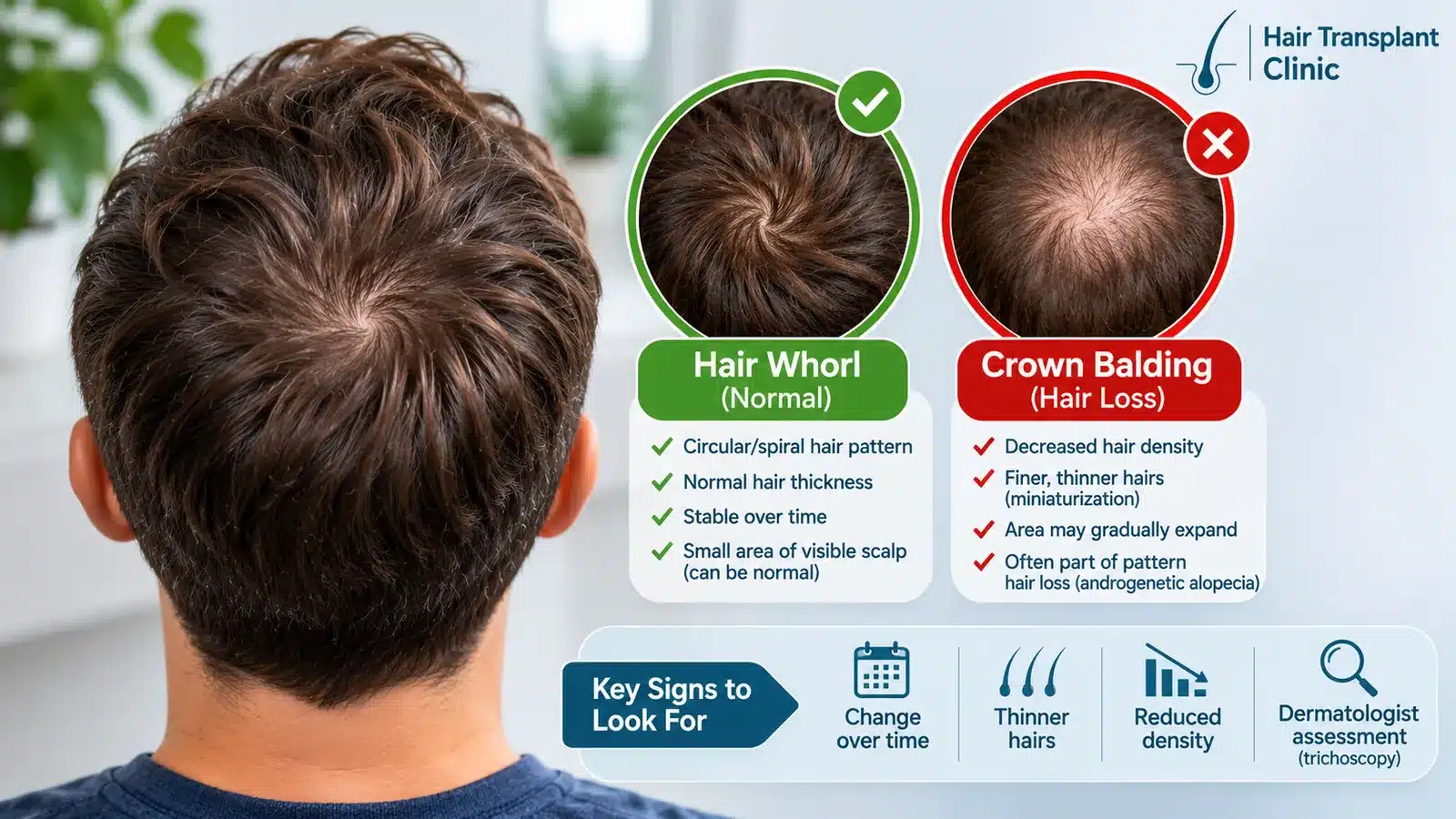
Hair Whorl or Balding? How to Tell the Difference
You take a photograph of the top of your head and notice something unexpected.
Near the crown, your hair seems to separate around a small, circular area where the scalp is visible.
You look at the photograph again.
Is this the natural direction of your hair, or are you starting to go bald?
The difference between a hair whorl and balding is not always obvious, especially when examining the crown under strong lighting.
A natural hair whorl can expose a small area of scalp even when hair density is normal. However, androgenetic alopecia can also begin around the crown, gradually making the surrounding hair thinner.
The important distinction is not simply whether you can see your scalp.
It is whether the surrounding hair is changing, whether the visible area is expanding and whether there are signs of follicular miniaturization.
Understanding these differences can help you recognise when a dermatological examination is useful.
What Is a Hair Whorl?
A hair whorl is a natural pattern in which hairs grow in different directions around a central point.
Most people have a visible whorl near the crown, also called the vertex.
The hairs typically follow a circular or spiral arrangement.
Because the strands point away from the centre in different directions, a small area of scalp may remain visible.
This is a normal anatomical characteristic.
A hair whorl does not automatically indicate hair loss, damaged follicles or reduced hair density.
Why Is the Scalp Visible in the Centre?
Imagine arranging several groups of hairs around a central point.
Instead of all the strands lying in the same direction, they spread outward.
The change in direction can create a small opening through which the scalp becomes visible.
This may happen even when the surrounding follicles produce healthy, full-thickness hair.
The appearance depends on several factors, including:
- Hair length.
- Hair shaft thickness.
- The natural direction of growth.
- Hair density.
- Hair colour.
- Scalp colour.
- Lighting conditions.
- The position of the camera.
A person with fine, straight hair may have a more visible whorl than someone with thick, curly hair.
That does not necessarily mean the first person is experiencing balding.
Can You Have More Than One Hair Whorl?
Yes.
Some individuals have two distinct hair whorls, sometimes described as a double crown.
Others have a particularly pronounced spiral pattern.
These variations are part of normal human hair growth.
Having a double crown does not automatically indicate that someone is more likely to experience androgenetic alopecia.
The important question is whether hair density is changing around the whorls.
A person may have a prominent double crown throughout childhood and adulthood without developing unusual hair loss in those areas.
What Does Early Crown Balding Look Like?
Crown balding is commonly associated with androgenetic alopecia, also called pattern hair loss.
In genetically susceptible follicles, androgen-related processes contribute to progressive miniaturization.
This means that affected follicles gradually produce hairs that become thinner, shorter and less pigmented.
Over time, the overall visual coverage decreases.
Unlike a natural whorl, which is primarily a change in hair direction, crown balding involves a change in the characteristics and distribution of the hairs themselves.
The progression may be gradual.
Early crown thinning can be difficult to notice in everyday life because the affected area is located behind the top of the head.
Many people first become aware of it through photographs, mirrors or comments from someone who can see the crown.
Hair Whorl vs Balding: The Main Differences
Although a natural whorl and early crown thinning may look similar in a single photograph, several characteristics can help distinguish them.
| Characteristic | Natural hair whorl | Possible crown balding |
|---|---|---|
| Hair direction | Circular or spiral pattern | Natural pattern may remain visible |
| Visible scalp | Often concentrated at the centre | May extend beyond the central whorl |
| Surrounding hair | Generally maintains its thickness | May become progressively finer |
| Change over time | Often relatively stable | May gradually expand |
| Hair density | Can be normal | May be reduced |
| Miniaturization | Not caused by the whorl itself | Often present in androgenetic alopecia |
| Other areas | No necessary associated hair loss | May coexist with frontal or temporal recession |
These differences are useful observations, not a substitute for diagnosis.
Some people have both a prominent natural whorl and early androgenetic alopecia.
A dermatologist may need to evaluate the actual follicles to establish what is happening.
The Most Important Sign: Has Your Crown Changed Over Time?
A photograph taken today provides limited information.
A comparison with earlier photographs may be considerably more informative.
Consider two hypothetical examples.
Example 1: A Stable Hair Whorl
A 28-year-old man notices a small circular opening at the crown.
He becomes concerned after taking a photograph under bright bathroom lighting.
However, when he looks at photographs from five years earlier, the same pattern is visible.
The size and shape appear relatively unchanged.
The surrounding hair still looks full, and there are no obvious changes in the frontal hairline.
This situation may be consistent with a natural hair whorl.
It does not prove that androgenetic alopecia is absent, but there is no clear evidence of progression from the photographs alone.
Example 2: Progressive Crown Thinning
Another person notices a similar circular area.
However, photographs from the previous two years suggest that the visible scalp has expanded.
The hair surrounding the central point appears finer and provides less coverage.
The thinning extends beyond the original spiral pattern.
There may also be some recession around the temples.
This combination raises greater concern about progressive pattern hair loss.
A clinical examination can help establish whether miniaturization is present.
Why Does Your Crown Look Thinner Under Bright Light?
Lighting can dramatically change the apparent density of hair.
Consider a photograph taken indoors under soft natural light.
The hair may appear relatively full because the strands cast shadows and partially conceal the scalp.
Now photograph the same area directly beneath a bright ceiling light.
The light can pass between the hairs, making the skin more visible.
This can create the impression of a bald spot.
Flash photography may have a similar effect.
Hair that is wet, oily or separated into strands may also reveal more scalp than dry hair.
Does Seeing Your Scalp Under a Flash Mean You Are Balding?
Not necessarily.
A visible scalp under strong lighting does not establish that follicles have been lost.
The appearance must be considered alongside hair thickness, density, pattern and change over time.
Someone with naturally fine hair may show more scalp under a flash without having androgenetic alopecia.
On the other hand, a person with genuine early thinning may also notice that the problem becomes more obvious in bright light.
Lighting can exaggerate a change, but it cannot establish the underlying cause.
What Is Hair Miniaturization?
Miniaturization is one of the most useful concepts for understanding androgenetic alopecia.
A healthy follicle normally goes through repeated cycles of hair growth, regression, rest and shedding.
In androgenetic alopecia, genetically susceptible follicles gradually produce finer hairs.
Over successive cycles, some hairs become shorter and less substantial.
This affects the visual density of the scalp.
Importantly, the number of visible hairs is not the only relevant factor.
Hair shaft thickness contributes substantially to perceived coverage.
A region containing many fine hairs may appear less dense than another region containing thicker strands.
How Can You Recognise Miniaturization?
You may notice that the hair around the crown appears less substantial or that it no longer provides the same coverage as before.
However, accurately evaluating differences in hair diameter is difficult without magnification.
A dermatologist can use trichoscopy to examine the hair shafts and follicles more closely.
In androgenetic alopecia, variations in hair shaft diameter and an increased proportion of miniaturized hairs can provide important diagnostic evidence.
These findings are more meaningful than the mere presence of a visible whorl.
What Is Trichoscopy and How Does It Help?
Trichoscopy is a non-invasive examination of the hair and scalp using magnification.
It allows a dermatologist to evaluate details that may be difficult to identify with the naked eye.
These can include:
- Differences in hair shaft diameter.
- Miniaturized hairs.
- The number of hairs within follicular units.
- The distribution of hair density.
- Scalp redness or scaling.
- Perifollicular changes.
- The presence or absence of follicular openings.
Trichoscopy can help distinguish androgenetic alopecia from other causes of hair loss.
For example, an area with a natural whorl but normal follicular characteristics may require no hair restoration treatment.
An area showing progressive miniaturization may suggest a different diagnosis and management plan.
However, trichoscopy must be interpreted alongside medical history and clinical examination.
No single finding should be used in isolation to diagnose every form of hair loss.
Can a Cowlick Be Mistaken for Balding?
Yes.
The term cowlick is commonly used to describe a section of hair that grows in a direction different from the surrounding hair.
A cowlick may occur near the frontal hairline or crown.
A crown hair whorl is a related natural growth pattern, but the two terms are not always used interchangeably in anatomical descriptions.
A pronounced cowlick may cause the hair to stand up, separate or expose a small region of scalp.
This can create an appearance similar to thinning in certain photographs.
The difference is that an unusual growth direction is not itself evidence of reduced follicular density.
If the pattern has remained stable and the surrounding hair is healthy, there may be no reason for concern.
Does Hair Length Affect How Bald Your Crown Looks?
Hair length can change visual coverage substantially.
Very short hair may make the natural whorl more obvious because the strands cannot overlap enough to conceal the centre.
With longer hair, the surrounding strands may partially cover the same area.
However, longer hair does not correct follicular miniaturization.
It can simply change how the thinning appears.
This distinction is useful when comparing photographs.
If your hair was much shorter in one photograph than another, differences in visible scalp may not reflect a real change in follicular density.
For meaningful comparisons, keep hair length as consistent as reasonably possible.
Can Wet Hair Make a Normal Crown Look Bald?
Yes.
When hair becomes wet, individual strands often stick together.
Instead of spreading evenly across the scalp, they form groups or sections.
This exposes more skin between them.
A natural whorl may become particularly noticeable after showering.
Similarly, styling gels, oils or other products may cause strands to clump together.
This does not necessarily mean the hair has become thinner.
However, wet hair can also reveal genuine low density.
A photograph taken immediately after washing should not be used as the sole basis for diagnosing crown balding.
How to Check Your Crown at Home
You can monitor changes in the appearance of your crown without examining it constantly.
The goal is to observe meaningful trends rather than interpret every small difference in a photograph as hair loss.
1. Use Consistent Lighting
Photograph the crown under similar lighting conditions.
Avoid comparing a dimly lit photograph with one taken under an intense flash.
2. Maintain a Similar Camera Angle
The angle of the photograph matters.
A directly overhead image may reveal more scalp than a photograph taken from behind.
Try to use approximately the same distance and position.
3. Compare Similar Hair Lengths
A recent haircut can make a normal hair whorl appear more prominent.
Hair products and styling can also influence the appearance.
4. Review Older Photographs
Photographs taken several months or years earlier may provide useful information about whether the pattern has changed.
5. Look Beyond the Centre
Do not focus exclusively on the small opening in the middle of the whorl.
Consider whether the surrounding region appears thinner or less dense.
6. Seek Assessment if the Change Persists
If the visible area is gradually expanding or you notice other signs of hair loss, a dermatologist can assess the underlying cause.
These steps are intended for observation, not self-diagnosis.
Repeated daily photographs are rarely necessary to establish a meaningful long-term pattern.
Does a Thinning Crown Always Mean Male Pattern Baldness?
No.
Although androgenetic alopecia is a common cause of progressive crown thinning, other conditions may produce changes in hair density.
Telogen Effluvium
Telogen effluvium involves increased hair shedding.
It may follow an illness, significant physiological stress, major weight loss or another triggering event.
The thinning is often diffuse rather than limited to a single crown region.
However, it can make an existing whorl more noticeable because overall hair density has decreased.
Alopecia Areata
Alopecia areata can produce localized patches of hair loss.
A smooth, clearly defined patch on the crown may require investigation for this condition.
Its appearance differs from typical androgenetic alopecia, although clinical evaluation is needed.
Scalp Inflammation
Certain inflammatory scalp conditions can cause discomfort, redness, scaling or changes in hair density.
Some may require treatment to prevent further damage.
Scarring Alopecia
Scarring alopecias can damage hair follicles permanently.
Symptoms may include burning, pain, itching, inflammation or a change in scalp texture, although some cases can be relatively asymptomatic.
A smooth area with absent follicular openings requires particular attention.
Read more about scarring alopecia and why early diagnosis matters.
The appearance of the crown alone cannot reliably distinguish all these conditions.
What If Your Hairline Is Also Receding?
The combination of crown thinning and frontal hairline recession may strengthen suspicion of androgenetic alopecia.
In many men, pattern hair loss affects the temples, frontal scalp and vertex to varying degrees.
However, its distribution differs between individuals.
Some people experience frontal recession first.
Others initially notice thinning at the crown.
Some develop more diffuse thinning across the upper scalp.
A prominent whorl alone does not determine which pattern a person has.
The physician evaluates the overall distribution of hair loss rather than focusing on one visible spot.
Can You Stop Crown Hair Loss Early?
When genuine pattern hair loss is identified, early assessment may provide more treatment options.
The appropriate approach depends on the diagnosis, medical history and individual circumstances.
For suitable patients, a dermatologist may discuss treatments such as topical minoxidil or finasteride.
These treatments have different indications, expected benefits, contraindications and potential adverse effects.
Not every treatment is appropriate for every patient.
They should not be started solely because a single photograph makes the crown appear thin.
The American Academy of Dermatology emphasises the importance of establishing the cause of hair loss before selecting treatment.
Some forms of hair shedding improve after the underlying trigger resolves.
Others require medical treatment, monitoring or a different approach.
Do You Need a Hair Transplant for Crown Thinning?
Not necessarily.
A natural hair whorl does not require a hair transplant.
Even when crown thinning is caused by androgenetic alopecia, surgery is not automatically the first or best option.
The physician must consider:
- The cause of hair loss.
- Its progression.
- The patient’s age and overall medical history.
- The size of the affected area.
- The availability of suitable donor follicles.
- The expected long-term pattern of hair loss.
- Whether medical treatment may be appropriate.
- The patient’s expectations.
Hair transplantation redistributes existing follicles rather than creating new ones.
The available donor supply must therefore be preserved carefully.
Our guide to the hair transplant donor area explains why the remaining donor reserve is central to surgical planning.
Why Does Crown Transplantation Require Special Planning?
The crown has a distinctive spiral growth pattern.
Restoring hair in this area requires attention to the natural direction and angle of the surrounding follicles.
The potential for further hair loss also matters.
If the thinning region continues expanding, the original transplant may no longer provide balanced coverage in the surrounding scalp.
For this reason, the surgeon must consider both the immediate appearance and the potential long-term progression of alopecia.
A crown transplant should not be performed simply because a natural whorl is visible under strong lighting.
When Should You See a Dermatologist?
A dermatological examination is particularly useful when the appearance of the crown changes progressively.
You should also seek assessment if you notice:
- Increasing scalp visibility around the crown.
- Gradual thinning beyond the natural whorl.
- Changes in the thickness of surrounding hairs.
- Receding temples or a changing frontal hairline.
- Sudden or unusually heavy shedding.
- Clearly defined bald patches.
- Persistent scalp redness, pain or scaling.
- Pustules, crusts or other signs of inflammation.
Sudden patchy hair loss, marked inflammation or signs of scarring deserve prompt assessment.
The earlier the underlying cause is identified, the easier it may be to determine whether treatment is indicated.
Crown Hair Assessment at Hairtransplant Clinic in Athens
At Hairtransplant Clinic, Dr. Ioannis Papangelopoulos, MD, PhD, is a dermatologist who personally performs hair transplantation procedures.
An individual assessment begins by determining whether the patient has genuine hair loss and identifying its likely cause.
The clinical examination considers the pattern of thinning, the scalp, follicular characteristics and the progression over time.
If there is confirmed androgenetic alopecia, the available treatment options can be discussed according to the patient’s circumstances.
For selected patients, surgical restoration may eventually be considered.
However, a visible natural hair whorl is not itself an indication for hair transplantation.
A responsible treatment plan begins with diagnosis rather than assuming that every area of visible scalp requires additional grafts.
Frequently Asked Questions
Is a hair whorl a bald spot?
Not necessarily. A natural hair whorl is a spiral growth pattern that may expose a small area of scalp even when the surrounding hair density is normal.
How can I tell if my crown is balding?
Look for progressive changes, such as expanding scalp visibility, thinning beyond the central whorl and finer surrounding hair. A dermatologist can assess miniaturization using trichoscopy.
Can a normal hair whorl get bigger?
Its apparent size can change with hair length, styling, wetness and lighting. However, a gradually expanding region of reduced hair density may indicate actual thinning and deserves assessment.
Is a cowlick the same as crown balding?
No. A cowlick refers to an unusual direction of hair growth. Crown balding involves reduced hair coverage, often associated with progressive follicular miniaturization.
Is it normal to see scalp at the crown?
Yes, some scalp visibility can be normal, particularly in the centre of a hair whorl. Visibility alone does not establish a diagnosis.
Why does my crown look bald in photographs?
Bright overhead lighting, camera angles, short hair, wet strands and the natural whorl pattern can all make the scalp more visible.
Can you have a hair whorl and male pattern baldness at the same time?
Yes. A person can have a natural whorl while also developing androgenetic alopecia around it. The two conditions are not mutually exclusive.
Does a double crown mean you will go bald?
No. Having two hair whorls is a natural variation and does not, by itself, establish an increased risk of balding.
Is crown thinning reversible?
It depends on the cause. Some forms of temporary shedding may improve, while androgenetic alopecia generally requires ongoing management if treatment is chosen. Results vary.
Will minoxidil help a thinning crown?
Minoxidil may be appropriate for selected patients with pattern hair loss. Its suitability depends on the diagnosis, and benefits and adverse effects should be discussed with a healthcare professional.
Can a hair transplant fix a thinning crown?
Hair transplantation may improve coverage in suitable patients with established hair loss and adequate donor hair. However, it is not appropriate simply to change the appearance of a normal whorl.
Final Thoughts: Hair Direction Is Not the Same as Hair Loss
A natural hair whorl and early crown balding can look surprisingly similar in photographs.
Both may reveal a small region of scalp at the top of the head.
However, the underlying causes are different.
A hair whorl is a normal pattern of growth direction.
Androgenetic alopecia involves progressive changes in susceptible follicles, including miniaturization and reduced hair coverage.
The most useful indicators are the condition of the surrounding hair, the presence of miniaturization and changes over time.
If you are uncertain whether your crown is naturally showing or genuinely thinning, the appropriate next step is a medical assessment.
At Hairtransplant Clinic in Athens, Dr. Ioannis Papangelopoulos personally performs hair transplantation procedures, with treatment decisions based on individual evaluation.
Contact Hairtransplant Clinic to arrange a consultation and discuss the possible causes of crown thinning.
Medical References
- American Academy of Dermatology — Hair Loss: Diagnosis and Treatment
- DermNet — Trichoscopy of Generalised Non-scarring Hair Loss
- DermNet — Examination of Hair and Scalp
- Trichoscopy in Alopecias: Diagnosis Simplified
- Trichoscopy: An Updated Diagnostic Approach
This article provides general educational information and does not replace individual medical advice, diagnosis or treatment.