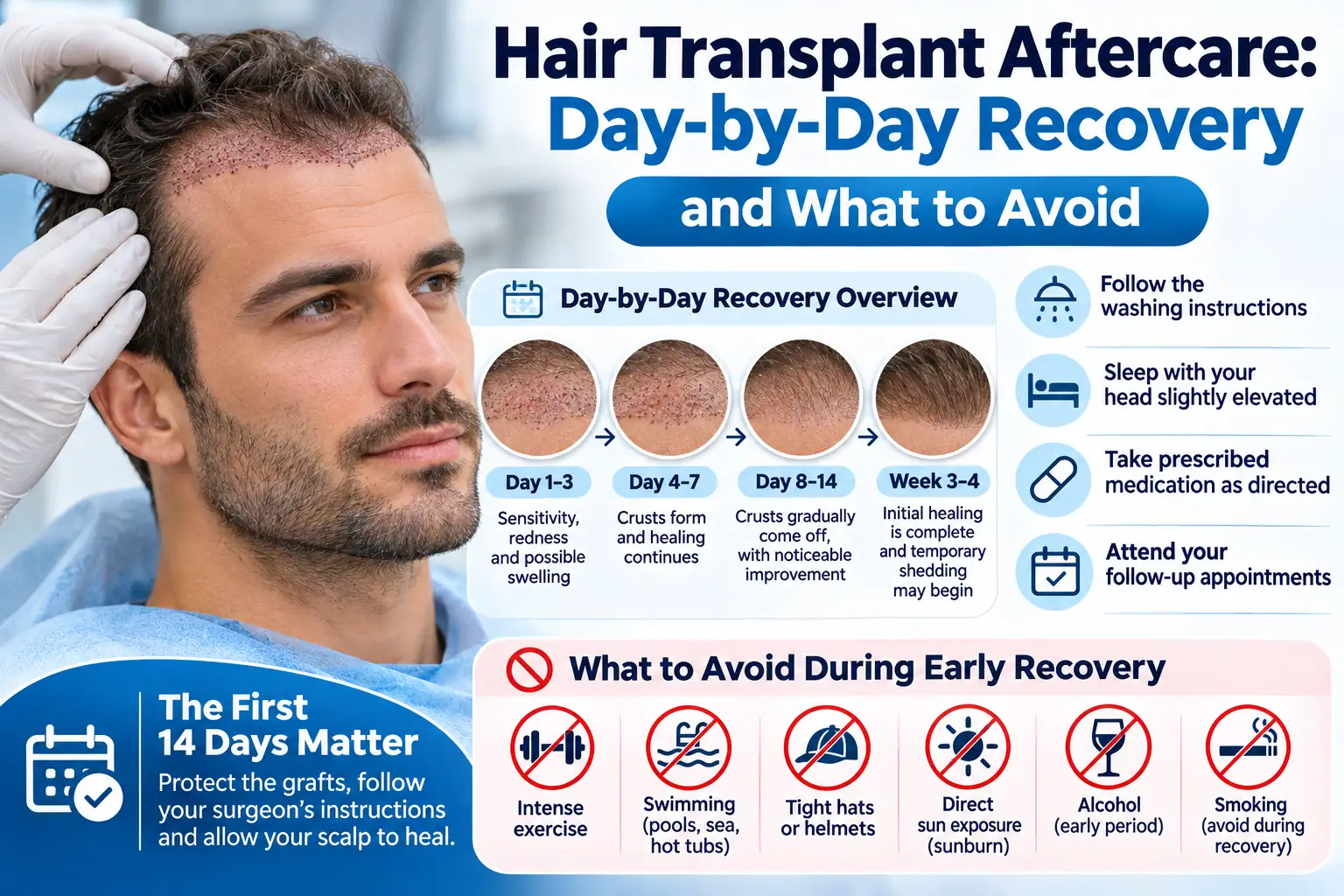
Hair Transplant Aftercare: Day-by-Day Recovery and What to Avoid
Your hair transplant is complete. The grafts have been placed, the surgical procedure is over, and you are ready to return home.
But what happens next?
Can you sleep normally? When should you wash your hair? Is it safe to wear a hat? And what happens if you accidentally touch the transplanted area?
These are some of the most common questions patients ask during the first days after hair restoration surgery.
Proper hair transplant aftercare is an essential part of recovery. Although careful surgical technique is crucial, the scalp also needs time to heal, and newly transplanted grafts must be protected from unnecessary pressure, friction and trauma.
The first two weeks are particularly important because the donor and recipient areas are healing.
However, recovery does not follow exactly the same schedule for every patient. The appropriate precautions depend on the surgical technique, the extent of the procedure, individual healing and the surgeon’s instructions.
This guide explains hair transplant aftercare day by day, what you should avoid, how to manage common postoperative symptoms, and when it is important to contact your doctor.
Hair Transplant Aftercare: What Are the Most Important Rules?
The most important principle is simple: follow the specific postoperative instructions provided by your surgeon.
Online guides can explain what usually happens after surgery, but they cannot replace an individual recovery plan.
During the initial healing period, several precautions are particularly important:
- Protect the transplanted area from rubbing, scratching and pressure.
- Follow the recommended washing and scalp-care routine.
- Use prescribed medication exactly as directed.
- Avoid unnecessary contact with newly implanted grafts.
- Follow restrictions on strenuous exercise and activities that cause excessive sweating.
- Protect the healing scalp from sunburn and unnecessary heat exposure.
- Avoid helmets, tight hats or other objects that could disturb the recipient area until cleared by your surgeon.
- Attend scheduled postoperative appointments.
- Contact your medical team if you experience unexpected or worsening symptoms.
These precautions help support normal healing.
They do not guarantee a particular number of surviving grafts or a specific cosmetic result.
Hair Transplant Recovery Timeline: What to Expect Day by Day
Hair transplant recovery involves two separate processes.
The first is wound healing, which takes place in the donor and recipient areas during the early postoperative period.
The second is hair growth, which develops gradually over several months.
A patient may feel physically comfortable after a relatively short period while still being months away from seeing the full cosmetic result.
The following timeline describes common recovery stages, not fixed deadlines.
Day 0: The Day of Your Hair Transplant
Immediately after surgery, the scalp may feel numb because of the local anaesthetic.
As the anaesthesia wears off, some patients experience tenderness, tightness or mild discomfort.
The recipient area may show small implantation sites, while the donor region will reflect the harvesting technique used.
Before leaving the clinic, you should receive clear instructions covering medication, scalp care, sleeping arrangements and follow-up.
During the first evening:
- Avoid touching or inspecting the grafts repeatedly.
- Protect the recipient area from accidental contact.
- Take medication only according to the prescribed instructions.
- Avoid strenuous activity.
- Follow the recommended resting and sleeping position.
If you have been given sedation or medication that affects alertness, follow the medical team’s instructions about driving, alcohol and supervision.
The first night is mainly about protecting the scalp and allowing the healing process to begin.
Day 1: Protecting the Newly Transplanted Grafts
During the first 24 hours, the recipient area is particularly vulnerable to mechanical trauma.
Small wounds are present where the follicular units have been implanted.
You may notice redness, mild swelling or temporary tenderness.
It is important to avoid unnecessary contact with the grafts.
Do not scratch the scalp or attempt to remove material that has dried around the implantation sites.
If you have been instructed to use a saline spray or another postoperative product, apply it according to the clinic’s directions.
Not every surgeon uses the same scalp-care protocol.
If you are unsure whether a particular product is appropriate, contact the treating team rather than improvising.
Day 2: Swelling and Scalp Sensitivity
During the second day, some patients notice increasing swelling around the forehead or upper face.
This can occur because of the local tissue response to surgery and the movement of postoperative fluid.
Mild swelling does not automatically indicate a complication.
However, swelling should be assessed in context.
Rapidly worsening swelling, severe pain, fever, spreading redness or unusual discharge require medical attention.
The donor region may also feel tender, particularly when pressure is applied.
Continue avoiding vigorous movements and protect the recipient area.
Day 3: The Scalp Begins to Change
By the third day, small crusts may be forming around the transplanted follicles.
These crusts are part of the normal wound-healing process.
Some patients also experience itching, tightness or temporary sensitivity.
Although the scalp may begin to look less inflamed, the grafts still require protection.
Do not interpret the appearance of crusts as permission to scratch or massage the recipient area.
Your surgeon should explain when washing is appropriate and how it should be performed.
Days 4–5: Early Healing Continues
During days four and five, many patients notice gradual improvements in swelling and tenderness.
However, the scalp may still have visible redness and crusting.
If your surgeon has authorised washing, the recommended process should be performed gently.
Avoid direct high-pressure water, aggressive rubbing and attempts to remove crusts forcibly.
The donor area may also be healing, although its appearance depends on whether FUE or FUT was performed.
At this stage, the scalp can appear significantly different from its eventual result.
That is expected.
Days 6–7: The End of the First Week
By the end of the first week, many patients experience less discomfort.
Some crusting and redness may remain.
Daily activities may become easier, although the appropriate level of activity depends on individual recovery.
The scalp is not necessarily ready for every normal habit simply because seven days have passed.
You should still follow restrictions concerning exercise, headwear, hair products and exposure to direct sunlight.
If you have persistent or worsening symptoms, arrange a medical review.
Days 8–10: Gradual Improvement
During the second week, the initial healing process usually continues progressing.
Many small crusts begin loosening as the skin heals and the recommended washing routine continues.
Do not pull away crusts that remain firmly attached.
If a hair shaft appears to come away during normal authorised washing, this does not automatically mean that the entire implanted follicular unit has been lost.
However, significant bleeding after accidental trauma should be reported to the clinic.
Days 11–14: Reassessing the Scalp
By the end of the second week, many patients have experienced substantial improvement in the visible signs of initial healing.
Swelling may have resolved, and much of the early crusting may have disappeared.
Some residual redness, sensitivity or altered sensation can persist.
Patients who underwent FUT may have additional wound-care requirements, including the removal of non-dissolvable stitches when indicated.
The surgeon should assess whether the scalp is healing as expected and which activities can safely be resumed.
Two weeks is a useful recovery milestone, not a universal guarantee that every scalp has completely healed.
What Happens During Weeks 3 and 4?
After the initial healing period, patients often feel more comfortable returning to familiar routines.
However, the biological process of hair restoration continues.
The transplanted hair shafts may begin shedding during the following weeks.
This can be surprising because the scalp may temporarily appear less dense than it did immediately after surgery.
The loss of visible transplanted hairs does not necessarily mean that the transplanted follicles have failed.
The follicles may remain in the skin while the hair shafts are shed as part of their growth cycle.
Some patients notice substantial shedding; others experience less visible change.
The appearance of the scalp during the first month should not be used to judge the final result.
When Can You Wash Your Hair After a Hair Transplant?
This is one of the most frequently asked questions about hair transplant aftercare.
The answer depends on your surgeon’s protocol.
Some postoperative instructions allow gentle washing relatively early, while others recommend a more cautious schedule.
For example, different professional medical sources describe different initial washing timelines.
There is no single first-wash day that should be applied to every patient.
The safest approach is to follow the specific instructions provided by the medical team that performed your procedure.
How Should You Wash the Transplanted Area?
Once washing has been authorised, the general objective is to clean the scalp without unnecessarily disturbing the healing grafts.
Depending on your surgeon’s instructions, this may involve:
- Using an approved shampoo or cleansing product.
- Applying water with gentle pressure.
- Avoiding direct, forceful shower jets.
- Avoiding aggressive massage or scratching.
- Rinsing carefully without pulling at crusts.
- Allowing the area to dry without vigorous towel rubbing.
The exact technique may change as healing progresses.
Do not assume that ordinary shampooing can be resumed immediately.
Can You Use Normal Shampoo?
The first postoperative washes may require a product specifically recommended by your clinic.
Regular shampoos can contain fragrances, strong cleansing agents or other ingredients that may irritate a healing scalp.
The timing for returning to your usual shampoo depends on individual healing and medical advice.
Avoid adding oils, exfoliating products or home remedies unless approved by your surgeon.
What if You Accidentally Rub the Scalp While Washing?
A brief accidental touch does not automatically mean that a graft has been lost.
However, vigorous rubbing or scratching during early healing can cause injury.
If you experience fresh bleeding, significant pain or obvious tissue disruption, contact your surgeon.
Do not attempt to determine graft survival by inspecting individual hairs under magnification.
How Should You Sleep After a Hair Transplant?
Sleeping can be uncomfortable during the first few nights because the donor region may be tender and the recipient area must be protected.
Some patients are advised to sleep with their head slightly elevated.
This may help limit postoperative swelling and reduce accidental contact with the recipient region.
However, the recommended position depends on the location of the transplanted grafts and the surgical technique.
Can You Sleep on Your Side?
Side sleeping may place pressure on certain areas of the scalp.
Whether it is appropriate depends on the recipient area’s location and how far healing has progressed.
Follow your surgeon’s instructions rather than assuming that side sleeping is always safe or always prohibited.
Can You Sleep on Your Back?
Some patients are advised to sleep on their back with appropriate support during initial recovery.
However, pressure against the donor region may be uncomfortable, and the precise arrangement should reflect the areas treated.
Your surgical team can explain how to protect the grafts without creating unnecessary discomfort.
What if You Accidentally Touch the Pillow?
An accidental touch does not automatically mean that a graft has been dislodged.
Nevertheless, avoid repeated friction or pressure on the recipient area.
If the scalp has been traumatised or there is fresh bleeding, contact the treating physician.
When Can You Wear a Hat After a Hair Transplant?
Patients often want to wear a hat to conceal redness, crusts or the temporary appearance of the scalp.
However, headwear can create friction or pressure against newly transplanted grafts.
For this reason, you should not begin wearing a hat without the surgeon’s approval.
The appropriate timing depends on:
- The location of the transplanted area.
- The extent of the procedure.
- The type and fit of the hat.
- The stage of healing.
- Whether the hat touches the recipient region.
A loose-fitting hat may be preferable to tightly fitted headwear in some situations, but only when permitted by the treating team.
What About Motorcycle Helmets?
Motorcycle helmets create a different issue because they are designed to fit securely against the head.
Pressure, friction and movement during placement and removal may disturb the healing scalp.
Do not resume helmet use until the surgeon confirms that it is appropriate.
If wearing a helmet is necessary for commuting or work, discuss this before surgery so that adequate recovery arrangements can be planned.
When Can You Exercise After a Hair Transplant?
Exercise is another area where patients receive different postoperative recommendations.
Returning to activity depends on the surgical method, the intensity of exercise and the progress of healing.
During early recovery, strenuous physical activity may increase blood flow, sweating and mechanical stress around surgical wounds.
Walking
Gentle walking may be possible relatively soon after surgery, depending on the patient’s condition and medical instructions.
However, patients should avoid activities that cause excessive exertion during the initial recovery period.
Gym Training and Weightlifting
Heavy lifting and demanding gym sessions may require a longer period of restriction.
The surgeon should explain when these activities can resume.
The recommendation may differ between patients who underwent FUE and those who underwent FUT.
Running and Cardiovascular Exercise
Running and vigorous cardiovascular exercise can increase sweating and physical strain.
Resume them only when the surgeon considers the scalp sufficiently healed.
Contact Sports
Football, basketball, martial arts and other activities involving possible head contact require particular caution.
An accidental blow or abrasion could damage healing tissue.
Do not assume that returning to work or light exercise means you are also ready for contact sports.
What About Sexual Activity?
Sexual activity can involve physical exertion, sweating or accidental contact with the scalp.
The appropriate timing depends on recovery and the surgeon’s recommendations.
There is no single safe date that applies to every patient.
Sun Exposure After a Hair Transplant
The scalp may be particularly sensitive while healing.
Direct sun exposure can cause irritation or sunburn, especially when the hair has been shaved and the skin remains exposed.
During early recovery, sun protection should focus on avoiding unnecessary exposure rather than applying unapproved products directly to healing grafts.
Patients should follow medical advice concerning:
- Direct sunlight.
- Outdoor activities.
- Suitable head protection.
- Sunscreen use after the skin has healed sufficiently.
Do not apply sunscreen to recently implanted areas unless the surgeon has specifically authorised it.
Sunburn can injure healing skin and should be avoided.
Can You Swim After a Hair Transplant?
Swimming should be postponed until the surgeon confirms that the relevant wounds have healed sufficiently.
Pools, the sea, hot tubs and other swimming environments involve different exposures.
Potential concerns include irritation, microorganisms, prolonged moisture and physical contact with the scalp.
The appropriate waiting period depends on the procedure and healing.
Avoid relying on a fixed date found online without considering your individual circumstances.
Smoking and Alcohol After a Hair Transplant
Smoking and alcohol use deserve attention during the perioperative period.
Smoking can adversely affect tissue oxygenation and wound healing.
The surgeon should provide individual advice about stopping smoking before surgery and avoiding it during recovery.
Alcohol can interact with medication, impair judgement and contribute to problems with following postoperative precautions.
It may also be inappropriate soon after anaesthesia or sedation.
Patients should discuss their usual consumption and any medications with their physician.
There is no sound basis for promising that one cigarette will automatically destroy a certain number of grafts.
However, avoiding tobacco and following the surgical team’s alcohol restrictions are sensible parts of postoperative care.
Is Swelling Normal After a Hair Transplant?
Mild swelling can occur during the first few days following surgery.
In some patients, swelling develops around the forehead and may extend towards the upper face.
This can be alarming, but swelling does not automatically mean that grafts have failed.
The important considerations are severity, progression and associated symptoms.
Swelling should generally improve as healing progresses.
Contact your doctor if swelling is severe, continues worsening or is accompanied by increasing pain, fever, marked redness or discharge.
Do not apply ice directly to newly transplanted grafts unless specifically instructed by the treating clinician.
Crusts and Scabs After a Hair Transplant: Should You Remove Them?
Small crusts commonly form around the implantation sites during the early healing period.
They result from the body’s normal response to minor surgical wounds.
Crust formation does not automatically indicate infection.
However, patients should not scratch, pick or forcibly remove crusts.
Doing so may injure the healing recipient area, particularly during the initial postoperative period.
Follow the recommended washing protocol and allow the crusts to loosen naturally.
If substantial crusting remains longer than expected, contact the medical team.
Do not use oils, abrasive products or other methods to remove the crusts without approval.
What if a Hair Comes Out With a Scab?
Seeing a hair attached to a crust can cause considerable anxiety.
However, the visible hair shaft is not the same thing as the complete follicular unit implanted beneath the skin.
A detached hair shaft does not prove that the graft has been lost.
If there is significant fresh bleeding, tissue injury or other concerning symptoms, seek medical assessment.
Otherwise, the surgeon can help distinguish normal shedding from a possible postoperative problem.
Itching After a Hair Transplant: What Should You Do?
Itching can develop as the scalp heals.
The sensation may occur in the recipient area, donor area or both.
Although it can be uncomfortable, scratching is not an appropriate response during early healing.
Aggressive scratching can damage the skin and disturb healing tissue.
Avoid applying products that have not been recommended by the clinic.
If itching becomes severe or is accompanied by a rash, worsening redness or other symptoms, contact your doctor.
The cause may require assessment rather than simply applying a moisturiser or another over-the-counter product.
Is Hair Loss Normal After a Hair Transplant?
Yes. Temporary shedding of visible transplanted hair shafts can occur during the postoperative period.
This is one of the most misunderstood parts of hair transplant recovery.
Patients sometimes expect the transplanted hairs visible immediately after surgery to continue growing without interruption.
In reality, some of these hairs may shed before a new growth cycle develops.
This phenomenon is commonly discussed under the term shock loss or postoperative shedding, although the terminology may also refer to the loss of surrounding native hair.
Does Shedding Mean the Grafts Have Failed?
Not necessarily.
A hair shaft can shed while the follicular structures remain in the scalp.
A temporary reduction in visible hair density during the first weeks does not automatically indicate that surgery has failed.
However, not every case of postoperative hair loss is benign.
Unexpected symptoms, significant scalp inflammation or concerns about healing should be evaluated by the treating physician.
Can Existing Hair Also Fall Out?
Sometimes.
Hair already present near the transplanted area may undergo temporary shedding following surgical stress.
The risk may be greater when the existing hair is already miniaturised or affected by progressive androgenetic alopecia.
Temporary shedding may recover, but pre-existing weak follicles do not always return to their previous appearance.
This is one reason why hair transplantation requires careful long-term planning.
When Will Your Transplanted Hair Start Growing?
The first stage of recovery involves healing the scalp.
New hair growth follows a slower biological process.
Although timelines vary, many patients experience several broad stages.
First Month
The scalp continues healing, and temporary shedding of transplanted hair shafts may become noticeable.
The appearance during this period does not represent the final result.
Months 2–3
The scalp may appear similar to its preoperative condition because many transplanted hairs are not yet visibly growing.
Some patients begin noticing fine new hairs, while others see little change.
Months 3–5
New growth often becomes more apparent during this period.
Initially, some hairs may be relatively fine, short or unevenly distributed.
The overall density continues developing.
Months 6–9
Many patients begin observing more meaningful changes in coverage.
Hair shafts may gradually become more noticeable as growth continues.
However, some areas remain slower to develop.
Months 10–18
The transplanted hair may continue maturing.
The timing of the final assessment varies according to the patient and treatment area.
The crown may require a longer period of evaluation in some cases.
A successful recovery cannot be judged solely from how the scalp looks during the first few weeks.
FUE vs FUT Aftercare: Are the Instructions Different?
The recipient area requires protection after either technique because newly implanted grafts must be allowed to heal.
However, donor-area care may differ.
FUE Hair Transplant Aftercare
FUE involves extracting individual follicular units from the donor region.
This leaves multiple small extraction wounds.
Aftercare may focus on gentle cleansing, avoiding unnecessary friction and monitoring the donor area for normal healing.
Temporary redness, tenderness or small crusts can occur.
Patients should not assume that FUE is completely scar-free or requires no postoperative precautions.
Learn more about the FUE hair transplant technique.
FUT Hair Transplant Aftercare
FUT involves removing a strip of hair-bearing tissue from the donor region and closing the resulting incision.
Aftercare therefore includes specific attention to the surgical wound.
The patient may receive instructions concerning incision care, activity restrictions and the removal of non-dissolvable stitches when applicable.
Tightness or tenderness around the donor incision may be more noticeable during healing.
The surgeon should explain which activities could place unnecessary tension on the incision.
Explore the FUT hair transplantation technique.
Why You Should Not Follow Another Patient’s Recovery Instructions
Two patients may undergo hair transplantation but receive different aftercare recommendations.
Their procedures may differ in graft count, harvesting technique, recipient area, scalp characteristics and medical history.
Instructions suitable for one patient may be inappropriate for another.
The most reliable plan is the one provided by the physician responsible for your surgery.
When Can You Cut, Shave or Colour Your Hair?
Returning to normal grooming is a common concern, particularly when the postoperative appearance is noticeable.
However, shaving, cutting and colouring involve different kinds of contact with the scalp.
Haircuts
The timing for a haircut depends on whether the recipient and donor areas have healed sufficiently.
Scissors and clippers can come into contact with the scalp, so precautions may be necessary even when the surrounding hair appears normal.
Ask your surgeon when the relevant area may be trimmed.
Shaving
Razors and close clipping can create additional mechanical irritation.
Avoid shaving healing surgical areas until the medical team confirms that it is safe.
Hair Dye
Hair dyes and bleaching products contain chemicals that may irritate sensitive or recently injured skin.
They should not be applied to a healing scalp without medical approval.
The appropriate waiting period depends on wound healing and the intended product.
Styling Products
Hair gel, wax, hairspray and similar products may be inappropriate during early recovery.
The concern is not only possible irritation from ingredients.
Applying or removing styling products may involve rubbing, pressure or repeated washing.
Return to normal styling only when cleared by the treating physician.
When Can You Return to Work After a Hair Transplant?
The appropriate time away from work depends on the procedure, occupation and individual recovery.
A patient with a desk-based job may have different needs from someone whose work involves heavy lifting, protective helmets, outdoor sun exposure or substantial physical exertion.
Appearance also matters for some patients.
Redness, crusting or temporary swelling may make them prefer additional time before returning to public-facing duties.
Medical organisations provide different general estimates for returning to normal activities.
For this reason, the surgeon should discuss your work requirements before surgery.
If you have a physically demanding job, plan your recovery around the restrictions relevant to your specific role.
What Should You Eat After a Hair Transplant?
There is no specific food or supplement that guarantees better graft survival.
However, normal wound healing benefits from adequate nutrition.
A balanced diet can help provide the protein, energy, vitamins and minerals required for ordinary tissue repair.
Practical considerations include:
- Eating adequate protein.
- Maintaining appropriate hydration.
- Including a variety of fruits and vegetables.
- Avoiding unnecessary dietary restrictions during recovery.
- Discussing nutritional deficiencies with a physician when relevant.
Patients should not automatically start high-dose vitamins, herbal supplements or products marketed for hair growth.
Some supplements can interact with medication or increase surgical risks.
If you have an existing nutritional deficiency or follow a restricted diet, discuss this with your medical team.
Should You Use Minoxidil or Finasteride After a Hair Transplant?
Hair transplantation does not necessarily prevent future thinning of non-transplanted hair.
For some patients with androgenetic alopecia, medical treatment may be considered as part of a longer-term management plan.
Minoxidil and finasteride are examples of medications that may be discussed in suitable circumstances.
However, medication decisions must take account of individual diagnosis, contraindications, potential adverse effects and personal circumstances.
When Can You Restart Minoxidil?
The timing for applying topical treatments after surgery should be determined by the treating physician.
Applying products to a recently operated scalp may cause irritation or interfere with the intended postoperative protocol.
Do not restart a topical treatment merely because the skin appears less red.
What About Finasteride?
Patients who are already taking finasteride should follow their doctor’s instructions about continuation or any temporary changes.
Do not independently stop, restart or alter prescribed medication around the time of surgery.
Do Supplements Improve Hair Transplant Results?
There is no reliable basis for promising that a particular supplement will increase graft survival in every patient.
Supplements may be appropriate when a clinically relevant deficiency is identified.
Routine supplementation without a medical indication is not a substitute for careful surgery and appropriate aftercare.
What Are the Warning Signs of a Hair Transplant Complication?
Although temporary redness, swelling and tenderness can occur, recovery should generally move towards improvement.
Certain symptoms require prompt medical assessment.
Contact your treating clinic if you experience:
- Severe or progressively worsening pain.
- Persistent or heavy bleeding.
- Spreading redness or increasing warmth.
- Pus or unusual discharge.
- Fever or feeling significantly unwell.
- Increasing rather than improving swelling.
- Wound separation.
- Unusual skin discolouration.
- Unexpected trauma to the transplanted area.
- Symptoms that do not match the recovery plan explained by your surgeon.
If you experience signs of a severe allergic reaction, breathing difficulties or another potentially life-threatening emergency, seek urgent medical assistance.
Do not attempt to diagnose postoperative complications from photographs or online forums alone.
Early professional assessment can help identify problems and determine the appropriate treatment.
What if You Accidentally Hit Your Head After a Hair Transplant?
Accidental contact with the scalp is one of the most worrying experiences for patients during early recovery.
You might bump your head while entering a car, accidentally touch the recipient area while sleeping or brush against a doorway.
Not every minor contact causes graft loss.
However, substantial trauma during initial healing can damage tissue.
The important questions are whether the impact caused bleeding, visible injury, significant pain or another unexpected change.
If the transplanted area is injured, contact the clinic for advice.
Do not attempt to reinsert a displaced graft yourself or manipulate the wound.
The surgical team should assess whether any further action is necessary.
Common Hair Transplant Aftercare Mistakes
Some problems arise because patients return to ordinary habits before the scalp has healed sufficiently.
Scratching the Scalp
Itching is common, but scratching can injure healing tissue.
Removing Scabs Too Early
Crusts should not be pulled away simply to improve the appearance of the scalp.
Washing Too Aggressively
Using strong water pressure or rubbing vigorously can create unnecessary trauma during early healing.
Returning to Intense Exercise Too Soon
Exercise restrictions should reflect the procedure and individual recovery.
Wearing Tight Headwear
Hats or helmets may create friction or pressure against recently implanted grafts.
Applying Unapproved Products
Oils, styling products, medications and home remedies should not be applied to healing areas without approval.
Ignoring Unusual Symptoms
Severe pain, increasing swelling or signs of infection should be assessed promptly.
Judging the Final Result Too Early
The first few weeks are not a reliable measure of eventual hair density.
Temporary shedding and delayed growth can make the scalp appear less dense before visible improvement begins.
How Should You Prepare for Your First Postoperative Appointment?
A follow-up visit allows your surgeon to assess the scalp and address questions about recovery.
Before the appointment, consider recording:
- Any pain or discomfort you have experienced.
- Changes in redness or swelling.
- Whether crusting is improving.
- Any difficulties with washing.
- Current medications and postoperative products.
- Accidental contact or trauma to the scalp.
- Questions about work, exercise, hats or sleeping.
- Any symptoms that concern you.
Photographs may help document changes when taken consistently and according to the clinic’s guidance.
However, close-up photographs alone cannot reliably establish whether every transplanted follicle has survived.
The surgeon should evaluate healing in the context of the actual procedure and medical history.
Why Long-Term Planning Matters After Recovery
Hair transplant aftercare does not end with the disappearance of crusts.
Patients also need to understand the long-term development of transplanted hair and the possibility of ongoing natural hair loss.
A hair transplant redistributes follicles from the donor region.
It does not create an unlimited new supply of hair.
The surrounding non-transplanted hair may continue thinning over the years.
This means that even a well-healed transplant requires realistic long-term expectations.
The physician may recommend continued monitoring or additional management when appropriate.
Understanding the available donor reserve also matters if further transplantation is considered in the future.
For a detailed explanation, read Hair Transplant Donor Area: What You Need to Know.
Hair Transplant Aftercare at Hairtransplant Clinic in Athens
At Hairtransplant Clinic in Athens, Dr. Ioannis Papangelopoulos, MD, PhD, personally performs hair transplantation procedures, supported by his medical team.
Hair restoration begins with an individual assessment of the patient’s hair loss, donor area, medical history and treatment goals.
Postoperative care is also an essential part of the surgical process.
Patients should understand the healing stages, expected symptoms, medication instructions and precautions relevant to their procedure.
The appropriate recovery plan depends on the technique used, the areas treated and the patient’s individual circumstances.
A physician-led approach places responsibility for treatment planning and medical decisions with an identified doctor rather than relying on generic promises about recovery or results.
If you are preparing for hair transplantation, discuss your work, exercise habits, sleeping arrangements and other practical needs before the procedure.
This allows the medical team to explain how recovery may affect your daily routine.
Frequently Asked Questions About Hair Transplant Aftercare
What is the most important rule after a hair transplant?
Follow the specific instructions provided by your surgeon. Protect the grafts from unnecessary contact, use approved products and medications, and attend postoperative appointments.
How many days do you need to be careful after a hair transplant?
The first two weeks are particularly important for protecting the transplanted area. However, precautions may continue for longer depending on the surgical method, the activity and individual healing.
Can I wash my hair two days after a transplant?
Some surgical protocols allow gentle washing relatively early, while others recommend waiting longer. Follow the exact timing and technique provided by your surgeon.
Can I touch my transplanted hair after seven days?
The scalp may still be healing after seven days. Avoid unnecessary rubbing or scratching, and follow the clinic’s instructions about when ordinary contact is safe.
When can I sleep normally after a hair transplant?
The appropriate sleeping position depends on the area treated and the stage of healing. Your surgeon should explain when it is safe to return to your usual position.
Can I wear a hat five days after a hair transplant?
Do not assume that a hat is safe after a fixed number of days. Approval depends on the type of headwear, recipient area and healing progress.
When can I return to the gym?
The recommended interval varies according to the procedure and intensity of exercise. Heavy training and contact sports may require a longer period of restriction than light everyday activity.
Is swelling normal after three days?
Mild swelling may occur during the first few days. Severe, worsening or unusually painful swelling requires medical assessment.
When do hair transplant scabs fall off?
Crusts usually loosen gradually during the early healing period. The precise timing varies. Do not forcibly remove them, and follow the prescribed washing routine.
What if I accidentally scratch my head?
A brief touch does not automatically mean that a graft has been lost. However, scratching that causes bleeding, significant pain or visible injury should be reported to the clinic.
Will my transplanted hair fall out after surgery?
Some visible transplanted hair shafts may shed during the first weeks. This does not necessarily mean that the transplanted follicles have failed. New growth usually develops gradually over subsequent months.
When do new hairs start growing after a transplant?
Early new growth often becomes noticeable around months three to five, although individual timelines vary. The result may continue maturing over approximately 10–18 months.
Can I use normal shampoo after a hair transplant?
Use the products recommended by your surgeon during early recovery. Return to your ordinary shampoo only when the scalp has healed sufficiently and the treating team has approved it.
Can I apply minoxidil immediately after surgery?
Do not apply topical treatments to the recently operated scalp without your surgeon’s approval. The appropriate timing depends on healing and the individual treatment plan.
What happens if the donor area becomes itchy?
Mild itching can occur during healing. Avoid scratching and contact your physician if the itching is severe, persistent or associated with a rash or other concerning symptoms.
Is redness normal after two weeks?
Some residual redness can persist, particularly in certain skin types. However, redness that increases, spreads or is accompanied by pain, heat or discharge requires medical assessment.
When should I contact my doctor after a hair transplant?
Contact the clinic promptly if you experience severe or worsening pain, significant bleeding, fever, spreading redness, unusual discharge or any unexpected symptom that concerns you.
Final Thoughts: Good Hair Transplant Aftercare Starts With the Right Instructions
Hair transplantation is not finished when the last graft is implanted.
The first days and weeks are an important part of the overall treatment process.
Protecting the scalp, following the recommended washing routine, avoiding unnecessary trauma and attending follow-up appointments all support the normal recovery process.
However, there is no universal hair transplant aftercare schedule that applies to every patient.
Some people recover comfortably and return to light activities relatively quickly.
Others require additional precautions because of the technique used, the extent of surgery or individual healing.
Temporary swelling, redness, crusting and shedding can occur without indicating that the transplant has failed.
The visible result develops gradually over the following months.
The most important distinction is between expected healing and symptoms that require medical assessment.
If you are considering a hair transplant in Athens, contact Hairtransplant Clinic to arrange an individual consultation with Dr. Ioannis Papangelopoulos.
A personalised assessment can help you understand the surgical options, expected recovery, postoperative care and realistic outcomes before making your decision.
Medical References
- NHS – Hair Transplant: Procedure, Recovery and Risks
- American Society of Plastic Surgeons – Hair Transplantation Recovery
- Cleveland Clinic – Hair Transplant: Procedure and Recovery
- NHS – Recovery After Surgery
Medical Disclaimer: This article provides general educational information and does not replace personalised medical advice. Hair transplant aftercare instructions vary according to the procedure, the patient’s medical history and individual healing. Always follow the recommendations of your treating physician and seek medical attention for severe or unexpected postoperative symptoms.