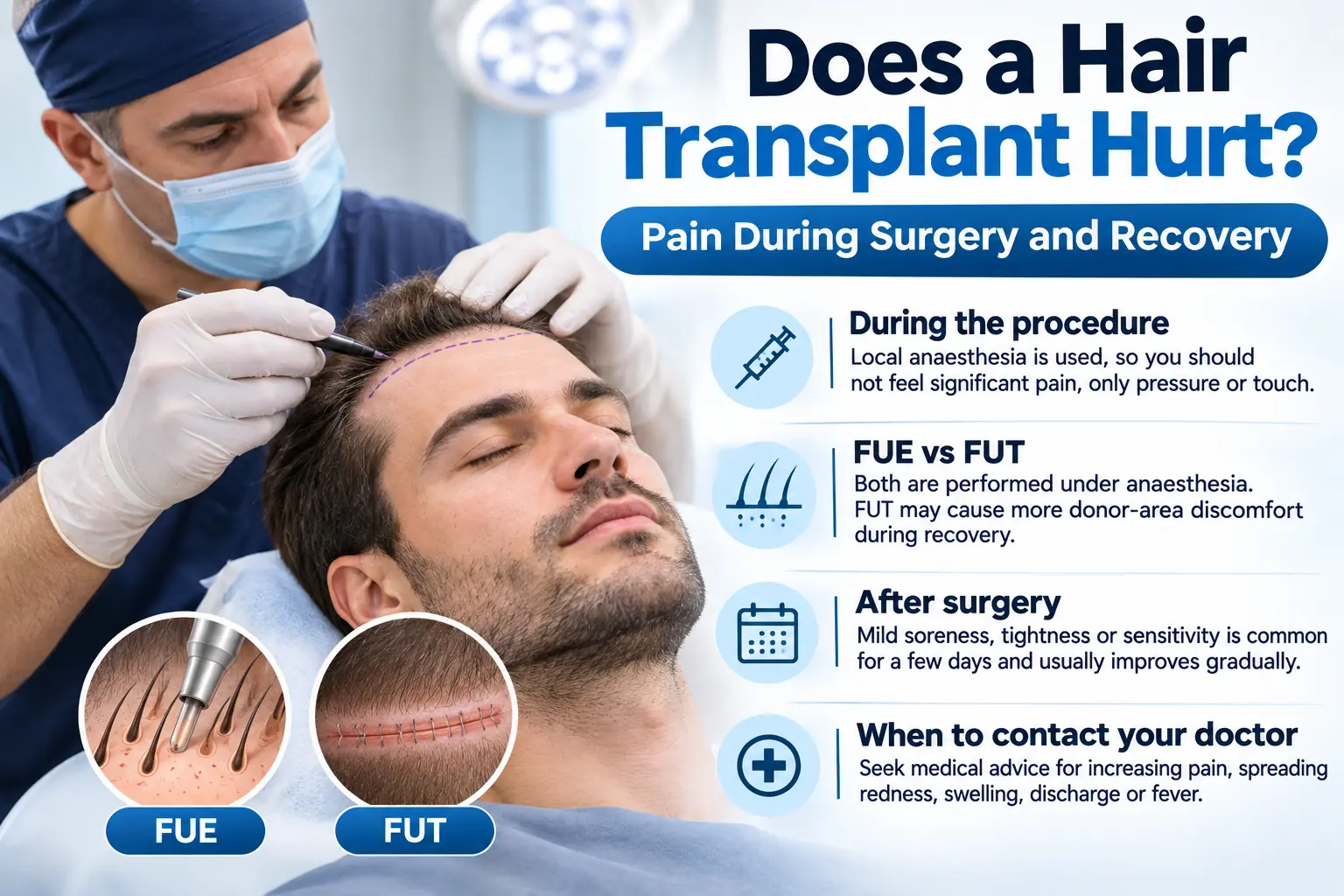
Does a Hair Transplant Hurt? Pain During Surgery and Recovery
One of the first questions people ask before considering hair restoration is simple: Does a hair transplant hurt?
The idea of having hair follicles removed and implanted into the scalp can sound uncomfortable, particularly if you have never undergone a surgical procedure before.
You may be worried about the anaesthetic injections, the extraction of grafts, or how your scalp will feel when you return home.
The good news is that modern hair transplantation is generally well tolerated when performed with appropriate local anaesthesia and medical care.
However, describing a hair transplant as completely painless would be misleading.
Some discomfort can occur when the anaesthetic is administered, and temporary tenderness, tightness or soreness may develop during recovery.
The intensity and duration of these sensations vary between patients.
In this guide, we explain what a hair transplant actually feels like, how pain is managed during FUE and FUT procedures, what is normal after surgery, and when discomfort may require medical attention.
Does a Hair Transplant Hurt During the Procedure?
Most patients should not experience significant pain during a hair transplant once the local anaesthetic has taken effect.
Hair transplantation is generally performed under local anaesthesia, which temporarily blocks pain signals from the areas being treated.
This allows the patient to remain awake while the surgeon works on the donor and recipient regions.
Depending on the individual situation and clinical protocol, sedation may also be considered.
Although the scalp is numbed, patients may still notice certain sensations, including:
- Pressure against the scalp.
- Gentle pulling or movement.
- Touch or vibration from surgical instruments.
- Temporary discomfort when anaesthesia is administered.
- Changes in comfort associated with remaining in one position for an extended period.
These sensations do not necessarily indicate that the local anaesthetic is failing.
However, there is an important distinction between feeling pressure and experiencing sharp or persistent pain.
If you feel pain during the procedure, you should tell the surgical team immediately.
The physician can assess the cause and determine whether additional anaesthesia or another intervention is required.
You should never feel obliged to tolerate significant pain silently.
Is the Local Anaesthesia Injection Painful?
For many patients, the administration of local anaesthesia is the most noticeable uncomfortable stage of a hair transplant.
Before harvesting begins, the physician administers local anaesthetic to the appropriate areas of the scalp.
The injections may produce a brief stinging, burning or pressure sensation.
The degree of discomfort depends on several factors, including individual sensitivity, the injection site and the anaesthetic technique.
As the medication takes effect, the treated area becomes numb.
This significantly reduces the ability to perceive pain during the surgical stages that follow.
How Long Does the Injection Discomfort Last?
The discomfort associated with an individual injection is generally brief, although several injections may be required to achieve appropriate anaesthesia.
It is not possible to promise that every injection will be painless.
Some patients tolerate the process very comfortably, while others find it more unpleasant.
If you are particularly anxious about injections, explain this during your consultation.
The physician can discuss how anaesthesia will be administered and what measures may be appropriate to improve comfort.
Can You Feel the Grafts Being Removed?
Under effective local anaesthesia, graft harvesting should not normally produce significant pain.
However, you may be aware of pressure, touch or movement.
The exact sensations depend partly on the harvesting technique.
The goal of anaesthesia is to control pain, not necessarily to eliminate every physical sensation.
Can the Anaesthetic Wear Off During Surgery?
Yes. Local anaesthetic effects are temporary.
Hair transplantation can take several hours, depending on the treatment plan and number of grafts.
During a longer procedure, the physician may need to reassess anaesthesia and administer additional medication.
The decision depends on the patient’s comfort, medical history, the anaesthetic already used and the stage of surgery.
Patients should inform the surgical team if they notice increasing discomfort rather than assuming it is something they must endure.
Is FUE Hair Transplantation Painful?
FUE, or Follicular Unit Excision, involves removing individual follicular units from the donor area using specialised surgical instruments.
The harvested grafts are then implanted into the areas requiring restoration.
Does FUE Hurt During Extraction?
FUE harvesting is normally carried out under local anaesthesia.
Once the scalp is adequately numbed, the extraction process should not cause significant pain.
Some patients describe feeling pressure or movement while the instruments are used.
The experience varies according to individual sensitivity and the extent of the procedure.
Does FUE Hurt During Implantation?
The recipient area is also anaesthetised.
During graft placement, you may notice some contact or pressure, but significant pain should not be expected when the anaesthesia is effective.
The surgeon must maintain appropriate pain control throughout the procedure.
Is the Donor Area Painful After FUE?
Temporary soreness and sensitivity are possible because individual follicular units have been removed from the donor region.
This creates multiple small surgical wounds.
During the first few days, patients may experience:
- Tenderness when touching the back of the scalp.
- Mild burning or stinging sensations.
- Tightness or sensitivity.
- Redness and small crusts.
- Discomfort when resting the donor area against a pillow.
These symptoms generally improve as healing progresses.
However, they should not be assumed to be harmless if they become severe or progressively worse.
For a detailed explanation of the technique, visit our FUE hair transplant service page.
Is FUT Hair Transplantation More Painful Than FUE?
FUT, or Follicular Unit Transplantation, differs from FUE in the way donor follicles are harvested.
Instead of extracting individual follicular units directly, FUT involves removing a strip of hair-bearing scalp tissue.
The donor incision is then closed, and the strip is divided into individual grafts.
Both procedures use appropriate anaesthesia to control pain during surgery.
The main difference in discomfort is often related to donor-area healing.
Pain During FUT Surgery
Patients should not normally experience significant pain during FUT harvesting when the local anaesthetic is working effectively.
However, they may notice pressure or pulling sensations.
As with FUE, unexpected pain should be communicated immediately to the medical team.
Pain After FUT Surgery
Because FUT involves a surgical incision and closure, patients may experience tenderness or tightness around the donor wound.
Depending on the procedure and individual healing, discomfort may become noticeable when moving the head, lying down or touching the incision.
Some patients experience more pronounced donor-site discomfort following FUT than after FUE.
Nevertheless, individual experiences vary, and it would be inaccurate to promise that one technique always produces less pain.
Does FUT Cause Long-Term Discomfort?
Most postoperative discomfort improves during healing.
However, some patients may experience persistent sensitivity, numbness, tingling or other sensory changes around surgical scars.
Persistent or worsening symptoms require assessment.
A surgeon should discuss these possibilities before the procedure.
Learn more about the FUT hair transplant technique.
Hair Transplant Pain Timeline: What to Expect During Recovery
A major concern for patients is not only how surgery feels, but what happens afterwards.
The following timeline describes common recovery experiences.
It is not a fixed schedule that applies to every person.
The type of procedure, extent of surgery, individual healing and postoperative instructions can all influence recovery.
Immediately After Surgery
As the local anaesthetic begins to wear off, you may become more aware of sensations in the donor and recipient areas.
These can include:
- Tightness.
- Mild soreness.
- Tenderness.
- A feeling of pressure.
- Temporary swelling.
The medical team should explain which symptoms are expected and what medication, if any, has been prescribed.
Some patients feel relatively comfortable immediately after the procedure, while others notice increasing discomfort as the anaesthetic effect decreases.
The First 24–48 Hours
The initial postoperative period may be the time when discomfort is most noticeable.
The donor region can feel sore, particularly when pressure is applied.
The recipient area may feel sensitive, although patients should avoid touching or rubbing the implanted grafts unnecessarily.
Mild swelling may develop, sometimes extending towards the forehead.
The degree of swelling varies between patients.
During this period, protecting the grafts and following the surgeon’s instructions are particularly important.
Days 3–5
In an uncomplicated recovery, soreness often begins to improve over the first few days.
Patients may still notice tightness, sensitivity or mild swelling.
Small crusts can be present around the transplanted follicles.
Itching may also begin as the scalp heals.
However, increasing pain, spreading redness or unusual discharge should not be dismissed as normal healing.
Days 6–10
Many patients experience further improvement in comfort during this stage.
The scalp may still be sensitive, especially around the donor region.
Crusts gradually loosen according to the individual healing process and the postoperative washing protocol.
It is important not to scratch or forcibly remove crusts.
The treating physician should explain when and how the scalp can be washed safely.
Days 10–14
By this stage, many patients feel considerably more comfortable.
However, mild tenderness or altered sensation may persist.
Patients who underwent FUT may have specific follow-up requirements related to the donor incision and any non-dissolvable stitches.
Recovery should always be assessed individually.
After Two Weeks
The initial healing period is generally well advanced, but the scalp may not yet feel completely normal.
Some patients experience residual numbness, tingling or sensitivity for longer.
These sensations should gradually improve.
If symptoms persist, worsen or interfere with everyday activities, the physician should reassess the scalp.
Pain recovery and hair growth are separate processes.
The scalp can feel comfortable long before the transplanted follicles begin producing visible new hair.
What Kind of Pain Is Normal After a Hair Transplant?
Not every sensation after surgery has the same meaning.
Understanding the differences can help patients describe their symptoms more accurately.
Mild Soreness
Mild soreness around the donor area is a common postoperative experience.
It is usually associated with the healing of surgical wounds.
It should generally improve rather than intensify over time.
Tightness
A feeling of tightness can develop because of tissue healing and local swelling.
After FUT, this sensation may be particularly noticeable around the donor incision.
Tenderness to Touch
The scalp may feel sensitive when touched or when resting against a pillow.
Patients should avoid unnecessary pressure on the recipient area during early healing.
Itching
Itching is a common part of wound healing.
However, severe or persistent itching may also indicate irritation, a reaction to a product or another scalp condition.
Patients should not scratch the recipient area or apply unapproved products.
Numbness or Tingling
Temporary changes in sensation can occur following surgery.
These may reflect irritation or disruption of small superficial nerves.
Such symptoms often improve over time, but persistent or troubling changes should be evaluated.
Burning Sensations
Some patients describe temporary stinging or burning around the donor area.
Mild sensations can occur during healing.
However, severe burning, increasing pain or symptoms accompanied by marked inflammation warrant medical attention.
When Is Pain After a Hair Transplant a Warning Sign?
Although mild discomfort can be expected, severe or worsening pain should never automatically be considered part of normal recovery.
Contact your surgical team promptly if you experience:
- Pain that becomes increasingly severe rather than improving.
- Spreading redness or warmth around the surgical area.
- Significant or worsening swelling.
- Pus or unusual discharge.
- Fever or feeling generally unwell.
- Persistent or unexpected bleeding.
- Wound separation.
- Severe pain that is not controlled by the prescribed treatment.
- Any unexpected symptoms that cause concern.
These signs may indicate a complication that requires medical assessment.
Possible complications of hair transplantation include infection, bleeding, adverse reactions to medication or anaesthesia, and problems with wound healing.
Serious complications are not the typical outcome of appropriately performed hair restoration surgery, but they remain possible.
If you experience breathing difficulties, facial or throat swelling associated with a possible allergic reaction, fainting or other potentially life-threatening symptoms, seek emergency medical care.
How Can You Reduce Discomfort After a Hair Transplant?
There is no single method that eliminates every postoperative sensation.
However, following an appropriate recovery plan can help make healing more manageable.
1. Take Medication Only as Directed
Your surgeon may prescribe or recommend medication for postoperative discomfort.
Follow the instructions carefully.
Do not independently increase the dose or combine pain medications without checking that they are appropriate for your medical history and other treatments.
Some medicines can affect bleeding or interact with other drugs.
Do not stop prescribed medication before surgery or during recovery unless the relevant clinician advises you to do so.
2. Protect the Recipient Area
The transplanted follicles require particular care during initial healing.
Avoid rubbing, scratching or placing unnecessary pressure on the recipient area.
Follow the clinic’s instructions for sleeping, washing and handling the scalp.
3. Avoid Intense Physical Activity Until Cleared
Strenuous exercise can increase sweating and mechanical stress during early recovery.
Your physician should explain when walking, gym sessions, running and more demanding activities can be resumed.
The appropriate timing depends on the surgical technique and healing process.
4. Follow the Recommended Washing Routine
Washing instructions may differ between clinics and procedures.
Use the products and technique recommended by your surgeon.
Avoid vigorous massage, forceful water pressure or attempts to remove crusts prematurely.
5. Attend Follow-Up Appointments
Postoperative reviews allow the physician to assess healing and identify possible complications.
If your symptoms differ significantly from what was explained before surgery, contact the clinic rather than waiting for a routine appointment.
Does Sleeping Hurt After a Hair Transplant?
Sleeping can be uncomfortable during the first few nights, particularly when the donor area is tender.
Some patients struggle to find a comfortable position that avoids contact with the recipient region.
The appropriate sleeping position depends on the treatment area and surgical instructions.
The clinic may recommend temporary adjustments to the way you rest, including measures to minimise pressure or friction.
However, patients should follow their own surgeon’s guidance rather than assuming that one sleeping position is suitable for everyone.
If you have significant difficulty sleeping because of postoperative pain, contact the medical team for advice.
Does Washing Your Hair Hurt After a Transplant?
The first postoperative washes can make patients nervous.
The scalp may still feel sensitive, and the transplanted area may have visible crusts.
However, gentle washing performed according to the clinic’s instructions should not normally cause significant pain.
A mild sensation of tenderness may occur.
Pain caused by vigorous rubbing, scratching or strong water pressure is avoidable and may also place unnecessary stress on the healing scalp.
The exact timing and method of the first wash should be provided by the treating surgical team.
Do not assume that ordinary washing habits can be resumed immediately.
Does Hair Growth Hurt After a Transplant?
The development of new hair is not normally a painful process.
Following the initial postoperative period, some transplanted hair shafts may shed before new growth becomes visible.
This is a recognised part of the hair restoration process.
New growth often begins to appear several months after surgery and continues to develop gradually.
The visible hair can change in thickness and coverage over time.
However, new tenderness, bumps or irritation should not automatically be attributed to normal hair growth.
What About Small Pimples in the Transplanted Area?
Occasional bumps can develop as the scalp heals and hair begins to emerge.
Some may relate to follicular irritation, while others may reflect folliculitis or another condition.
Painful, persistent or inflamed bumps should be assessed by the physician.
Do not squeeze them or attempt to treat them with random products.
Can Hair Transplant Pain Last for Months?
Most patients experience improvement in the initial postoperative discomfort as healing progresses.
However, some degree of altered sensation can persist longer.
Examples include:
- Localised numbness.
- Tingling.
- Unusual sensitivity.
- Tenderness around a scar.
- Less commonly, persistent neuropathic-type pain.
The duration and severity vary.
Persistent pain should not automatically be dismissed as normal, particularly when it interferes with sleep or daily activities.
A physician may need to examine the scalp and assess possible causes, such as scar-related sensitivity, nerve irritation or an inflammatory condition.
Does a Larger Hair Transplant Mean More Pain?
Not necessarily.
A larger procedure may involve more extensive donor harvesting, a wider recipient area or a longer surgical session.
These factors can influence postoperative discomfort, but they do not allow pain intensity to be predicted precisely.
Individual sensitivity, surgical technique, anaesthesia, scalp characteristics and healing all matter.
A patient receiving a relatively small number of grafts may still experience notable sensitivity, while another undergoing a larger procedure may report little discomfort.
The number of grafts alone is not a reliable measure of how painful the experience will be.
The surgeon should explain what to expect from your particular treatment plan.
Is Hair Transplantation More Painful for Women?
There is no reliable rule that hair transplantation is inherently more painful for women or men.
Pain perception varies considerably between individuals.
Differences in technique, treatment area, medical history and anaesthetic requirements are usually more relevant to the specific surgical experience.
For women, the diagnosis and distribution of hair loss are particularly important before transplantation is recommended.
Not all forms of female hair loss are appropriate for surgery.
The medical assessment must establish the cause of thinning and whether a suitable donor region is available.
What if You Have a Low Pain Tolerance?
Having a low pain tolerance does not automatically mean you cannot undergo a hair transplant.
It does mean that discussing pain control before surgery is particularly important.
Some people feel especially uncomfortable with needles.
Others are concerned about remaining awake during a long procedure or dealing with postoperative sensitivity.
These concerns deserve a clear explanation.
During your consultation, discuss:
- Any previous difficulty with local anaesthesia.
- Known medication allergies.
- Previous reactions to anaesthetics.
- Current medications.
- Medical conditions that may affect treatment.
- Fear of needles or significant procedural anxiety.
- Your expectations regarding pain and recovery.
The physician can explain the available pain-control options and whether any additional precautions are appropriate.
Do not independently take sedatives, sleeping tablets or other medicines before surgery.
Any medication intended to reduce anxiety or discomfort must be approved by the treating clinician.
Is a Hair Transplant Safer or Less Painful Under General Anaesthesia?
General anaesthesia is not routinely required for standard follicular-unit hair transplantation.
These procedures are generally performed under local anaesthesia, sometimes with sedation.
General anaesthesia has its own risks and requirements.
Being unconscious is not automatically a safer or more appropriate approach for a typical hair transplant.
The choice of anaesthesia should be made according to the clinical circumstances, medical history and the procedure being performed.
If you are concerned about remaining awake, discuss the available options with a qualified physician before deciding on surgery.
Does Pain Affect Hair Transplant Results?
Pain intensity alone does not determine whether transplanted follicles will grow successfully.
A patient who experiences mild postoperative soreness is not necessarily more or less likely to achieve a satisfactory result than someone who reports very little discomfort.
Hair transplant outcomes depend on several factors, including:
- Appropriate patient selection.
- Donor-area quality.
- Careful graft extraction.
- Graft handling and preservation.
- Recipient-site planning.
- Surgical technique.
- Postoperative healing.
- Continued progression of natural hair loss.
However, complications that cause significant pain, such as infection or impaired wound healing, may also affect the surgical result.
This is another reason why severe or unusual symptoms should be assessed rather than ignored.
Read more about the importance of protecting the hair transplant donor area.
Questions to Ask Your Surgeon About Pain
Before undergoing hair transplantation, it is reasonable to ask exactly how discomfort will be managed.
A useful consultation should address the following questions:
- What type of anaesthesia will be used during my procedure?
- What will the anaesthetic injections feel like?
- Will I remain awake throughout the operation?
- What should I do if I feel pain during surgery?
- What discomfort is expected during the first 48 hours?
- Which medication may be recommended after surgery?
- How should I sleep and wash my scalp during healing?
- When can I return to work and exercise?
- Which symptoms would indicate a possible complication?
- Who should I contact if I experience unexpected pain after returning home?
The answers should be specific to your medical history and proposed treatment rather than based on general promotional promises.
A Physician-Led Approach at Hairtransplant Clinic
Choosing a hair transplant clinic involves more than comparing techniques, graft numbers or prices.
It also means understanding who is medically responsible for your procedure, how anaesthesia will be managed and what follow-up care is available.
At Hairtransplant Clinic in Athens, Dr. Ioannis Papangelopoulos, MD, PhD, personally performs hair transplantation procedures, supported by his medical team.
The treatment plan is based on an individual assessment of the patient’s hair loss, donor area, medical history and realistic goals.
Before surgery, patients should have an opportunity to discuss the proposed technique, anaesthesia, expected discomfort and postoperative instructions.
A physician-led procedure places medical responsibility at the centre of surgical planning.
The goal is to provide appropriate clinical care throughout the process, while explaining the possibilities and limitations of treatment without making unrealistic promises.
Frequently Asked Questions About Hair Transplant Pain
Does a hair transplant hurt a lot?
Most patients do not experience significant pain during the procedure once local anaesthesia has taken effect. Some discomfort may occur during injections, while temporary soreness or tightness can develop after surgery.
What is the most painful part of a hair transplant?
For some patients, the local anaesthetic injections are the most uncomfortable stage. Others find the initial postoperative soreness more noticeable. Experiences vary, and there is no single stage that every patient finds most painful.
Is an FUE hair transplant painful?
FUE is generally performed under local anaesthesia, which helps control pain during graft harvesting and implantation. Temporary donor-area tenderness, redness or soreness may occur during recovery.
Is FUT more painful than FUE?
FUT involves a donor incision and may produce different postoperative sensations, including tightness or incision-related soreness. Some patients experience greater discomfort after FUT, but pain varies and one technique cannot be guaranteed to be less painful in every case.
Do hair transplant injections hurt?
Local anaesthetic injections may cause brief stinging, burning or pressure. Once the medication becomes effective, the scalp should be sufficiently numb for the surgical procedure.
How many days does hair transplant pain last?
Initial soreness often improves over the first few days. Tenderness and changes in sensation may persist longer. The exact duration depends on the procedure, healing and individual characteristics.
Is pain normal three days after a hair transplant?
Mild discomfort can still occur three days after surgery, particularly in the donor area. However, pain that is increasing, severe or associated with fever, spreading redness or discharge requires medical assessment.
Is pain normal one week after a hair transplant?
Some residual tenderness or sensitivity may remain after one week. The overall trend should generally be towards improvement. Persistent or worsening symptoms should be discussed with the treating physician.
Can you sleep normally after a hair transplant?
Sleeping positions may need temporary adjustment to protect the transplanted area and avoid discomfort. Follow your surgeon’s specific instructions, especially during the initial healing period.
Can I take painkillers after a hair transplant?
Your physician may prescribe or recommend suitable pain relief. Take only medication approved for your situation, and do not change doses or combine medicines without medical advice.
Does transplanted hair growing back hurt?
New hair growth is not normally painful. If you experience painful bumps, increasing inflammation or persistent scalp discomfort, the area should be examined.
What should I do if I feel sharp pain during surgery?
Tell the surgical team immediately. The physician can assess whether additional anaesthesia or another intervention is needed. You should not attempt to tolerate significant pain without informing the team.
Can I go back to work after a hair transplant?
Many patients can resume some routine activities relatively soon, but the appropriate time away from work depends on the procedure, healing and job requirements. Your surgeon should provide individual advice.
Is a hair transplant completely painless?
No surgical procedure should be advertised as completely painless for every patient. Local anaesthesia usually allows hair transplantation to be performed without significant operative pain, but injections and postoperative healing may involve discomfort.
Final Thoughts: Does a Hair Transplant Hurt?
The fear of pain is understandable, especially when you are considering elective surgery.
Fortunately, modern hair transplantation is generally well tolerated with appropriate local anaesthesia.
During the procedure, most patients should not experience significant pain once the treated areas are adequately numbed.
However, the injections may cause temporary discomfort, and tenderness, tightness or soreness can occur during postoperative recovery.
FUE and FUT have different donor-harvesting methods, which may also influence how the scalp feels during healing.
The most important point is that pain should be anticipated, explained and appropriately managed rather than dismissed or described as impossible.
If you are thinking about hair transplantation in Athens and want to understand what the procedure may involve in your individual case, contact Hairtransplant Clinic to arrange a consultation with Dr. Ioannis Papangelopoulos.
A personalised medical assessment can help you understand the appropriate technique, anaesthesia, recovery expectations and potential risks before making your decision.
Medical References
- NHS – Hair Transplant: Procedure, Recovery and Risks
- International Society of Hair Restoration Surgery – After Hair Restoration Surgery
- International Alliance of Hair Restoration Surgeons – Hair Transplant Risks
- American Society of Plastic Surgeons – Preparing for Hair Transplantation
Medical Disclaimer: This article provides general educational information and does not replace individual medical advice. Anaesthesia, pain perception, recovery and possible complications vary between patients. Always follow the instructions of your treating physician and seek medical assessment for severe or unexpected symptoms.