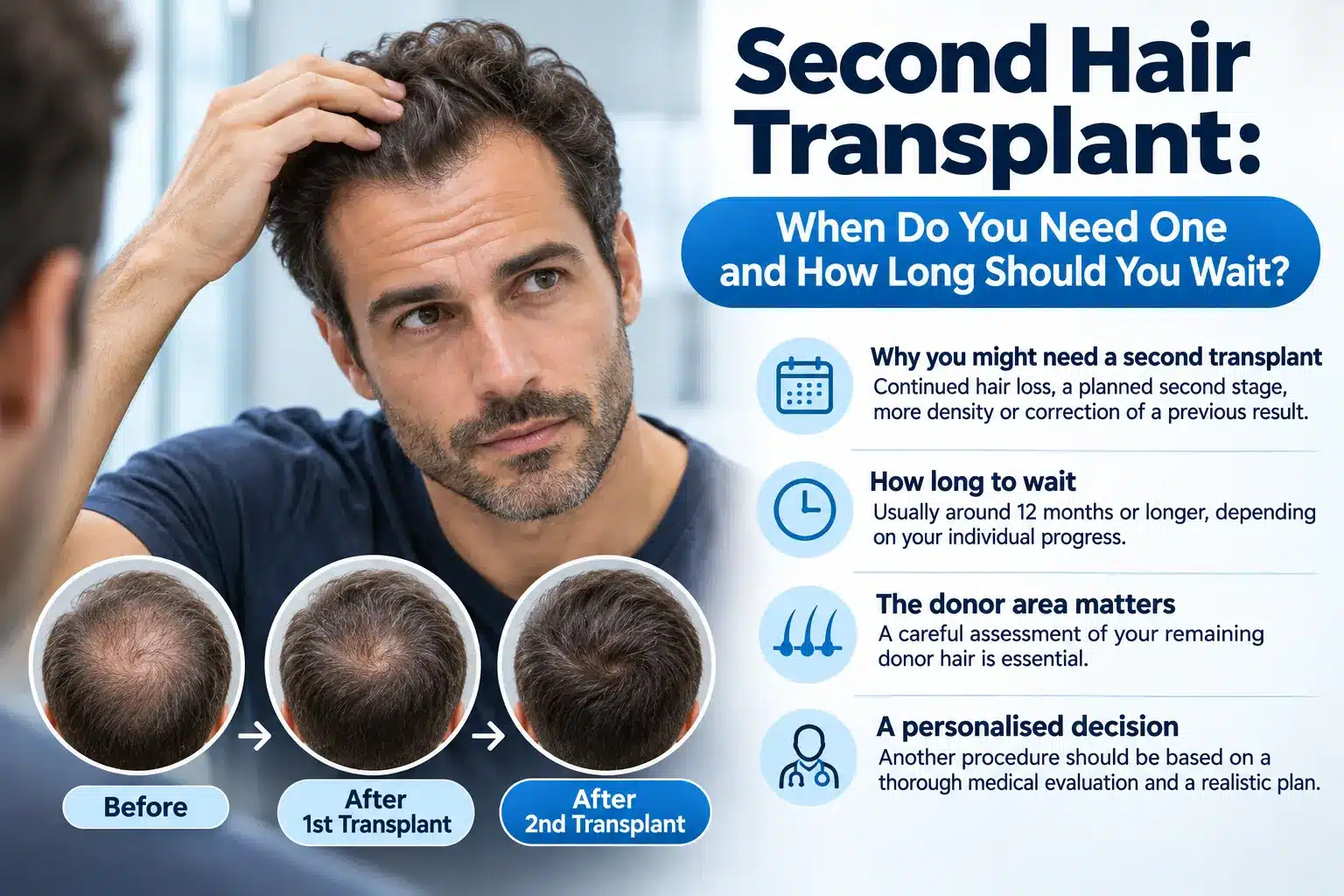
Second Hair Transplant: When Do You Need One and How Long Should You Wait?
You had a hair transplant. The procedure went well, your new hair started growing, and you were pleased with the improvement.
But several years later, you noticed something unexpected: the transplanted hairline was still visible, while the natural hair behind it had become thinner.
Or perhaps you underwent surgery only eight months ago and are already wondering whether another procedure could improve your density.
These situations raise an important question: Do you need a second hair transplant?
The answer depends on why you are considering another procedure.
A second hair transplant may be appropriate when natural hair loss continues, when restoration was deliberately planned in stages, or when an earlier result requires correction.
However, not every patient needs additional surgery. Sometimes the first result has not yet fully developed. In other cases, the remaining donor hair may be insufficient to support another operation.
This guide explains when a second hair transplant makes sense, how long you should wait, what happens to your donor area, and which factors determine whether another procedure can provide a worthwhile improvement.
Can You Have a Second Hair Transplant?
Yes, a second hair transplant is possible for many patients, provided sufficient suitable donor hair remains and another procedure is medically appropriate.
Hair transplantation is not necessarily limited to one operation during a person’s lifetime.
Some patients achieve satisfactory coverage after a single procedure. Others may undergo further treatment because of progressive hair loss, a planned second stage, or specific problems with an earlier result.
However, eligibility cannot be determined by the amount of hair you would like to restore.
Before recommending additional transplantation, the surgeon must establish:
- Why further restoration is being considered.
- Whether the first transplant has fully developed.
- How much suitable donor hair remains.
- Whether natural hair loss is still progressing.
- Whether the scalp has healed appropriately.
- Whether existing scars or previous harvesting affect the available options.
- Whether another procedure can realistically achieve the desired improvement.
The objective is not simply to perform another operation.
It is to determine whether further surgery offers a reasonable benefit without unnecessarily compromising the donor region.
Why Do People Need a Second Hair Transplant?
There are several reasons why someone might consider a repeat hair transplant.
Understanding the cause is essential because each situation requires a different treatment strategy.
1. Hair Loss Continues After the First Transplant
One of the most common reasons for considering a second hair transplant is continued androgenetic alopecia.
Imagine a man who underwent hair transplantation at 32 to restore his receding temples and frontal hairline.
The transplanted follicles developed normally, producing a natural-looking improvement.
By 39, however, he notices increasing thinning across the mid-scalp.
The transplanted hairline may still be present, but the surrounding non-transplanted hair has continued to thin.
This does not necessarily mean that the original surgery failed.
Hair transplantation redistributes existing follicular units. It does not eliminate the biological processes responsible for hereditary hair loss.
Follicles harvested from a suitably selected donor region may retain their characteristics after transplantation, while other scalp follicles remain susceptible to progressive miniaturisation.
A second procedure may sometimes be considered to restore newly affected areas.
However, the physician must first evaluate the progression of hair loss and whether medical management could be appropriate.
2. The Original Hair Transplant Was Planned in Stages
Some patients require extensive restoration across several areas of the scalp.
For example, a patient with advanced hair loss may need treatment of the frontal hairline, mid-scalp and crown.
Attempting to achieve extensive coverage in one session may not always be the most suitable strategy.
Instead, the surgeon may recommend a staged approach.
The first procedure could focus on creating a natural frontal hairline and improving coverage at the front of the scalp.
A later procedure might address remaining areas if sufficient suitable donor hair is available.
In this situation, a second hair transplant is not evidence of failure.
It is part of a longer-term surgical plan.
Importantly, the second stage should still follow a new assessment. The result of the first procedure and the condition of the donor area may influence the original plan.
3. The Patient Wants Greater Hair Density
Some patients achieve satisfactory hair growth but would prefer more density in a particular region.
For example, the hairline may look natural while the area behind it still appears thin under strong lighting.
Additional transplantation may sometimes improve coverage.
However, hair density is influenced by more than the number of implanted grafts.
Hair thickness, texture, colour contrast, follicular-unit composition and the distribution of existing hair all influence the final appearance.
There are also practical limits to placing new grafts between existing follicles.
A surgeon must consider the possibility of damaging neighbouring hair or creating unnecessary surgical trauma.
Greater density should therefore be considered only when it is technically appropriate and likely to provide a worthwhile improvement.
4. The Previous Hair Transplant Needs Correction
A second operation may also be considered when the earlier transplant produced an unsatisfactory appearance.
Examples include:
- An unnaturally low hairline.
- Incorrect hair direction or angulation.
- Excessively straight or dense frontal graft placement.
- Uneven distribution of transplanted hair.
- Inadequate growth after the expected maturation period.
- Visible donor-area scarring or depletion.
These situations may require specialist corrective planning.
Simply adding more grafts does not necessarily solve an underlying problem.
In selected cases, revision may involve removing, redistributing or supplementing previously transplanted follicles.
Corrective surgery can be more complex than an initial transplant because the surgeon must work around existing follicles, scar tissue and potentially reduced donor reserves.
How Long Should You Wait Before a Second Hair Transplant?
The time between procedures is an important part of treatment planning.
A second hair transplant is commonly considered only after the first result has developed sufficiently to be assessed, often around 12 months or longer.
However, there is no universal waiting period that applies to every patient.
The appropriate interval depends on the area treated, individual healing, the first procedure’s progress and the reason for further surgery.
After 3 Months: Usually Too Early to Judge the Result
At three months, many patients are still in the early stages of transplanted hair growth.
Temporary shedding may have occurred during the first weeks, and new hair may only be beginning to appear.
Limited visible density at this stage does not establish that the transplant has failed.
Planning another operation solely because the hair looks thin after three months would usually be premature.
If there are unexpected symptoms, complications or concerns, however, the patient should contact the treating physician without waiting for a particular milestone.
After 6 Months: Progress Is Visible, but the Result Is Still Developing
By six months, some patients notice meaningful changes in coverage.
However, hair growth and maturation remain incomplete in many cases.
Different follicles can enter their growth cycles at different times.
The visible hair may also continue changing in thickness, length and overall contribution to scalp coverage.
A six-month appointment is useful for monitoring progress, but it should not automatically become the date for another surgical procedure.
After 9 Months: Reassessment May Be Helpful
At nine months, the surgeon may have a clearer understanding of how the transplanted hair is developing.
Nevertheless, the result can continue improving.
If a patient is concerned about density, the physician should examine the scalp and compare progress with earlier postoperative records.
A second procedure should not be recommended solely because the result differs from the patient’s expectations at this stage.
After 12 Months: A Common Point for Formal Assessment
Around 12 months, many hair transplant results are sufficiently developed for a more meaningful assessment.
The surgeon can examine the transplanted coverage, hairline appearance, donor region and progression of surrounding natural hair loss.
This can help establish whether additional surgery is appropriate.
However, 12 months is not an automatic deadline.
Some patients require a longer period before the result can be considered sufficiently mature.
After 15–18 Months: Further Maturation May Still Occur
Certain areas, particularly the crown, may take longer to demonstrate their full cosmetic improvement.
For this reason, a physician may recommend waiting beyond 12 months before deciding whether another procedure is necessary.
The treatment area, individual hair characteristics and postoperative development should guide the decision.
The correct time for a second hair transplant is when the first procedure can be assessed reliably and the patient is suitable for further surgery—not simply when a fixed number of months has passed.
Is a Second Hair Transplant After One Year a Good Idea?
One year may be an appropriate point to discuss another procedure, but it does not mean that surgery is automatically necessary.
A repeat operation may be worth considering when:
- The first transplant has developed sufficiently for evaluation.
- The donor area has healed appropriately.
- The remaining donor density is adequate.
- There is a clearly defined area requiring additional restoration.
- The expected improvement is realistic.
- There is an appropriate long-term strategy for continued hair loss.
Conversely, further surgery may be postponed when transplanted hair is still maturing, the underlying diagnosis is uncertain, or scalp conditions require treatment.
The physician must also determine whether the desired improvement can be achieved without compromising existing hair or donor-area appearance.
The Most Important Factor: How Much Donor Hair Remains?
A second hair transplant presents a challenge that does not exist in quite the same way before the first procedure.
Some of the patient’s available donor follicles have already been harvested.
This means that the surgeon is working with a reduced reserve.
The donor area is usually located at the back and sides of the scalp, where suitable follicles may be relatively resistant to typical androgenetic hair loss.
However, the number of follicular units that can be harvested safely is limited.
Removing more grafts does not create new follicles to replace those already taken.
What Does the Surgeon Examine?
Before recommending a second transplant, the physician should evaluate several characteristics of the donor region.
Remaining follicular density: How many potentially suitable grafts remain, and how are they distributed?
Hair thickness: Does the available hair have sufficient calibre to provide meaningful coverage?
Previous harvesting pattern: Were the first grafts removed evenly or concentrated within certain areas?
Scarring: Are there visible extraction scars, a previous strip scar or other changes in the donor region?
Miniaturisation: Are some remaining donor follicles showing signs of progressive thinning?
Future needs: Should part of the remaining donor reserve be protected for possible future hair loss?
These considerations help establish the limits of another surgical procedure.
For further information, read our guide to the hair transplant donor area.
Can a Second Hair Transplant Damage the Donor Area?
Yes. Additional harvesting can create problems if the available donor reserve is not assessed and managed carefully.
One important risk is overharvesting.
Overharvesting occurs when excessive numbers of follicular units are removed from the donor region, potentially leaving it noticeably thin or uneven.
After a previous FUE procedure, the surgeon must account for the extraction sites and reduced density left by the first operation.
Repeated harvesting from already depleted areas may increase the risk of visible donor thinning.
A satisfactory result in the recipient area should not come at the cost of creating substantial new aesthetic problems in the donor region.
This is one reason why a surgeon may recommend fewer grafts than the patient initially requests.
Can You Have a Second FUE Hair Transplant?
Yes. A second FUE hair transplant may be possible when sufficient suitable donor follicles remain.
FUE involves harvesting individual follicular units from the donor region using specialised surgical instruments.
After an earlier FUE procedure, the surgeon must assess which areas were harvested and where additional follicles might be obtained safely.
A repeat FUE should not automatically follow the same extraction pattern as the original operation.
Careful planning is necessary to minimise unnecessary depletion and maintain a natural donor-area appearance.
Is Second FUE More Difficult Than the First?
It can be.
Previous harvesting may have changed the density and appearance of the donor region.
Existing small scars and changes in tissue characteristics may also influence the technical aspects of another extraction procedure.
The degree of difficulty depends on the original harvesting pattern, remaining hair characteristics and individual scalp anatomy.
A repeat FUE is therefore a new surgical assessment rather than a simple repetition of the first operation.
Learn more about the FUE hair transplant technique.
Can You Have FUE After an FUT Hair Transplant?
In selected patients, yes.
Someone who previously underwent FUT may later be considered for FUE, depending on the condition of the donor area.
FUT involves removing a strip of hair-bearing scalp, which leaves a linear scar.
When planning another procedure, the surgeon must evaluate that scar, the remaining donor density, scalp characteristics and the available harvesting options.
The presence of a previous FUT scar does not automatically prevent FUE.
However, it can influence treatment planning.
Can You Have FUT Again?
A further FUT procedure may also be possible in selected patients.
The decision depends on factors such as scalp laxity, previous scar characteristics and the available donor region.
Another FUT procedure may not be appropriate when tissue characteristics or previous surgery limit safe harvesting.
Neither FUE nor FUT should be presented as universally preferable for a second transplant.
The correct technique depends on the individual surgical situation.
How Many Grafts Do You Need for a Second Hair Transplant?
There is no standard graft count for a second hair transplant.
Some patients may need additional coverage in a relatively small area.
Others may require restoration across a much larger region.
The appropriate number depends on the size of the recipient area, existing density, donor reserve and overall treatment strategy.
A common misconception is that repeating the original graft count will produce twice the density.
For example, if a patient received 2,500 grafts during the first procedure, another 2,500 grafts would not automatically double the visible coverage.
Hair density does not increase according to such a simple formula.
The result depends on the quality of the grafts, the area being treated, their placement and the characteristics of the hair already present.
Placing additional grafts into an area containing existing follicles also requires careful planning to reduce unnecessary trauma.
The objective is not to maximise graft numbers, but to achieve an appropriate improvement using the remaining donor supply responsibly.
Should You Restore the Hairline or Crown First?
For patients with extensive hair loss, the question of which region to prioritise can be particularly important.
The frontal hairline helps define the face and can have a significant effect on appearance.
The crown, also called the vertex, may require substantial graft allocation because of the size of the affected region and the circular direction of hair growth.
However, restoration priorities cannot be determined from appearance alone.
The surgeon must consider:
- The patient’s age.
- The degree of frontal and crown thinning.
- Existing transplanted hair.
- Available donor follicles.
- Hair calibre and density.
- Possible future progression.
- The patient’s realistic goals.
In some cases, improving the frontal region may offer the most appropriate cosmetic benefit.
In others, further crown restoration may be reasonable.
Attempting to cover every affected region with insufficient donor hair can produce limited density throughout the scalp.
A responsible plan establishes priorities before committing the remaining grafts.
What if Your First Hair Transplant Did Not Work?
An unsatisfactory result after a first transplant does not always have the same explanation.
Two situations need to be distinguished.
Poor Hair Growth
Sometimes the final amount of growth is lower than expected.
Potential contributing factors may include graft handling, surgical trauma, scalp conditions, postoperative complications or other individual factors.
Not every cause can necessarily be identified with certainty.
Before repeating surgery, the physician should investigate why the original result was unsatisfactory.
Active inflammation, scarring disorders or other scalp conditions may need to be addressed before further transplantation can be considered.
Simply placing more grafts without understanding the original problem may expose the patient to unnecessary risk.
Unnatural Hairline or Graft Placement
In other cases, grafts may have grown but the overall appearance is not satisfactory.
The hairline may appear too low, unnaturally straight or incorrectly directed.
Hair emerging at inappropriate angles can be particularly noticeable in the frontal region.
These problems may require a corrective strategy rather than additional density alone.
The surgeon may need to evaluate whether certain grafts should be removed, relocated or complemented with carefully positioned new follicles.
Correction is not always possible to the degree the patient desires, especially when the donor reserve is limited.
Can You Have a Second Hair Transplant After 5 or 10 Years?
Yes. Some patients consider another procedure many years after their original transplant.
By that point, their hair loss pattern, donor density, general health and cosmetic preferences may have changed.
For example, a patient who underwent frontal restoration at 30 might request further treatment at 42 after experiencing additional thinning.
Another patient may wish to revise a hairline created using an older technique.
The interval itself does not determine suitability.
A patient returning after many years still requires a complete assessment.
In some cases, changes in scalp condition or donor availability may limit what can be achieved.
The physician should approach the situation as a new surgical decision informed by the history of the first procedure.
What Are the Risks of a Second Hair Transplant?
A second hair transplant is still a surgical procedure and carries potential complications.
Some risks are similar to those associated with an initial transplant, while others may be affected by previous harvesting or existing scar tissue.
Possible concerns include:
- Bleeding or infection.
- Donor-area scarring.
- Excessive donor depletion.
- Temporary swelling or discomfort.
- Changes in scalp sensation.
- Temporary shedding of neighbouring hair.
- Unpredictable graft growth.
- Unnatural distribution or density.
- Further surgery being necessary to address an unsatisfactory result.
Previously transplanted areas may require particular care because suitable grafts are being placed among existing follicles.
The surgeon must also consider the technical limitations created by scar tissue and reduced donor supply.
No particular survival percentage, density or cosmetic outcome can be guaranteed.
The patient should receive a clear explanation of the potential benefits, limitations and complications before deciding to proceed.
Is Recovery Different After a Second Hair Transplant?
Recovery depends on the surgical technique, the number of grafts, the recipient area and individual healing.
Patients who previously underwent FUE may be familiar with the initial postoperative process.
However, they should not assume that a second procedure will involve exactly the same experience.
The surgical plan may differ, and existing scars or changes in donor tissue may affect recovery.
Temporary redness, crusting, tenderness and swelling can occur.
Transplanted hair may also undergo temporary shedding before visible new growth develops.
The physician should provide postoperative instructions specifically for the new procedure.
Patients should follow these instructions rather than relying exclusively on the aftercare routine from their first surgery.
Can You Avoid Needing a Second Hair Transplant?
Not every future change in hair density can be prevented.
However, appropriate planning before and after the first procedure may reduce the likelihood of unnecessary additional surgery.
The most important measures involve understanding the underlying cause of hair loss and protecting the remaining donor reserve.
Plan for Future Hair Loss
A hairline should be designed with the possibility of continued natural thinning in mind.
An unnecessarily low hairline may require a large number of grafts and reduce future treatment options.
Preserve Donor Hair
The surgeon should avoid excessive harvesting and consider how the donor area may need to support future restoration.
Consider Medical Management When Appropriate
For patients with androgenetic alopecia, medical treatments may be discussed to help manage ongoing hair loss.
Options such as minoxidil or finasteride may be appropriate for certain patients following medical evaluation.
Their potential benefits, limitations and adverse effects must be considered individually.
These treatments are not suitable for everyone and do not guarantee that additional transplantation will never be necessary.
Attend Follow-Up Appointments
Postoperative monitoring provides an opportunity to evaluate graft development, scalp healing and continued native hair loss.
Clinical photographs taken under comparable conditions can also help assess changes over time.
What if You Do Not Have Enough Donor Hair for Another Procedure?
An inadequate donor reserve can significantly limit further surgery.
When too much hair has already been harvested, or when the remaining donor follicles are unsuitable, another transplant may not provide an acceptable result.
In these situations, the physician may recommend:
- Reducing the proposed treatment area.
- Prioritising specific regions rather than attempting extensive coverage.
- Investigating ongoing hair loss and possible medical management.
- Considering appropriate nonsurgical cosmetic alternatives.
- Avoiding further surgery when the risks or limitations outweigh the likely benefits.
Some patients ask whether beard or body hair can replace scalp donor hair.
These sources may be considered in selected specialised cases, but their characteristics differ from scalp hair, and they are not a universal or unlimited alternative.
A decision not to proceed with another hair transplant can be an appropriate medical recommendation.
How Much Does a Second Hair Transplant Cost?
The cost of a second hair transplant depends on the complexity of the individual case.
There is no universal price that applies to every repeat procedure.
The assessment may need to consider the planned number of grafts, the remaining donor reserve, the surgical technique and the condition of the recipient area.
Corrective surgery may require additional planning because of previous graft placement or existing scar tissue.
The patient should understand what the proposed treatment includes, the expected scope of surgery and the limitations of the anticipated result.
For more information on the factors affecting pricing, see our guide to hair transplant cost in Greece.
Three Situations That Require Different Decisions
Consider three hypothetical patients who contact a hair restoration clinic.
Patient A: New Hair Loss Five Years After Surgery
The patient underwent frontal restoration five years ago and remains satisfied with the transplanted hairline.
However, the mid-scalp has gradually become thinner.
The physician identifies progressive natural hair loss.
A second transplant may be considered, but the decision must also account for ongoing thinning and the available donor reserve.
Patient B: Limited Density Eight Months After Surgery
The patient underwent a transplant eight months earlier and wants to improve the crown immediately.
However, hair growth is still developing.
The physician may recommend further observation before making a decision about another procedure.
In this situation, additional surgery could be premature.
Patient C: A Planned Second Stage After Extensive Hair Loss
The patient originally had substantial hair loss affecting the frontal scalp and crown.
The first procedure focused on frontal restoration.
Following appropriate healing and evaluation, the physician assesses whether the remaining donor reserve can support crown treatment.
A second transplant may be a reasonable continuation of the original plan.
These examples demonstrate why the reason for another procedure matters as much as the number of months since the first surgery.
What Should You Bring to a Second Hair Transplant Consultation?
If possible, bring records from your first procedure.
Useful information includes:
- The date of the original operation.
- Whether FUE, FUT or another technique was used.
- The number of grafts harvested.
- The areas from which grafts were extracted.
- The regions where grafts were implanted.
- Any postoperative complications.
- Photographs taken before surgery and during recovery.
- Information about current medications or hair-loss treatments.
The surgeon may also ask how your hair has changed since the first operation.
Previous records can help establish the amount of donor hair already used and identify factors that may influence another procedure.
If records are unavailable, clinical examination can still provide useful information, although some details of the original surgery may remain uncertain.
How Hairtransplant Clinic Approaches a Second Hair Transplant
At Hairtransplant Clinic in Athens, Dr. Ioannis Papangelopoulos, MD, PhD, personally performs hair transplantation procedures, supported by his medical team.
For patients considering another operation, the starting point is a comprehensive medical assessment.
The physician evaluates the existing transplant, remaining donor area, pattern of hair loss and potential benefits of further surgery.
The aim is to distinguish between patients who may benefit from another transplant and those who require further monitoring, medical treatment or a different approach.
A second transplant should not be presented as a routine procedure simply because the patient wants additional density.
It should be supported by a realistic surgical plan that respects the remaining donor reserve and the patient’s long-term hair restoration needs.
Frequently Asked Questions About a Second Hair Transplant
Can I get a second hair transplant?
Yes. A second hair transplant may be possible when sufficient suitable donor hair remains and the procedure is medically appropriate. The decision requires an individual assessment of the first result, scalp condition and future hair loss.
How long should I wait before a second hair transplant?
A meaningful assessment is commonly performed around 12 months after the first procedure, although some patients need more time. The appropriate interval depends on hair growth, healing and the proposed treatment area.
Can I have a second hair transplant after 6 months?
Six months may be too early to judge the final result of the first procedure. Although circumstances vary, further assessment and monitoring are often preferable before scheduling another operation.
Can I have a second hair transplant after one year?
Potentially, yes. If the first result has developed sufficiently, the donor area is suitable and another procedure offers a realistic benefit, surgery may be considered after approximately one year.
Is a second hair transplant successful?
A second procedure may provide a worthwhile improvement in selected patients, but outcomes depend on the remaining donor hair, existing grafts, scalp condition and surgical planning. No result can be guaranteed.
Can a second FUE use the same donor area?
Sometimes. The surgeon must assess previous extraction sites, remaining density and scars to determine where additional harvesting can be performed safely.
Will a second hair transplant damage existing transplanted hair?
Additional surgery among existing follicles may involve a risk of trauma or temporary shedding. Careful planning and technique are important, but risk cannot be eliminated completely.
Can I have three hair transplants?
Some patients undergo more than two procedures. However, the number of previous operations is less important than the remaining donor reserve, scalp condition and whether further surgery is medically justified.
Can I have a second transplant if my first one failed?
Possibly. The physician should first investigate why the original result was unsatisfactory. Correction may require a different strategy, and some patients may not have sufficient suitable donor hair for further surgery.
Is a second hair transplant more expensive?
It can be, particularly when corrective surgery or more complex planning is required. However, the final estimate depends on the individual treatment plan rather than the fact that it is a second operation.
Does a second transplant stop future hair loss?
No. Transplantation does not automatically prevent progressive thinning of surrounding natural hair. Long-term management may still be necessary.
Is a second hair transplant always necessary?
No. Many patients achieve satisfactory results after one procedure. Others may need time for further growth, medical management or simply a reassessment of their expectations.
Final Thoughts: Do You Really Need a Second Hair Transplant?
A second hair transplant can be an appropriate option, but it should never be considered an automatic next step.
Some patients require additional restoration because hereditary hair loss has progressed.
Others may benefit from a deliberately planned second stage or carefully considered corrective surgery.
However, dissatisfaction with early hair growth does not necessarily mean another operation is required.
The most important questions are whether the first result has matured, whether sufficient suitable donor hair remains, and whether additional surgery can provide a realistic improvement.
The right decision is not simply whether another hair transplant is possible, but whether it is appropriate for your individual circumstances.
If you are considering a second hair transplant in Athens, contact Hairtransplant Clinic to arrange an individual consultation with Dr. Ioannis Papangelopoulos and discuss your previous procedure, remaining donor hair and potential treatment options.
Medical References
- International Society of Hair Restoration Surgery – Follow-up Hair Restoration Procedures
- International Society of Hair Restoration Surgery – Is One Hair Transplant Surgery Enough?
- International Society of Hair Restoration Surgery – Patient Information
Medical Disclaimer: This article is intended for general educational purposes and does not replace individual medical advice. The suitability, timing, risks and outcomes of repeat hair transplantation vary between patients. A qualified physician should evaluate each case before recommending further surgery.