White Bulb on Fallen Hair: Does It Mean the Hair Follicle Is Gone?
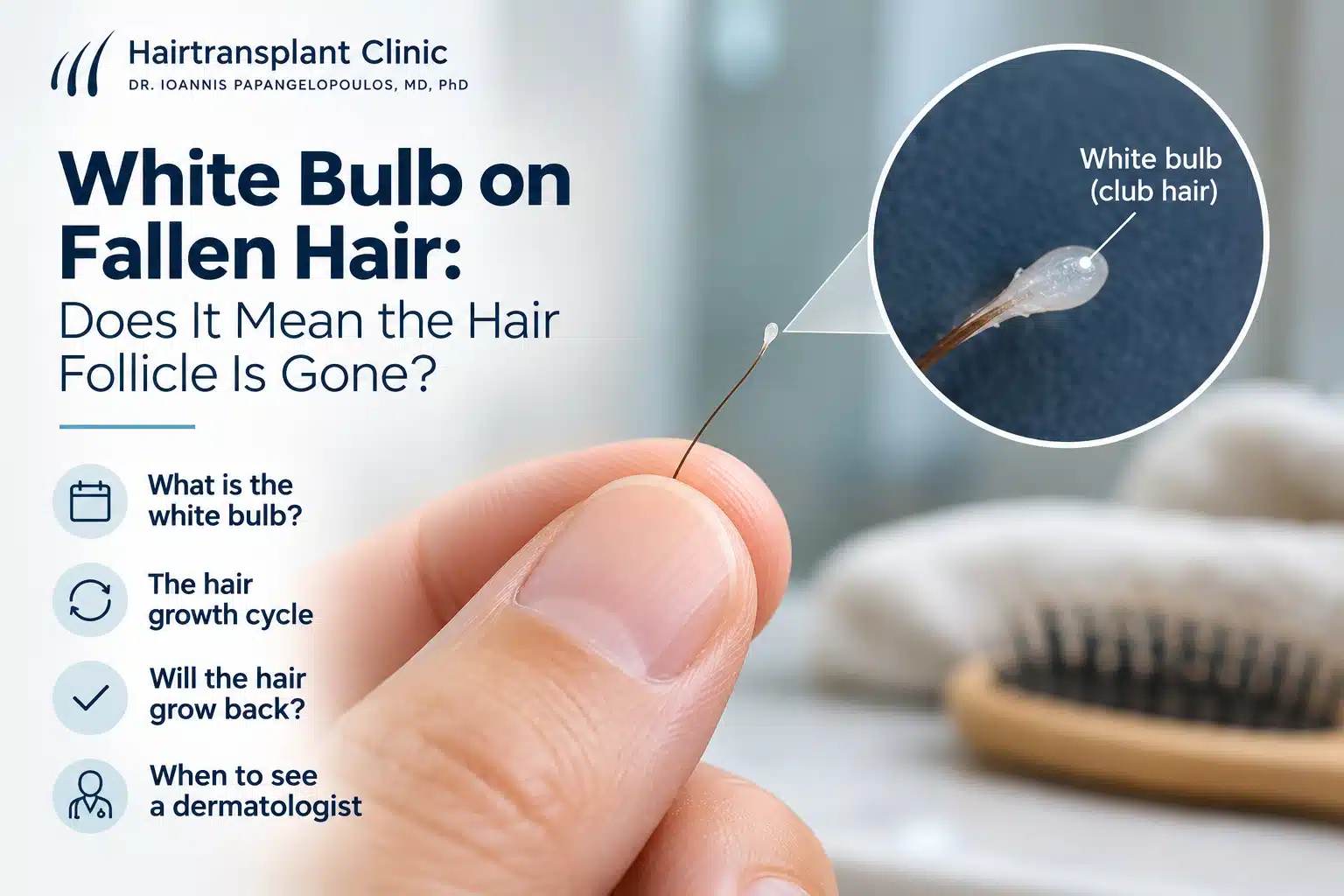
You have just washed your hair when you notice a strand on your hand. Looking closely, you see a tiny white bulb at one end.
It almost looks like a small root.
Naturally, you might wonder: Does this mean the entire hair follicle has fallen out? Will hair grow back in that spot?
In most cases, the answer is reassuring.
A small white bulb at the end of a naturally shed hair is usually part of the normal hair growth cycle. It does not mean that the entire follicle has been removed or that the area will remain permanently bald.
However, the appearance of one fallen hair cannot tell you whether you are experiencing a hair loss condition.
Understanding the difference between a shed hair, its root and the living hair follicle is the key.
What Is the White Bulb at the End of a Fallen Hair?
The small white or pale structure is commonly called a white hair bulb or white root.
In many cases, it is the characteristic club-shaped end of a telogen hair, also known as a club hair.
During the natural hair cycle, a hair eventually stops actively growing and enters a resting phase.
As this happens, the part closest to its base undergoes changes and becomes keratinised, forming a small, rounded structure.
When that hair is eventually shed, this pale end may remain visible.
It is not the entire living hair follicle.
It is part of the hair that has completed its growth cycle.
Why Is the Bulb White?
The club-shaped end of a resting hair is generally less pigmented than the rest of the strand.
Its keratinised structure can also give it a whitish appearance.
This does not automatically indicate infection, pus, dead tissue or permanent damage.
The shape and colour may vary. Not every pale particle attached to a strand is necessarily a club bulb; hair products and other residues can look similar.
Hair Root vs Hair Follicle: Understanding the Difference
This distinction is particularly important.
The hair follicle is a living structure located within the skin. It contains cells responsible for producing the hair shaft and participates in the continuous cycle of hair growth.
The hair shaft is the structure produced by the follicle.
When a telogen hair naturally falls out, the visible strand and its club-shaped end are released.
The entire follicle does not simply come out with it.
The follicle usually remains within the scalp and can continue its normal growth cycle.
Think of the follicle as the structure that produces hair, rather than the hair itself.
Losing one finished hair strand does not necessarily mean losing the structure that produces the next one.
Will Hair Grow Back if It Falls Out With a White Bulb?
In normal hair shedding, yes, the follicle remains capable of producing another hair.
This is part of the natural hair cycle.
However, there is an important qualification.
A visible white bulb does not prove that the underlying follicle is healthy or that future hair growth will be normal.
For example, a follicle affected by androgenetic alopecia may continue producing hair, but the strands can gradually become thinner and shorter.
In certain inflammatory or scarring conditions, follicular damage may interfere with regrowth.
Therefore, the white bulb alone is neither evidence of permanent baldness nor proof that there is no hair loss problem.
The overall pattern of shedding and changes in hair density matter much more.
Understanding the Normal Hair Growth Cycle
Hair does not grow continuously without interruption.
Each follicle moves through different phases.
Anagen: The Growth Phase
Anagen is the period of active hair production.
For scalp hair, this phase can last several years.
During anagen, cells within the follicle continuously produce the growing hair shaft.
Catagen: The Transition Phase
Catagen is a relatively short transition period.
Active growth stops, and the lower part of the follicle undergoes structural changes.
This prepares the hair for the resting stage.
Telogen: The Resting Phase
During telogen, the hair is no longer actively growing.
Its characteristic club-shaped end is formed, and the hair remains within the follicle until it is released.
The process of releasing a hair is often described as exogen, the shedding phase.
Meanwhile, the follicle can begin preparing for another growth cycle.
This is why normal hair shedding can occur every day without causing visible baldness.
Is It Normal to Lose Hair With White Bulbs Every Day?
Yes.
It is normal to lose approximately 50–100 scalp hairs per day, although individual patterns and washing habits vary.
Some of those hairs may have clearly visible white club-shaped ends.
You might notice more hairs on wash days because strands that were already ready to shed can be released during washing and combing.
The number visible in your hands or shower is not always the same as your total daily shedding.
What deserves attention is a clear and persistent change from your usual pattern, particularly if your hair density is also decreasing.
A few white-bulb hairs in the shower do not, by themselves, indicate a disease.
When Can White-Bulb Hair Shedding Become a Concern?
The appearance of the bulb is less important than the number of hairs being lost and the circumstances surrounding that change.
For example, someone who has always noticed a few strands while washing their hair may have nothing unusual to investigate.
A different situation is someone who suddenly begins losing noticeably more hair than before.
The concern becomes greater when increased shedding is accompanied by:
- A widening hair part
- Progressive thinning at the crown
- Recession around the temples
- Reduced overall hair volume
- A sudden bald patch
- Redness, pain, scaling or inflammation of the scalp
These findings may suggest that the problem goes beyond normal hair-cycle shedding.
A dermatologist can assess the pattern and determine whether further investigation is appropriate.
White Bulbs and Telogen Effluvium
One of the common causes of excessive shedding is telogen effluvium.
This condition occurs when more hairs than usual enter the resting and shedding phases following a significant physical or physiological trigger.
Possible triggers include severe illness, fever, childbirth, major emotional stress, rapid weight loss, certain medications and nutritional deficiencies.
In many cases, increased shedding begins approximately two to three months after the triggering event.
Because telogen hairs have club-shaped ends, someone experiencing telogen effluvium may notice many fallen hairs with small white bulbs.
However, the appearance of these bulbs does not establish the diagnosis on its own.
Telogen effluvium commonly causes diffuse shedding rather than a single clearly defined bald patch.
In many cases, hair density improves after the trigger resolves, although recovery takes time and some cases require longer follow-up.
For more information, see our guide to stress-related hair loss.
White Bulbs and Male or Female Pattern Hair Loss
Androgenetic alopecia is another common cause of progressively reduced hair density.
Unlike a sudden episode of excessive shedding, pattern hair loss typically develops gradually.
The central process is follicular miniaturisation.
Affected follicles begin producing thinner, shorter hairs over successive growth cycles.
In men, this commonly affects the hairline, temples and crown.
In women, it often appears as progressive thinning over the central scalp and widening of the hair part.
A person with androgenetic alopecia can still shed hairs with white bulbs.
The bulb does not distinguish normal shedding from hereditary hair loss.
In fact, androgenetic alopecia and telogen effluvium can occur together.
This is why examining the scalp and hair density is more informative than studying one strand.
Hair Shedding vs Hair Breakage
Not every hair found in a brush or shower has naturally fallen out from the follicle.
Some strands break along their length.
Hair breakage can result from physical or chemical damage, such as repeated heat styling, excessive bleaching, tight hairstyles or friction.
A broken hair may lack the typical club-shaped end because it has fractured somewhere along the shaft.
It may also be noticeably shorter than the surrounding hair.
However, examining a single strand at home cannot reliably distinguish every type of shedding or breakage.
If breakage is widespread, identifying the underlying cause may require an examination of the hair shaft and scalp.
Does Pulling Out a Hair With a White Bulb Destroy the Follicle?
Not usually from a single isolated event.
When a hair is plucked, the strand may come out with material that previously occupied part of the follicle.
This does not ordinarily mean that the entire follicular structure has been removed from the skin.
But repeated forceful pulling is not harmless.
Chronic traction or repeated hair pulling can cause irritation and damage.
In some circumstances, prolonged mechanical injury may contribute to lasting hair loss.
There is no benefit in pulling hairs out deliberately to examine their bulbs.
Can a White Bulb Tell You Whether Your Hair Loss Is Permanent?
No.
The long-term outlook depends on what is happening within the follicle and the surrounding scalp.
In temporary shedding conditions, follicles generally remain capable of producing new hairs.
In androgenetic alopecia, follicles may progressively miniaturise.
In certain scarring alopecias, inflammation can permanently damage follicular structures.
All these situations require different medical approaches.
A white bulb is simply not a reliable indicator of whether hair loss will be temporary or permanent.
What About White Bulbs After a Hair Transplant?
Hair shedding after a hair transplant can create additional concerns.
During the weeks following a procedure, some transplanted hair shafts may be temporarily shed as part of the post-operative hair cycle.
This phenomenon is often discussed in relation to postoperative shedding or shock loss.
Seeing a hair with a pale end does not automatically mean that an entire transplanted graft has been lost.
The visible hair shaft and the surgically transplanted follicular unit are not the same thing.
However, the appearance of an individual shed hair cannot confirm graft survival either.
If you have recently undergone transplantation and experience bleeding, increasing pain, significant inflammation or a suspected injury to the recipient area, you should contact your surgical team.
Postoperative concerns should always be assessed in the context of the actual procedure and recovery stage.
How Does a Dermatologist Investigate Excessive Hair Shedding?
The first step is understanding the pattern.
A dermatologist may ask when the shedding started, whether it appeared suddenly or gradually, and whether anything significant happened in the preceding months.
Medical history, medications, recent illness and changes in overall health can all provide useful clues.
The scalp examination may focus on hair density, distribution of thinning and signs of inflammation.
Trichoscopy
Trichoscopy is a non-invasive examination using magnification to evaluate hair and scalp structures.
It may help identify differences in hair shaft diameter, signs of miniaturisation and other features associated with particular forms of alopecia.
This can be especially useful when two conditions produce a similar appearance to the naked eye.
Are Blood Tests Needed?
Not everyone with increased shedding requires the same laboratory investigations.
Depending on the history and examination, a dermatologist may consider tests for iron deficiency, thyroid dysfunction or other relevant conditions.
The choice of investigations should be based on clinical findings rather than the presence of a white bulb.
Does Hair Loss With White Bulbs Require Treatment?
Not necessarily.
Normal shedding does not require medical treatment simply because the fallen hairs have club-shaped ends.
If excessive shedding is caused by a temporary trigger, management may focus on identifying and addressing that trigger.
If pattern hair loss is diagnosed, medical treatments may be considered according to the patient’s circumstances.
Other conditions, especially inflammatory or scarring alopecias, may require a different and sometimes more urgent approach.
A hair transplant is not a treatment for ordinary hair shedding.
It may be considered in appropriately selected patients with established hair loss, sufficient donor hair and a suitable long-term restoration plan.
At Hairtransplant Clinic, Dr. Ioannis Papangelopoulos, MD, PhD, personally performs hair transplantation following an individual medical assessment.
The decision to perform surgery should be based on the diagnosed condition and the patient’s overall needs, not on the appearance of a fallen hair.
Frequently Asked Questions
Does a white bulb mean the hair came out from the root?
It usually means that the shed hair has a club-shaped end associated with the resting phase. It does not mean the entire living follicle was removed from the scalp.
Will a hair with a white bulb grow back?
During normal shedding, the follicle remains capable of producing another hair. Whether normal regrowth occurs depends on the health of the follicle and any underlying hair loss condition.
Is losing hair with white bulbs a sign of baldness?
No. White bulbs occur during normal shedding. Progressive thinning, changes in hair density and the overall pattern are more informative signs.
Why do I notice white bulbs after washing my hair?
Washing and combing can release hairs that were already ready to shed. This can make normal daily shedding more noticeable.
Is the white bulb made of sebum?
A typical telogen club bulb is a keratinised part of the hair, not simply a ball of sebum. However, product residue or other material may sometimes be mistaken for a bulb.
Can stress cause hair with white bulbs to fall out?
Significant physical or emotional stress may contribute to telogen effluvium, which causes increased shedding of resting hairs. The bulb alone cannot establish stress as the cause.
Should I count every hair I lose?
Usually, counting individual hairs every day is unnecessary. A sustained increase in shedding or visible changes in density are more useful reasons to seek medical assessment.
When should I see a dermatologist?
Arrange an assessment if shedding becomes noticeably excessive, thinning progresses, bald patches appear, or you experience pain, redness, scaling or other scalp symptoms.
Final Thoughts
Finding a small white bulb on a fallen hair can be unsettling, especially if you are already worried about thinning.
But in most cases, this structure is simply part of a hair that has completed its natural growth cycle.
It does not mean that the entire follicle has fallen out.
The more meaningful questions are whether your shedding has increased, whether your hair density is changing and whether there are signs of an underlying scalp condition.
A dermatological assessment can help establish the cause and determine whether monitoring or treatment is needed.
The appearance of one fallen hair does not tell the whole story of your hair health.