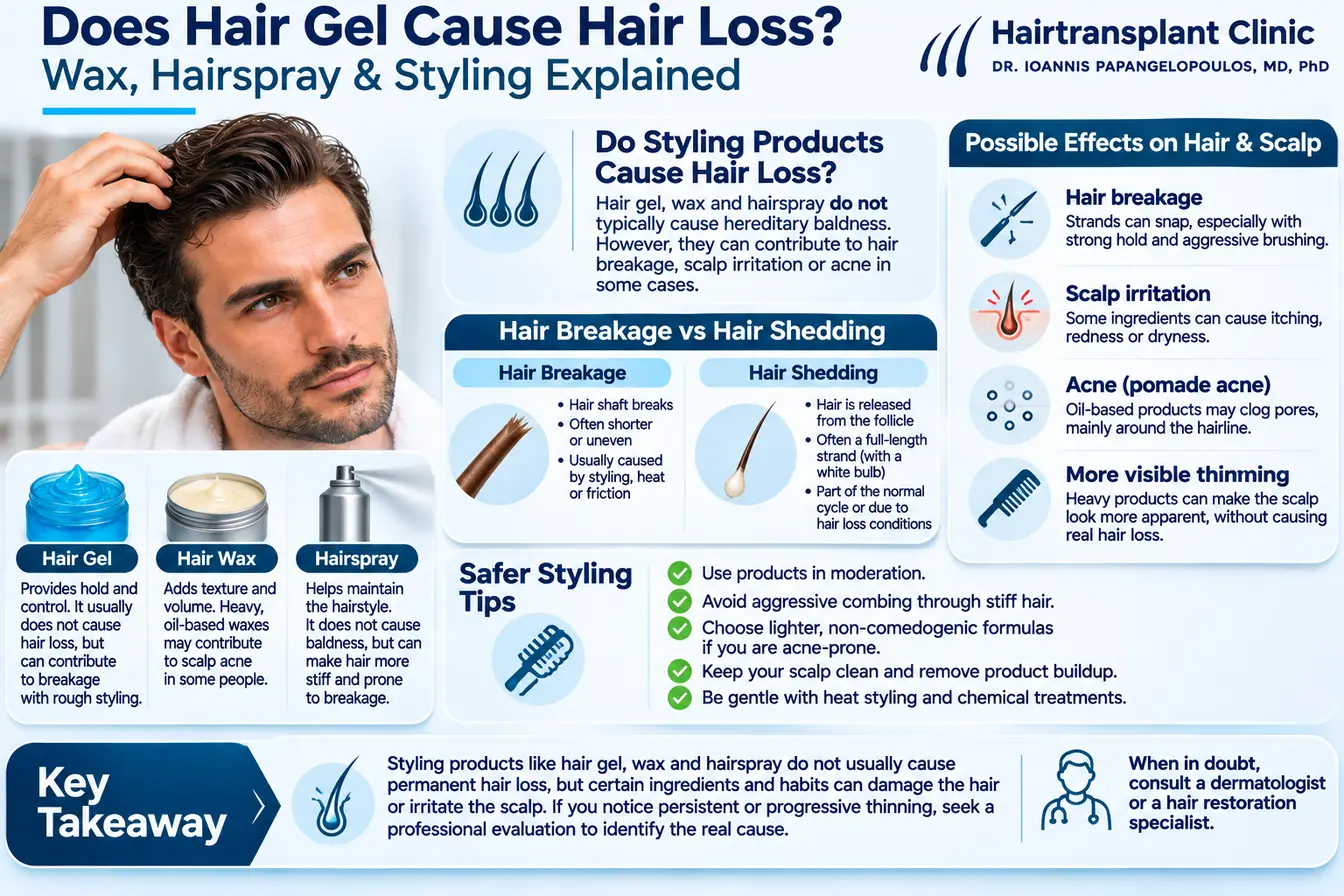
Does Hair Gel Cause Hair Loss? Wax, Hairspray & Styling Explained
You apply hair gel in the morning, style your hair and leave for work. Later, when you run your fingers through your hair, you notice several loose strands.
The next morning, you see more hair in the shower.
Naturally, you begin to wonder: Could the gel be making your hair fall out?
Similar concerns arise with hair wax, hairspray, pomades and other styling products. Many people worry that daily styling will clog their follicles, weaken their roots or eventually cause baldness.
The answer is more complicated than a simple yes or no.
Ordinary hair gel, wax and hairspray have not been shown to cause hereditary pattern baldness simply through normal use. However, certain products and styling habits can contribute to hair breakage, scalp irritation or skin problems.
Understanding the difference between damaged hair and genuine follicular hair loss is essential.
Does Hair Gel Cause Hair Loss?
In most cases, hair gel itself is not responsible for permanent hair loss.
Hair gel is designed primarily to change the way existing hair behaves. It can provide hold, control movement and help maintain a hairstyle.
It generally acts on the hair shaft, which is the visible part of the hair above the scalp.
The living follicle responsible for producing hair is located within the skin.
These are different structures.
Hair Gel Does Not Change Your Genetic Predisposition
Androgenetic alopecia, also known as male or female pattern hair loss, involves genetic susceptibility and the effects of androgen signalling on hair follicles.
Over time, susceptible follicles may become smaller and produce progressively finer hairs.
This process is known as follicular miniaturisation.
There is no convincing evidence that ordinary hair gel directly creates this genetic susceptibility.
Applying a suitable styling product does not automatically cause a healthy follicle to begin miniaturising.
However, someone can use hair gel every day while independently developing androgenetic alopecia.
When thinning becomes noticeable, the styling product may be blamed simply because it is part of the person’s daily routine.
For more information about hereditary thinning, read our guide to male hair loss and its treatment options.
Hair Breakage vs Hair Shedding: What Is the Difference?
Before deciding whether a styling product is responsible, it helps to distinguish two processes that may look similar.
Hair Breakage
Hair breakage occurs when the hair shaft fractures along its length.
The follicle may remain completely capable of producing new hair.
Broken strands can appear shorter than the surrounding hair.
They may also have irregular ends or contribute to a rough, frizzy appearance.
Excessive heat, chemical processing, aggressive brushing and mechanical tension can increase the risk of breakage.
Hair Shedding
Hair shedding occurs when a hair is released from its follicle as part of the hair-growth cycle or a hair-loss condition.
A naturally shed hair may have a small, pale, club-shaped structure at one end.
This does not mean that the living follicle has fallen out.
Our article on the white bulb on fallen hair explains why this structure can appear during normal shedding.
How Can You Tell the Difference?
| Feature | Hair Breakage | Hair Shedding |
|---|---|---|
| What happens? | Hair shaft breaks | Hair is released from the follicle |
| Typical strand appearance | Often shorter or uneven | May be a full-length strand |
| Possible causes | Styling damage, heat, friction | Normal cycle, telogen effluvium, alopecia |
| Follicle necessarily damaged? | No | No |
| Requires the same treatment? | Not necessarily | Not necessarily |
These observations can provide clues, but they are not reliable enough to establish a medical diagnosis on their own.
Hair breakage and genuine hair shedding may occur simultaneously.
Can Strong-Hold Hair Gel Damage Your Hair?
Yes, particularly when it is combined with aggressive styling.
Strong-hold gels are designed to keep hair in place.
As the product dries, the strands may become relatively stiff.
This is useful for maintaining a hairstyle, but it can create problems if someone repeatedly tries to comb through the hardened hair.
Imagine applying gel in the morning and allowing it to dry.
Several hours later, you decide to change your hairstyle.
Instead of softening the product, you pull a comb through the rigid strands.
The resulting mechanical stress may cause some hairs to break.
The American Academy of Dermatology specifically advises limiting long-lasting hold products when subsequent combing could damage the hair.
Does That Mean Strong-Hold Gel Is Dangerous?
Not necessarily.
The risk depends on how the product is used, the condition of the hair and the amount of mechanical stress applied.
Someone who styles their hair gently and leaves it in place may experience no meaningful problems.
A person who repeatedly pulls through stiffened hair may be more likely to experience breakage.
The important factor is not simply the presence of gel.
It is the combination of product properties and styling behaviour.
Does Hair Wax Cause Hair Loss?
Hair wax is another product frequently blamed for thinning.
Waxes and pomades commonly contain ingredients that create texture, separation, shine or hold.
Some formulations are relatively lightweight.
Others are heavier and may cause individual strands to clump together.
This can change the apparent density of the hair.
Why Does Hair Wax Make My Scalp More Visible?
Imagine someone with relatively fine hair applying a heavy, glossy wax.
Before styling, the individual hairs are spread across the scalp.
After applying the wax, several strands group together.
The spaces between these groups become more noticeable.
Under bright lighting, this may make the scalp appear significantly more visible.
However, the actual number of follicles has not suddenly changed.
The product has altered how the existing hair is distributed.
This effect may be particularly noticeable around the crown, temples or central parting.
It can also make an existing hair-loss condition easier to see.
If you have noticed progressive changes rather than a temporary difference caused by styling, our guide to early hair thinning explains which signs deserve attention.
Can Hair Wax Clog Hair Follicles?
This is a common misconception.
People sometimes describe heavy styling products as blocking the roots and preventing hair from breathing.
However, hair follicles do not rely on direct exposure to outside air for their oxygen supply.
Living follicular cells receive oxygen and nutrients through the surrounding tissues and blood circulation.
A layer of wax on the scalp does not automatically suffocate the follicles or cause hereditary baldness.
That does not mean every oily product is harmless.
Hair Wax and Pomade Acne
Certain oil-containing hair products can contribute to clogged pores and acne, especially around the hairline.
This is sometimes described as pomade acne or acne cosmetica.
Small bumps may appear on the forehead, temples or back of the neck.
The products responsible can include pomades, waxes, gels and other formulations that leave oily residue.
This is a different condition from androgenetic alopecia.
A person developing acne after using a new wax should not automatically conclude that their hair follicles are permanently damaged.
How Can You Reduce the Risk?
If you notice small bumps after introducing a styling product, consider whether the timing is related.
A lighter formulation labelled oil-free or non-comedogenic may be helpful for some individuals.
Avoid applying excessive product directly to acne-prone skin.
Also clean pillowcases and other fabrics that may accumulate residue.
Persistent or painful scalp bumps require medical assessment because not every eruption around the follicles is ordinary acne.
Does Hairspray Cause Hair Loss?
Hairspray is designed to help maintain a hairstyle by coating the hair with substances that provide hold.
There is insufficient evidence that ordinary use of hairspray directly causes androgenetic alopecia.
However, hairspray may contribute to problems under certain circumstances.
Mechanical Damage
Strong-hold hairspray can make hair less flexible.
Repeated aggressive brushing through stiffened strands may contribute to breakage.
This is particularly relevant if the hair is already weakened by bleaching, colouring or excessive heat.
Scalp Irritation
Some hairsprays contain ingredients that may irritate sensitive skin.
The possibility depends on the formulation and individual sensitivity.
A person may develop itching, dryness or redness after exposure to a particular product.
However, it would be inaccurate to assume that every hairspray containing alcohol or fragrance inevitably causes hair loss.
The relevant issue is whether the individual experiences a reaction to that specific product.
Does Hairspray Make Thinning Hair Worse?
It can sometimes make existing thinning more noticeable.
For example, a shiny or heavily fixed hairstyle may expose more scalp than a softer style.
This is a cosmetic difference rather than proof of additional follicular loss.
Can Styling Products Cause an Allergic Scalp Reaction?
Yes.
Hair gels, waxes, sprays and other cosmetic products may contain fragrances, preservatives and other ingredients capable of triggering reactions in susceptible individuals.
These reactions generally fall into two categories.
Irritant Contact Dermatitis
Irritant contact dermatitis occurs when an ingredient or repeated exposure damages the skin barrier.
Symptoms may include:
- Dryness
- Redness
- Burning
- Itching
- Scaling
- Sensitivity
Not every episode of scalp irritation is an allergy.
Sometimes the problem is caused by the irritating effects of a formulation or excessive cleansing.
Allergic Contact Dermatitis
Allergic contact dermatitis involves an immune response to a particular substance.
A person may develop sensitivity after repeated exposure.
This means that a product previously tolerated without difficulty can sometimes cause symptoms later.
The reaction may affect the scalp, hairline, forehead, neck or areas behind the ears.
If symptoms persist or repeatedly return after using a product, a dermatologist may recommend patch testing to identify the responsible allergen.
Can Dermatitis Cause Permanent Hair Loss?
Mild irritation does not automatically result in permanent follicular destruction.
However, significant scalp inflammation should not be ignored.
Some inflammatory scalp disorders can damage follicles, especially when scarring alopecia is present.
Persistent redness, pain, pustules, crusting or focal hair loss requires an appropriate diagnosis.
A person should not simply assume that all these symptoms are caused by ordinary hair gel.
Does Using Hair Gel Every Day Increase the Risk of Baldness?
Daily use does not automatically mean that permanent hair loss will occur.
There is no established rule stating that using hair gel a particular number of times per week causes androgenetic alopecia.
The relevant factors include:
- The specific product
- The quantity applied
- How the hair is styled
- Whether the product causes irritation
- How frequently the hair is washed
- Whether aggressive brushing or traction is involved
- The condition of the hair shaft
For example, a person using a modest amount of lightweight gel and styling gently may experience no problems.
Another person may combine strong-hold gel, daily heat styling and repeated aggressive brushing.
The second routine creates more opportunities for mechanical damage.
The difference is the overall hair-care behaviour, not simply whether a styling product is used daily.
Should You Wash Your Hair Every Day if You Use Gel or Wax?
There is no universal washing schedule suitable for every person.
Hair texture, scalp oil production, sweating, product accumulation and skin conditions all influence the appropriate frequency.
Someone who uses large amounts of heavy wax may need a different cleansing routine from someone who applies a small amount of lightweight gel.
The aim is to remove unwanted residue without causing unnecessary dryness or irritation.
Can Washing Remove Product Buildup?
Yes.
An appropriate shampoo can help remove styling products, sebum and accumulated residue.
However, using a harsh cleansing product every day is not automatically better.
Excessive cleansing may irritate certain scalps or dry out already fragile hair.
The most appropriate routine balances cleanliness with scalp comfort.
Does Washing Cause More Hair to Fall Out?
Hair washing can release strands that were already approaching the shedding phase.
Seeing hairs during washing does not necessarily mean the shampoo caused them to detach prematurely.
The overall shedding pattern and changes in density are more informative than one wash.
If you notice increasingly heavy shedding over several weeks, a medical evaluation may be appropriate.
Can Sleeping With Gel or Wax Cause Hair Loss?
Sleeping with styling product in your hair has not been established as an independent cause of permanent pattern baldness.
However, it may contribute to practical hair-care problems.
Products can accumulate on the hair and pillowcase.
Stiffened strands may also experience friction during sleep.
For someone who already has fragile or chemically damaged hair, this additional friction may increase the risk of breakage.
Heavy, oily products can also transfer onto the forehead or pillowcase and potentially contribute to acne in susceptible individuals.
There is no need to panic if you occasionally sleep with a styling product.
However, avoiding excessive buildup and following a gentle cleansing routine is sensible.
What About Using Hair Gel With a Hair Dryer or Straightener?
Several sources of damage can occur together.
For example, someone may regularly use hair gel, a hot hair dryer and a straightening iron.
They may also pull the hair tightly with a brush to achieve a particular hairstyle.
Each part of the routine can contribute to mechanical or thermal stress.
Excessive heat can weaken the hair shaft.
Repeated pulling can increase breakage.
Chemical treatments and bleaching may make the hair more vulnerable.
A styling product is not necessarily the primary cause, but it may be part of a routine that places considerable stress on the hair.
Tips for Reducing Damage
Allow hair to dry partially before using heat.
Use lower temperature settings when appropriate.
Avoid pulling aggressively with brushes or combs.
Do not repeatedly comb through hair that has hardened with strong-hold products.
Use a suitable conditioner to reduce tangling and friction.
For tightly curled or textured hair, detangling while damp with an appropriate conditioner may reduce breakage compared with aggressive dry brushing.
These measures help protect existing hair shafts.
They do not, however, cure hereditary alopecia.
Are Natural or Alcohol-Free Styling Products Always Safer?
Not necessarily.
The word natural is not a guarantee that a product cannot irritate the skin.
Botanical extracts, essential oils and fragrances can also cause allergic reactions.
Similarly, alcohol-free products are not automatically suitable for everyone.
Different ingredients serve different purposes, and their effects depend on the formulation and concentration.
A product that works well for one person may not be appropriate for another.
What Should You Look for?
Choose products based on your hair characteristics and scalp condition.
If you have acne-prone skin, consider products designed to minimise pore blockage.
If you have sensitive skin, avoiding a known irritant or allergen is more useful than relying on a broad marketing claim.
When a persistent reaction occurs, identifying the responsible ingredient matters more than assuming that all cosmetic products are harmful.
Can Hair Gel Cause Hairline Recession?
Hairline recession usually requires a different explanation from ordinary styling-product use.
In men, progressive recession at the temples is commonly associated with androgenetic alopecia.
The underlying process involves susceptible follicles gradually producing finer hairs.
A person may notice these changes while using gel daily, but that does not establish a causal relationship.
Can Styling Habits Contribute to Hairline Damage?
Yes, especially when a hairstyle repeatedly pulls on the same follicles.
Very tight hairstyles may create mechanical tension, potentially contributing to traction alopecia.
This is different from applying gel without significant tension.
The concern is the repeated pulling force, not simply the presence of styling product.
What if Your Hairline Is Receding?
If the temples continue to move backward or the hair behind the hairline becomes progressively finer, a dermatological assessment is more useful than repeatedly changing styling products.
Women may also experience progressive thinning due to female pattern hair loss and other conditions.
Our guide to female hair loss and its causes explains why the diagnosis can differ between patients.
Can Hair Gel Be Used After a Hair Transplant?
This requires particular care.
After hair transplantation, the recipient area contains newly implanted grafts and the scalp is undergoing healing.
During early recovery, the skin may be sensitive, and the grafts require protection from unnecessary friction and pressure.
Applying gel, wax or hairspray too soon may create avoidable problems.
Why Should You Avoid Unapproved Products?
Certain formulations may irritate healing skin.
Applying a styling product may require touching, rubbing or manipulating the recipient area.
Removing the product may also involve washing or combing movements that are inappropriate during early healing.
For these reasons, styling products should only be resumed according to the treating surgeon’s instructions.
When Can You Start Using Hair Gel Again?
There is no universal day that is appropriate for every patient.
The timing depends on the healing process, the extent of surgery, the product and the surgeon’s postoperative protocol.
Do not assume that a recommendation found online applies to your own procedure.
Patients who have undergone FUE hair transplantation should follow their surgical team’s specific aftercare instructions before reintroducing styling products.
When Is Hair Loss Not Caused by Styling Products?
A person can experience genuine alopecia while also using gel, wax or hairspray.
This distinction is important because changing cosmetic products will not necessarily address the underlying disorder.
Several findings suggest that another explanation should be considered.
Progressive Thinning at the Crown
If the crown gradually becomes less dense, androgenetic alopecia may be a possible cause.
A natural hair whorl can also make the scalp visible, so the pattern and progression matter.
Receding Temples
Progressive temple recession accompanied by finer hairs may indicate pattern hair loss.
This should not automatically be attributed to daily gel use.
Sudden Excessive Shedding
A sudden increase in shedding can occur with telogen effluvium or other conditions.
Relevant triggers may include illness, medication changes, major physiological stress or nutritional problems.
A Clearly Defined Bald Patch
A relatively sudden patch of hair loss may be associated with alopecia areata or another condition.
This requires a different assessment from ordinary hair breakage.
Persistent Scalp Inflammation
Pain, redness, pustules, crusting or significant scaling can indicate a scalp disorder requiring medical evaluation.
Do not assume that all symptoms are minor reactions to styling products.
Our overview of alopecia, its causes and available treatments explains why identifying the specific condition is essential.
How Does a Dermatologist Determine the Cause of Hair Loss?
The evaluation starts with a medical history and examination of the hair and scalp.
The dermatologist may ask when the problem began, whether the shedding is sudden or gradual, and which styling products or treatments are being used.
The examination considers hair density, shaft characteristics and the condition of the scalp.
If product-related irritation is suspected, the doctor may review the ingredients and consider additional tests.
When hereditary thinning is suspected, trichoscopy can help assess follicular miniaturisation.
If there are signs of another underlying disorder, further investigations may be appropriate.
The aim is to distinguish hair-shaft damage from actual follicular hair loss.
These conditions do not necessarily require the same treatment.
Does Hair Breakage Require a Hair Transplant?
No.
Hair transplantation is not a treatment for ordinary hair-shaft breakage caused by aggressive styling.
If the follicles remain healthy, improving the hair-care routine may be more appropriate than considering surgery.
Hair transplantation may be discussed in selected patients with established hair loss, suitable donor follicles and realistic long-term goals.
Even then, the underlying cause must first be established.
At Hairtransplant Clinic in Athens, Dr. Ioannis Papangelopoulos, MD, PhD, personally performs hair transplant procedures following an individual medical assessment.
The objective is to determine whether surgical restoration is appropriate, rather than treating every cosmetic concern with a procedure.
Frequently Asked Questions About Hair Gel and Hair Loss
Does hair gel cause permanent baldness?
Ordinary hair gel has not been shown to directly cause hereditary pattern baldness through normal use. However, aggressive styling, mechanical damage and product-related scalp irritation may contribute to other hair or skin problems.
Can using gel every day make your hair thinner?
Daily use does not automatically reduce follicular density. However, repeated aggressive combing through hardened gel may contribute to breakage, making the hair appear thinner.
Is hair wax worse than hair gel?
Neither is universally worse. Different formulations have different properties. Heavy, oily products may contribute to acne in susceptible individuals, while strong-hold products can increase breakage risk when used with aggressive styling.
Does hairspray damage hair follicles?
Normal hairspray use has not been established as a direct cause of hereditary follicular miniaturisation. However, some products may irritate the scalp, and strong-hold styling combined with brushing can contribute to hair-shaft damage.
Can hair wax clog pores and cause hair loss?
Certain oily formulations can contribute to acne along the hairline. This does not mean the product automatically destroys follicles or causes permanent baldness.
Will my hair grow back if I stop using gel?
If the main problem is hair-shaft breakage, improving styling habits may allow new hair to grow without the same damage. However, stopping gel will not necessarily reverse androgenetic alopecia or other medical conditions.
Should I wash my hair every night after using wax?
There is no universal requirement. Washing frequency should reflect product buildup, scalp oiliness, hair type and irritation. The goal is appropriate cleansing without excessive damage.
Does sleeping with hairspray cause hair loss?
Sleeping with hairspray has not been established as a direct cause of permanent pattern baldness. However, friction involving stiffened or fragile strands may contribute to breakage.
Is alcohol-free hair gel better for thinning hair?
Not automatically. Suitability depends on the complete formulation, scalp sensitivity and the condition of the hair. Alcohol-free products can still contain ingredients that irritate some individuals.
Can hair gel cause itching and dandruff?
Some styling products can irritate the scalp or cause contact dermatitis. However, persistent flaking may have other causes, including seborrhoeic dermatitis. An accurate diagnosis is important.
Is it safe to use styling products after FUE?
Styling products should only be resumed when the treating surgeon confirms that the scalp has healed sufficiently. There is no single universally appropriate waiting period.
When should I see a dermatologist?
Seek assessment if your hairline is progressively receding, overall density is decreasing, shedding is unusually heavy, or you develop bald patches, persistent itching, pain or scalp inflammation.
Final Thoughts: Hair Gel Is Not Usually the Cause of Baldness
Hair gel, wax and hairspray are everyday cosmetic products.
Their main purpose is to change the appearance and behaviour of existing hair, not to alter the genetic processes responsible for hereditary pattern baldness.
However, the way these products are used matters.
Strong-hold styling combined with aggressive brushing can damage hair shafts.
Certain formulations may irritate sensitive skin or contribute to acne around the hairline.
Heavy products can also change the way hair separates, making existing thinning appear more noticeable.
The important distinction is between temporary cosmetic changes, hair breakage and genuine hair loss.
If your hair density continues to decrease despite changing your styling routine, the next step should be an accurate medical diagnosis.
For an individual assessment of progressive thinning or hair loss, you can contact Hairtransplant Clinic to discuss your concerns and appropriate treatment options.
You do not necessarily need to stop styling your hair. You need to understand whether the problem involves the hair shaft, the scalp or the follicle itself.
Medical References
- American Academy of Dermatology – Hair Styling Without Damage
- American Academy of Dermatology – How to Stop Damaging Your Hair
- American Academy of Dermatology – Are Your Hair Care Products Causing Breakouts?
- American Academy of Dermatology – Hair Loss: Diagnosis and Treatment
- DermNet – Shampoos and Hair Care Product Reactions