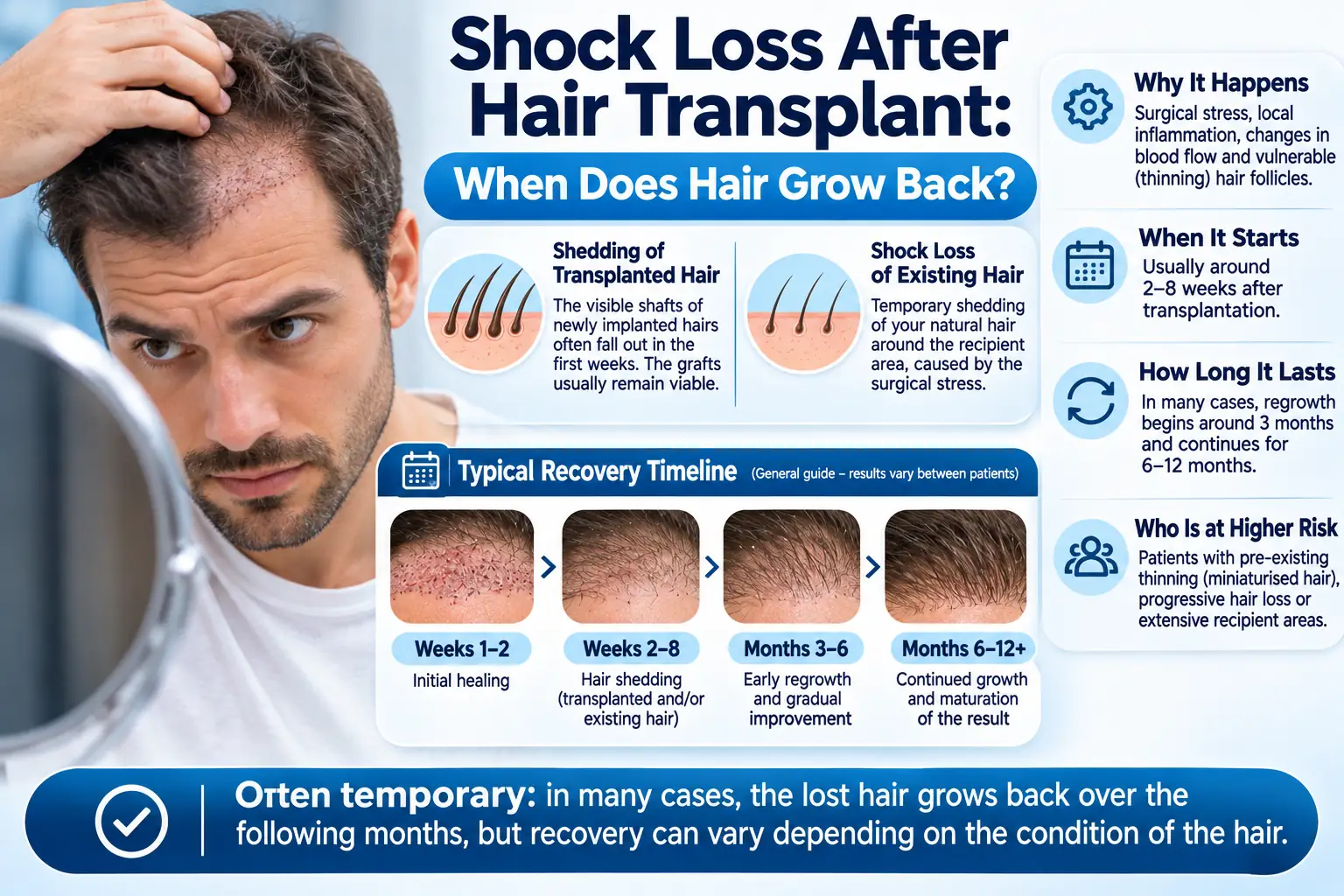
Shock Loss After Hair Transplant: When Does Hair Grow Back?
You have finally undergone a hair transplant. During the first days, you can see the newly implanted hairs along your hairline, and everything appears to be progressing as expected.
Then, a few weeks later, something worrying happens.
The transplanted hairs begin falling out. Your scalp looks thinner, and you may even notice that some of your original hair has disappeared.
Naturally, you start wondering: Is shock loss after a hair transplant normal? Have the grafts failed? Will the lost hair grow back?
The reassuring answer is that postoperative hair shedding is often temporary. However, not all hair loss following transplantation has the same cause, and recovery cannot be guaranteed in every situation.
A particularly important distinction exists between the expected shedding of transplanted hair shafts and shock loss affecting the patient’s original, non-transplanted hair.
Understanding this difference can help you recognise what may be part of normal recovery and when further medical assessment is appropriate.
In this guide, we explain what hair transplant shock loss is, why it happens, when it usually begins, how long recovery may take, and what you should know about protecting your existing hair.
What Is Shock Loss After a Hair Transplant?
Shock loss is a term used to describe hair shedding that can occur following hair transplantation because of the physiological stress and local effects of surgery.
In its more specific medical meaning, shock loss refers to temporary shedding of existing native hair in or near the surgical area, rather than the simple loss of the visible shafts of newly transplanted hairs.
The medical literature often refers to this process as postoperative effluvium or recipient-site effluvium.
The follicles may temporarily stop producing visible hair while their normal growth cycle is disrupted.
In many cases, these follicles remain viable and begin producing hair again after a period of recovery.
However, the outcome depends partly on the health of the affected follicles before surgery.
Hair that was already significantly weakened by androgenetic alopecia may not always recover fully.
This is why postoperative shedding should be evaluated in the context of the patient’s existing hair loss rather than automatically classified as harmless.
Shock Loss vs Transplanted Hair Shedding: An Important Difference
One of the most common sources of confusion is the assumption that all hair falling out after surgery represents the same phenomenon.
In reality, there are three different situations to understand.
1. Shedding of Transplanted Hair Shafts
Following transplantation, some of the newly implanted hair shafts may shed during the first several weeks.
This happens because the follicles undergo a biological adjustment after surgery.
The visible portion of the hair can fall out while the transplanted follicle remains beneath the scalp.
After a resting period, viable follicles may begin producing new hair.
This type of shedding is common and does not automatically mean that the operation has failed.
However, shedding alone cannot confirm whether every implanted follicle has survived.
2. Shock Loss of Existing Natural Hair
This is the more specific form of postoperative shock loss.
Hair that was growing naturally in or around the recipient area begins shedding after surgery.
The process may affect hairs that were relatively healthy before transplantation as well as follicles that were already miniaturised.
Temporary disruption of the hair growth cycle is one possible explanation.
When follicles remain healthy and viable, regrowth is generally expected.
When follicles were already severely affected by hereditary hair loss, complete recovery may be less predictable.
3. Hair Shedding in the Donor Area
Shock loss can also occur in the donor region, usually at the back or sides of the scalp.
This is often called donor-site effluvium.
It involves temporary shedding of hair remaining around or within the harvesting area.
It is different from the permanent reduction in density that occurs when follicles are surgically removed.
Distinguishing between donor shock loss, excessive harvesting and other forms of alopecia is essential when the donor region appears unexpectedly thin.
Why Does Shock Loss Happen?
Hair follicles operate through a repeating biological cycle.
Each follicle moves through several stages of growth, transition, rest and shedding.
Hair transplantation can temporarily disrupt this cycle.
Surgical Trauma
Even carefully performed transplantation involves creating small surgical wounds.
Follicles in the surrounding tissue may be affected by the local response to surgery.
The resulting stress can temporarily interrupt normal hair growth.
Local Inflammation
Inflammation is part of the body’s response to tissue injury.
A limited inflammatory reaction is expected during healing.
However, the local environment around neighbouring follicles may temporarily change as the scalp recovers.
Changes in Local Blood Flow
Hair follicles depend on an adequate blood supply.
Surgical manipulation, local swelling and temporary changes in microcirculation may contribute to postoperative shedding.
This does not mean that shock loss always indicates permanent damage to the blood supply.
Pre-existing Follicle Miniaturisation
One of the most important contributing factors is the condition of the patient’s natural hair before surgery.
In androgenetic alopecia, susceptible follicles gradually produce finer and shorter hairs.
These miniaturised follicles may be more vulnerable to surgical stress than strong, healthy follicles.
Consequently, a patient with significant existing thinning may experience more noticeable postoperative shedding.
Surgical Planning and Implantation Density
The way recipient sites are created also matters.
Implanting new grafts between existing hairs requires careful assessment of follicle position, direction and density.
Excessive tissue trauma or inappropriate implantation strategies may increase the risk of injury to neighbouring follicles.
For this reason, hair transplant planning should take existing hair density into account rather than focusing exclusively on the number of grafts implanted.
When Does Shock Loss Start After a Hair Transplant?
Shock loss does not usually become visible immediately after surgery.
It often appears after the scalp has already begun healing.
A 2026 medical review published in Frontiers in Medicine describes recipient-site shock loss as typically developing approximately 2–8 weeks after transplantation.
Donor-site effluvium may become apparent around 2–4 weeks after surgery.
These are general clinical observations, not fixed deadlines.
Some patients notice relatively early shedding, while others experience changes later.
The amount of hair affected can also vary considerably.
Can Shock Loss Start After Two Weeks?
Yes.
Two weeks is within the reported period when postoperative shedding may begin.
However, shedding at this stage can involve transplanted hair shafts, neighbouring natural hair or both.
The location and appearance of thinning help the physician determine what is happening.
Can Shock Loss Start After One Month?
Yes.
The first month is a common period for patients to become aware of postoperative shedding.
The scalp may look less dense than it did immediately after transplantation.
This change can be particularly noticeable when transplanted shafts have shed before new growth begins.
Can Shock Loss Begin After Three Months?
Hair loss first appearing after three months should not automatically be attributed to ordinary postoperative shock loss.
Although recovery patterns vary, a new or progressively worsening problem may require evaluation for other causes.
These include ongoing androgenetic alopecia, telogen effluvium from another trigger, inflammatory scalp disease or other medical conditions.
How Long Does Shock Loss Last?
There is no single recovery period that applies to every patient.
The duration depends on which hairs are affected, their condition before surgery and individual healing characteristics.
In cases of temporary recipient-site shock loss, new growth may begin becoming noticeable around the third postoperative month.
Donor-site effluvium often improves over several months, with medical literature describing recovery in many cases within approximately three to six months.
However, visible restoration of hair density may take longer because newly growing hairs need time to gain length.
A patient may therefore have viable follicles that are producing new hair without yet seeing a significant cosmetic improvement.
Hair Transplant Shock Loss Recovery Timeline
Weeks 1–2: Initial healing
The scalp begins recovering from surgery. Redness, small crusts, temporary swelling and sensitivity may occur.
The patient should follow the surgical team’s postoperative instructions.
Weeks 2–4: Early shedding
The shedding of transplanted hair shafts may become noticeable.
Some patients may also begin losing native hairs close to the recipient area.
This can make the scalp appear thinner.
Weeks 4–8: More noticeable hair loss
Postoperative shedding may continue.
Patients can become concerned because the hairline or crown may temporarily appear less dense than expected.
The amount of shedding does not reliably predict the final transplant result.
Months 3–4: Early regrowth
Viable follicles affected by temporary shock loss may begin producing visible hair again.
New growth may initially be fine, short or uneven.
Months 4–6: Gradual improvement
Hair coverage may become more noticeable as follicles return to active growth.
Some patients see substantial improvement, while others require additional time.
Months 6–9: Further maturation
The appearance of the hair can continue changing as transplanted and recovering native follicles produce longer hairs.
Persistent areas of thinning may require reassessment.
Months 9–12 and beyond: Long-term evaluation
The surgeon can assess whether the expected degree of regrowth has developed.
The overall cosmetic result may continue maturing, particularly in areas such as the crown.
The exact assessment period depends on the individual procedure and the patient’s hair characteristics.
Does Shock Loss Mean the Hair Transplant Failed?
No. Shock loss does not automatically mean that a hair transplant has failed.
This is an essential distinction.
The appearance of the scalp during the first few months is not a reliable indicator of the final outcome.
A patient may experience temporary shedding and later develop satisfactory growth.
However, it is equally important not to promise that every patient experiencing shock loss will recover all the hair that was lost.
Several factors can influence the final result:
- The health of the affected native follicles.
- The degree of miniaturisation before surgery.
- Whether the follicles were temporarily disrupted or permanently damaged.
- The progression of hereditary hair loss.
- The quality of graft harvesting and implantation.
- The development of postoperative complications.
The surgeon should evaluate these factors before drawing conclusions about graft survival or the need for further treatment.
Is Shock Loss Permanent?
For many patients, shock loss is temporary.
However, permanent or incomplete recovery can occur in certain circumstances.
The distinction is especially important when the shedding affects natural hair that was already thinning before surgery.
Temporary Shock Loss
Temporary shock loss occurs when viable follicles stop producing visible hair for a period but later resume growth.
The follicular structures remain capable of generating new hair.
Regrowth commonly develops gradually rather than appearing all at once.
Permanent Loss of Miniaturised Hair
In androgenetic alopecia, some follicles are already producing very fine hairs and may be approaching advanced stages of miniaturisation.
Surgical stress can be followed by shedding of these weakened hairs.
In certain cases, they may not return to their previous visible density.
This does not necessarily mean that the surgeon physically destroyed those follicles.
Their underlying susceptibility to progressive hair loss may have contributed to the outcome.
Permanent Injury to Existing Follicles
Permanent damage can also occur if existing follicles are directly injured during surgery.
This is different from temporary shock loss.
Such injury may be associated with inappropriate placement of recipient sites or other surgical trauma.
Careful patient selection, planning and technique are therefore important.
Who Is More Likely to Experience Shock Loss?
Not every patient has the same risk.
Several characteristics may increase the likelihood of noticeable postoperative shedding.
Patients With Existing Thin Hair
When a recipient area still contains many miniaturised hairs, those follicles may be particularly vulnerable to temporary disruption.
This is relevant to patients undergoing transplantation to increase density between existing hairs.
The surgeon should examine the recipient area before deciding how closely new grafts can be placed.
Patients With Progressive Androgenetic Alopecia
Hair loss can continue independently of transplantation.
Patients with rapidly progressing androgenetic alopecia may experience both postoperative shedding and ongoing natural thinning.
This can make it difficult to determine how much of the observed hair loss is directly associated with surgery.
Women With Diffuse Hair Thinning
Women undergoing hair transplantation may have significant native hair remaining throughout the recipient area.
In female pattern hair loss, diffuse thinning can make postoperative shock loss more noticeable.
Published research has identified female sex as a risk factor in certain recipient-site shock-loss studies.
However, individual risk cannot be determined by sex alone.
Patients Undergoing Extensive Restoration
Procedures involving larger recipient areas or implantation among substantial amounts of existing hair may present additional planning challenges.
The degree of tissue manipulation and the distribution of recipient sites can influence the risk of postoperative effects.
Nevertheless, the number of implanted grafts alone does not determine whether shock loss will occur.
Shock Loss After FUE: What Should You Expect?
FUE, or Follicular Unit Excision, involves individually harvesting follicular units from the donor area.
The grafts are then implanted into the recipient region.
Shock loss after FUE may affect the existing hair around the implanted grafts.
In some cases, the donor area may also experience temporary shedding.
The appearance of thinning in these two regions has different possible explanations.
Recipient Area After FUE
Temporary shedding can occur around the newly implanted grafts.
The severity may depend on the condition of the original hair and the extent of surgical manipulation.
Patients with miniaturised surrounding follicles may have a less predictable recovery.
Donor Area After FUE
Some patients notice patchy thinning in the donor region several weeks after surgery.
This may represent temporary donor-site effluvium.
However, persistent donor thinning can also result from excessive harvesting.
These conditions should not be treated as identical.
A medical assessment may be required to distinguish temporary postoperative shedding from permanent donor depletion.
For further details about the technique, explore FUE Hair Transplant.
Shock Loss After FUT: Is It Different?
FUT involves removing a strip of hair-bearing tissue from the donor region.
The resulting follicular-unit grafts are then prepared and implanted into the recipient area.
As with FUE, postoperative shedding may affect existing hair around the implantation sites.
FUT also creates a donor incision, which introduces different healing considerations.
Temporary shedding near a donor incision may occur, although the appearance must be distinguished from scarring or other postoperative changes.
Neither technique can guarantee that shock loss will never occur.
The appropriate harvesting method should be selected according to the patient’s donor characteristics, hair loss pattern and long-term restoration plan.
Can Shock Loss Affect the Donor Area?
Yes, although donor-site shock loss is less frequently described than recipient-site shedding.
The donor region may develop temporary thinning several weeks after follicular extraction.
A medical review published in February 2026 describes donor-site effluvium as often appearing around two to four weeks after surgery, with recovery commonly occurring over the following three to six months.
The available evidence remains limited, and the true frequency is uncertain.
How Is Donor Shock Loss Different From Overharvesting?
This distinction is crucial.
Donor shock loss involves temporary shedding from follicles that remain in the donor region.
Overharvesting involves excessive removal of follicular units, creating a potentially lasting reduction in donor density.
A donor region that looks thin immediately after surgery cannot be diagnosed accurately from a photograph alone.
The physician may need to examine the extraction pattern, remaining follicular density and signs of new growth.
For further information, read Hair Transplant Donor Area: What You Need to Know.
How Can You Tell Whether Hair Is Growing Back?
Patients frequently examine their hairline or crown in the mirror, searching for signs that recovery has begun.
However, daily visual inspection is not a reliable method of determining follicular recovery.
Hair grows slowly, and changes in lighting, hair length or camera angle can create misleading impressions.
Signs That May Suggest Regrowth
New hair growth may appear as:
- Short hairs emerging in previously thinned areas.
- Fine hairs that gradually increase in length.
- Improved coverage over several months.
- Reduced visibility of the scalp under comparable conditions.
These changes can be encouraging, but they do not establish the survival of every follicle.
Why Trichoscopy Can Be Helpful
Trichoscopy allows a physician to examine the scalp and hair follicles under magnification.
It may help identify short regrowing hairs, differences in hair-shaft thickness and signs of miniaturisation.
The examination can also help distinguish temporary postoperative shedding from other forms of hair loss.
In selected cases, the physician may recommend additional tests if the pattern of shedding is unusual or persistent.
Should You Take Progress Photographs?
Yes, when recommended by your treating clinic.
Photographs can help document changes over time.
For meaningful comparisons, try to maintain similar lighting, camera distance, hair length and positioning.
A photograph taken under harsh overhead lighting should not be compared directly with one taken under soft light.
Monthly assessments are generally more informative than repeatedly comparing photographs taken a few days apart.
Can Shock Loss Be Prevented?
Shock loss cannot be completely prevented in every patient.
However, careful medical assessment and surgical planning can help address potentially modifiable risk factors.
Assess Existing Hair Before Surgery
The surgeon should evaluate whether the planned recipient area contains healthy or severely miniaturised hair.
This helps establish how much restoration is appropriate and how the existing follicles should be protected.
Avoid Unnecessary Surgical Trauma
Precise recipient-site planning and careful implantation are important, particularly when new grafts are placed between existing hairs.
The goal is to minimise unnecessary injury while achieving a realistic distribution of grafts.
Consider the Progression of Hair Loss
A patient experiencing rapidly progressive androgenetic alopecia may require medical management or further monitoring before surgery.
Proceeding without considering future thinning can lead to disappointing long-term coverage.
Follow the Postoperative Instructions
Appropriate scalp care supports normal healing.
Patients should avoid unnecessary pressure, friction, scratching and unapproved products during the initial postoperative period.
However, good aftercare does not guarantee that shock loss will not occur.
Does Minoxidil Help With Shock Loss?
Minoxidil is a medication used in the management of certain forms of hair loss.
Some medical literature suggests that it may help support or accelerate regrowth in selected patients experiencing postoperative shedding.
However, it should not be presented as a guaranteed treatment for shock loss.
The decision to use minoxidil depends on the underlying diagnosis, medical history and condition of the scalp.
Can You Apply Minoxidil Immediately After Surgery?
Do not begin applying topical minoxidil to a recently operated scalp without the treating physician’s approval.
The recipient area needs time to heal.
Topical products may cause irritation or interfere with the postoperative care protocol.
The surgeon should explain when a previously prescribed treatment can be resumed.
Can Minoxidil Cause Shedding?
Some patients experience increased shedding when beginning minoxidil treatment.
This can occur because of changes in the hair growth cycle.
It should not automatically be confused with surgical shock loss.
If shedding develops after starting or changing a medication, discuss it with your physician.
Can Finasteride Reduce the Risk of Shock Loss?
Finasteride may be prescribed for suitable patients with male androgenetic alopecia.
Its primary role is to help manage androgen-driven hair follicle miniaturisation.
It is not a guaranteed preventive treatment for postoperative shock loss.
However, controlling the underlying progression of androgenetic alopecia may be relevant when planning long-term hair restoration.
Finasteride has potential adverse effects and contraindications and is not appropriate for everyone.
Patients should discuss its potential benefits and risks with a qualified physician.
Do not start, stop or change prescribed treatment solely because temporary shedding appears after transplantation.
Does PRP Help With Hair Transplant Shock Loss?
Platelet-rich plasma, or PRP, has been investigated as an adjunctive treatment in different hair restoration settings.
Some studies suggest potential benefits for certain hair-growth outcomes.
However, the evidence does not establish PRP as a guaranteed method of preventing or reversing shock loss.
The same caution applies to treatments marketed as follicle boosters or accelerated hair-regrowth solutions.
A patient should understand the quality of the available evidence, potential risks and realistic expected benefits before choosing an additional treatment.
Temporary postoperative shedding does not automatically mean that another procedure or treatment is necessary.
Can Stress Make Shock Loss Worse?
Stress can influence the hair growth cycle, and physiological or psychological stress may contribute to certain forms of hair shedding.
However, it would be misleading to suggest that feeling anxious after surgery directly causes permanent loss of transplanted follicles.
Patients often become concerned when they see hair shedding because they expected continuous improvement.
Understanding the normal recovery process can help prevent unnecessary worry and unrealistic expectations.
If extensive shedding occurs, the appropriate response is medical assessment rather than assuming that stress is the only cause.
Is Shock Loss More Common in Women?
Women may experience postoperative shock loss, particularly when transplantation is performed in regions containing substantial native hair.
Female pattern hair loss often produces diffuse thinning rather than a completely bald recipient area.
As a result, many existing follicles may remain close to the sites where new grafts are implanted.
Some published clinical findings suggest that women, particularly those with female pattern hair loss, can have increased susceptibility to recipient-site effluvium.
However, the risk varies considerably and should not be reduced to a simple prediction based on sex or age.
Women considering transplantation require careful diagnosis and donor-area evaluation.
Not every type of female hair loss is suitable for surgical restoration.
What if Your Hair Looks Worse After the Transplant?
This is one of the most emotionally challenging aspects of hair restoration.
A patient may enter surgery expecting thicker hair but temporarily appear to have less coverage than before.
There are several possible explanations.
The Transplanted Hair Shafts Have Shed
The initial appearance after surgery includes hair shafts that may later shed.
Until new growth develops, the recipient area can look less dense.
The Existing Hair Has Experienced Shock Loss
Native follicles close to the recipient area may temporarily stop producing visible hair.
When these follicles remain viable, regrowth may occur over subsequent months.
Natural Hair Loss Has Continued
The patient’s underlying androgenetic alopecia may continue progressing independently of surgery.
This is particularly relevant when hair loss was active before transplantation.
The Result Is Not Yet Mature
Hair transplantation requires time.
Judging the final result after only two or three months is generally premature.
However, patients should not ignore unusual symptoms or assume that every change is normal.
A physician can assess whether the pattern is consistent with expected recovery.
Three Common Shock Loss Scenarios
Scenario 1: A Patient Notices Shedding After Three Weeks
A patient underwent frontal hair transplantation three weeks earlier.
The newly implanted hairs begin falling out, but the scalp is otherwise healing normally.
This may represent expected shedding of transplanted hair shafts.
The patient should continue following postoperative instructions and attend scheduled follow-up appointments.
The shedding alone does not establish graft failure.
Scenario 2: A Patient Loses Existing Hair Around the Hairline
A patient underwent transplantation to increase frontal density.
Five weeks later, natural hair surrounding the transplanted grafts appears thinner.
The physician may investigate recipient-site shock loss.
The likelihood of recovery depends partly on the condition of the affected follicles and the progression of the underlying alopecia.
Scenario 3: A Patient Notices Patchy Donor-Area Thinning
A patient underwent FUE and notices a localised patch of reduced density at the back of the scalp.
Possible explanations include temporary donor-site effluvium, overharvesting or another form of hair loss.
The surgeon must examine the area before determining the cause.
These examples illustrate why different types of postoperative shedding should not be treated as identical.
When Should You Contact Your Doctor?
Although postoperative shedding can be temporary, certain symptoms should prompt medical assessment.
Contact your treating team if you experience:
- Increasing or severe scalp pain.
- Spreading redness or unusual warmth.
- Pus or abnormal discharge.
- Fever.
- Significant or worsening swelling.
- Unexpected bleeding.
- Areas of damaged or unusually discoloured skin.
- Rapidly progressing patchy hair loss.
- Persistent hair loss without signs of improvement.
- Symptoms that differ substantially from those explained during your consultation.
These signs may indicate a complication or another scalp condition that requires examination.
Do not attempt to diagnose infection, follicular damage or permanent alopecia using online photographs alone.
Should You Consider Another Hair Transplant Because of Shock Loss?
Not immediately.
A second hair transplant should not be planned simply because the scalp looks thin during the early postoperative period.
Newly transplanted follicles require time to develop visible hair.
Existing follicles affected by temporary shock loss may also recover over subsequent months.
Additional surgery before the first result has matured could expose the donor region to unnecessary harvesting.
If the final result remains unsatisfactory after an appropriate assessment period, the surgeon can evaluate whether further treatment is reasonable.
The decision depends on remaining donor hair, the cause of the thinning and the realistic potential benefit.
Hair Transplant Shock Loss at Hairtransplant Clinic
At Hairtransplant Clinic in Athens, Dr. Ioannis Papangelopoulos, MD, PhD, personally performs hair transplantation procedures, supported by his medical team.
Hair restoration planning involves evaluating the patient’s existing hair, donor-area characteristics and pattern of alopecia.
These factors are particularly relevant when transplantation is performed in areas where natural hair remains.
Patients should understand the possibility of temporary postoperative shedding before surgery.
They should also know when new growth may become visible and which symptoms require medical attention.
When unexpected hair loss develops after transplantation, an individual medical assessment can help distinguish normal recovery from continued androgenetic alopecia or other causes.
The objective is a realistic, physician-led approach to hair restoration and long-term donor-area management.
Frequently Asked Questions About Shock Loss After Hair Transplant
Is shock loss normal after a hair transplant?
Postoperative hair shedding is a recognised phenomenon. The shedding of transplanted hair shafts is common, while shock loss involving existing native hair occurs in some patients. Neither automatically means the transplant has failed.
When does shock loss start?
Recipient-site shock loss commonly becomes noticeable approximately two to eight weeks after transplantation. The timing varies according to the patient and procedure.
How long does shock loss last?
Temporary shock loss may improve over several months. Regrowth may begin around the third postoperative month, but visible recovery can take longer.
Does shock loss grow back?
Often, yes. When the affected follicles remain viable, regrowth is generally expected. However, follicles that were already severely miniaturised may not return to their previous density.
Can shock loss be permanent?
In some circumstances, yes. Persistent loss may occur when existing hair was already significantly weakened or when follicles have sustained permanent injury.
Does shock loss mean that grafts have died?
No. The shedding of hair shafts does not establish that transplanted follicular units have died. The final result requires assessment after adequate time for growth.
Can shock loss affect the donor area?
Yes. Donor-site effluvium can cause temporary thinning around extraction sites. It must be distinguished from permanent thinning caused by excessive harvesting.
Can FUE cause shock loss?
Yes. Shock loss may occur after FUE, particularly in regions containing existing natural hair. Donor-site effluvium is also possible.
Can FUT cause shock loss?
Yes. Temporary shedding of existing hair may occur after FUT as well. The donor and recipient areas have different surgical characteristics, but no technique guarantees complete prevention.
Can minoxidil stop shock loss?
Minoxidil may be considered in selected patients, but it does not guarantee prevention or recovery. The treating physician should decide whether it is suitable and when it can be used after surgery.
Will shock loss make my final hair transplant result worse?
Not necessarily. Temporary shedding can occur before satisfactory regrowth. However, permanent loss of weakened native hair or other complications may influence the final appearance.
Can I prevent shock loss by taking vitamins?
There is no established vitamin supplement that reliably prevents postoperative shock loss in every patient. Nutritional deficiencies should be addressed when medically indicated.
Is shock loss more likely when existing hair is thin?
Potentially. Miniaturised follicles may be more vulnerable to postoperative shedding, making careful recipient-area evaluation important.
Should I worry about shock loss after one month?
Some shedding around one month can be consistent with the expected postoperative period. However, the location, severity and associated symptoms should be considered by the treating physician.
When should I worry about hair not growing back?
If thinning continues progressing, the scalp becomes inflamed, or expected regrowth is not developing over the following months, arrange a medical reassessment rather than assuming the problem is temporary.
Final Thoughts: Shock Loss Is Often Temporary, but Proper Evaluation Matters
Seeing hair fall out after a transplant can be alarming, particularly when you have invested time, money and expectations in restoring your appearance.
However, shock loss after a hair transplant does not automatically indicate surgical failure.
The initial shedding of transplanted hair shafts is commonly part of the postoperative growth cycle.
Temporary shock loss can also affect existing natural hair around the recipient area and, less frequently, the donor region.
When affected follicles remain viable, regrowth may begin over the following months.
Nevertheless, the condition of the natural hair before surgery matters.
Follicles already affected by advanced miniaturisation may not always recover completely, which is why careful planning and realistic expectations are essential.
The most reliable way to understand postoperative hair loss is to assess its timing, location, severity and progression with the physician responsible for the procedure.
The appearance of your scalp during the first few months does not determine the final outcome of your hair transplant.
If you are experiencing unexpected shedding or considering hair restoration in Athens, contact Hairtransplant Clinic to arrange a consultation with Dr. Ioannis Papangelopoulos.
An individual medical assessment can help determine whether the shedding is consistent with normal recovery, whether additional investigation is necessary, and what the appropriate next steps may be.
Medical References
- Romera de Blas C, et al. (2026). Complications in Follicular Unit Excision Hair Transplantation: Current Evidence and Practical Approaches. Frontiers in Medicine.
- International Alliance of Hair Restoration Surgeons – Hair Transplant Risks
- International Alliance of Hair Restoration Surgeons – Is Hair Transplant Shock Loss Temporary?
- Hair Transplantation – StatPearls, NCBI Bookshelf
- International Society of Hair Restoration Surgery – Telogen Effluvium
Medical Disclaimer: This article is intended for general educational purposes only and does not replace an individual medical consultation. Postoperative shedding, follicular recovery and hair transplant outcomes vary between patients. Contact your treating physician if you experience unexpected hair loss, significant pain, inflammation or other concerning symptoms.