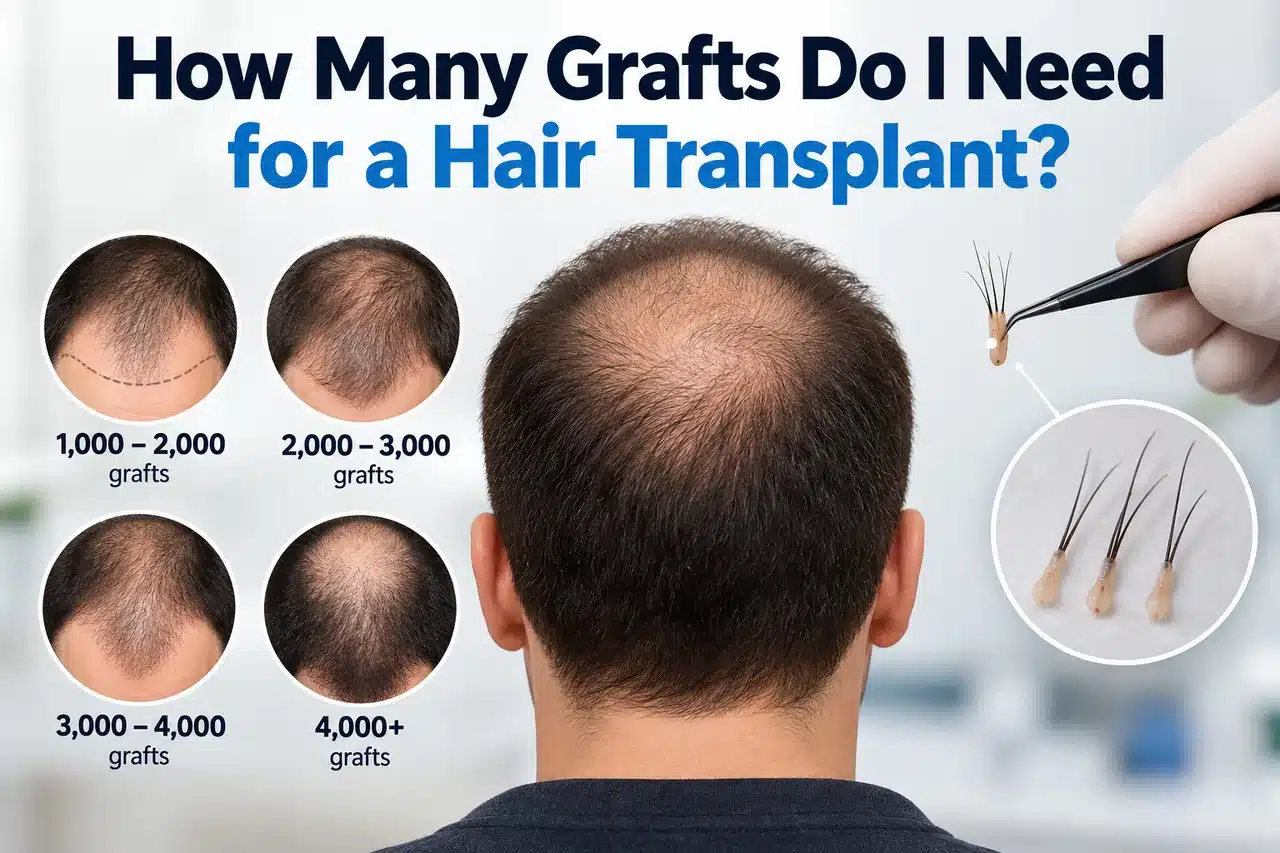
How Many Grafts Do I Need for a Hair Transplant?
One of the first questions people ask when considering a hair transplant is: How many grafts will I need?
You may have seen clinics advertising procedures involving 1,500, 2,500 or even 5,000 grafts. Perhaps you have also come across online hair transplant calculators that promise to estimate the number you need from a photograph.
These figures can be useful for understanding the scale of a procedure, but they do not tell you whether a particular graft count is appropriate for your scalp.
A patient with a small area of frontal recession may have very different needs from someone experiencing extensive thinning across the hairline, mid-scalp and crown.
Hair thickness, existing density, the pattern of hair loss and the available donor reserve all affect the surgical plan.
Even two people with similar-looking bald areas may require different numbers of follicular units to achieve a comparable visual improvement.
The right number of hair grafts is not the highest number that can be transplanted. It is the number that can be used safely and effectively to achieve a realistic, natural-looking restoration.
Below, we explain what grafts are, how surgeons estimate requirements, what different graft counts may represent and why an individual medical assessment is essential.
What Is a Hair Graft?
Before estimating the number of grafts needed for a hair transplant, it is important to understand what a graft actually contains.
In modern follicular-unit hair transplantation, a graft generally refers to a follicular unit.
A follicular unit is a naturally occurring grouping of hair follicles within the scalp.
It may contain one, two, three or occasionally more hairs.
During a hair transplant, suitable follicular units are collected from a donor area and transferred to areas affected by hair loss.
Is One Graft the Same as One Hair?
No.
This is one of the most common misunderstandings about hair transplantation.
A single-hair graft contains one hair, whereas a two-hair graft contains two.
Other follicular units may contain three or more hairs.
Therefore, 2,500 grafts do not necessarily mean 2,500 individual hairs.
The actual hair count depends on the composition of the follicular units harvested from that particular patient’s donor area.
This distinction matters because the visual effect of transplantation depends on more than the graft count alone.
The number of hairs per graft, their thickness and their distribution can all influence how much coverage is achieved.
Why Are Different Grafts Used in Different Areas?
The frontal hairline requires particular care.
Single-hair follicular units are often useful when creating a softer, natural-looking transition at the front of the scalp.
Behind the hairline, follicular units containing multiple hairs may help provide visual coverage where appropriate.
The surgeon decides how to distribute the available grafts according to their characteristics and the design of the recipient area.
The aim is not to place identical grafts everywhere, but to reproduce a balanced and natural pattern of hair growth.
What Determines How Many Grafts You Need?
There is no universal graft count for a hair transplant.
The requirement depends on several factors that must be considered together.
1. The Size of the Area Affected by Hair Loss
A relatively small area of recession at the temples will usually require a different treatment plan from extensive thinning across the upper scalp.
As the area requiring coverage becomes larger, the potential graft requirement generally increases.
However, area alone does not determine the final count.
Some patients have existing hairs throughout the affected region, while others have areas with very little remaining hair.
These differences affect how the surgeon approaches restoration.
2. The Existing Hair Density
A region with moderate thinning may already contain a substantial number of functioning follicles.
In such cases, the surgeon may consider how transplantation could complement the existing hair.
By contrast, a region with very little remaining coverage may require a different distribution of grafts.
The treatment must also account for the possibility that non-transplanted hairs will continue to thin.
A plan that appears adequate today should not ignore the future progression of androgenetic alopecia.
3. Hair Thickness and Calibre
Hair calibre is a major factor in the appearance of density.
Thicker hair can provide greater visual coverage than very fine hair, even when the number of grafts is similar.
Two patients with comparable areas of hair loss may therefore require different restoration strategies.
A physician must consider the characteristics of the available hair rather than calculating the graft count from scalp area alone.
4. Hair Colour, Curl and Texture
The natural characteristics of the hair can influence the appearance of coverage.
For example, the contrast between the colour of the hair and the scalp affects how easily the underlying skin can be seen.
Curly or wavy hair may create a different impression of fullness compared with straight hair.
These factors do not replace the need for adequate grafts, but they influence the surgical plan and the patient’s realistic expectations.
5. The Desired Level of Coverage
Not every patient has the same aesthetic goals.
One person may want to restore a balanced frontal hairline that suits their age and facial features.
Another may hope to improve visible coverage across a much larger region.
However, the desired result must remain compatible with the amount of suitable donor hair available.
A request for very high density does not automatically make that density medically appropriate or achievable.
6. The Donor Hair Available
The donor area is usually located at the back and sides of the scalp.
It provides the follicular units that can potentially be harvested for transplantation.
The available donor reserve is limited.
Removing too many grafts can reduce visible density in the donor region, while excessive or poorly distributed extraction may result in unwanted scarring and depletion.
Consequently, the surgeon must balance two separate questions:
How many grafts would provide the desired coverage?
How many grafts can the donor area safely provide?
A responsible treatment plan must answer both.
How Many Grafts Are Needed for Mild, Moderate or Advanced Hair Loss?
Patients often want to see numbers before arranging a consultation.
Broad examples can help explain why different procedures involve different graft counts.
However, they should never be treated as a substitute for a personal medical assessment.
The following ranges are illustrative planning examples, adapted from the clinic’s Greek patient guide. They are not universal targets, guaranteed requirements or recommended extraction limits for every patient.
| General Pattern | Illustrative Graft Range |
|---|---|
| Limited hairline recession or a relatively small area | 1,000–1,800 grafts |
| More substantial thinning involving the frontal or mid-scalp areas | 2,000–3,000 grafts |
| Extensive hair loss involving multiple regions | 3,500–5,000 grafts in selected plans, potentially across multiple sessions |
The actual number may fall below or above these examples.
A patient with advanced hair loss may not have enough stable donor hair to safely support the number of grafts they would ideally like.
Similarly, a smaller area does not automatically require a particular minimum number.
These figures describe possible treatment scales, not what an individual patient should receive.
Why Can the Same Degree of Hair Loss Require Different Graft Counts?
Consider two people who have comparable thinning across the frontal scalp.
One has relatively thick, wavy hair and a strong donor area.
The other has fine, straight hair and more limited donor density.
The same numerical graft plan may not create the same visual effect in both cases.
Their existing density, hair characteristics and long-term hair-loss patterns may also differ.
For this reason, a graft estimate must be personalised.
How Many Grafts Are Needed for the Hairline?
The frontal hairline is one of the most visually important parts of hair restoration.
Even a relatively limited change in its position or density can affect the overall appearance of the face.
However, hairline restoration is not simply a matter of filling an empty strip with as many grafts as possible.
The surgeon must consider:
- The patient’s age.
- Facial proportions.
- The position of the existing hairline.
- The degree of recession.
- The natural direction and angle of the hairs.
- The available donor reserve.
- The possibility of future hair loss behind the restored hairline.
Why Is Hairline Design More Important Than a High Graft Count?
An excessively low or unnaturally straight hairline can be difficult to maintain aesthetically if hair loss continues in the surrounding areas.
The physician must therefore plan a hairline that is appropriate for the patient today and remains reasonable over time.
The distribution of single-hair and multi-hair follicular units also matters.
A natural-looking transition at the front may be more important than attempting the greatest possible density throughout the area.
How Many Grafts Are Needed for the Crown?
The crown, also known as the vertex, is different from the frontal hairline.
Hair in this region often follows a circular or spiral growth pattern.
Restoration must respect the natural direction of the existing hairs.
The crown may also involve a relatively large area of thinning, depending on the patient’s hair-loss pattern.
This can create substantial demand for donor grafts.
However, it would be misleading to claim that every crown transplant requires a fixed number of follicular units.
The requirement depends on the size of the affected area, remaining natural hair, desired coverage and donor supply.
Should the Crown Always Be Restored First?
Not necessarily.
For a patient with limited donor reserves and extensive hair loss, the physician may recommend prioritising other areas.
The frontal hairline and mid-scalp can be particularly important for the overall appearance.
The decision depends on the individual patient’s goals and anatomical characteristics.
In some cases, grafts may be allocated to several regions.
In others, the surgeon may recommend a more conservative, staged approach.
Does the Norwood Scale Tell You Exactly How Many Grafts You Need?
The Norwood scale is commonly used to describe patterns of male androgenetic hair loss.
It classifies different degrees and distributions of recession and thinning.
However, a Norwood classification is not a precise graft calculator.
Two patients with the same general Norwood pattern may have different scalp dimensions, hair thickness, remaining density and donor reserves.
One may be suitable for a relatively extensive restoration, while another may need a more limited plan.
The classification can help describe the pattern of hair loss.
It cannot independently determine the exact number of grafts required.
How Does a Surgeon Calculate the Number of Grafts?
Estimating graft requirements involves the recipient area and the donor area.
The physician first evaluates which regions need restoration and whether the patient is a suitable candidate.
The assessment may then consider the area requiring coverage, existing hair density, hair calibre and the desired distribution of transplanted follicular units.
Measuring the Recipient Area
The physician estimates the surface area affected by thinning.
However, a larger area does not automatically mean every square centimetre should receive the same density of grafts.
The frontal hairline, central scalp and crown have different design requirements.
The number and placement of grafts are adjusted accordingly.
Evaluating Existing Hairs
If the recipient region still contains natural hair, the physician must account for its density and condition.
In some patients, existing hairs may be undergoing miniaturisation.
The future loss of these hairs can affect the long-term appearance of the transplant.
For this reason, a plan based only on the currently visible empty spaces may be inadequate.
Assessing Donor Capacity
The donor region is examined to determine the amount of suitable hair that may reasonably be harvested.
This involves more than counting visible hairs at the back of the head.
The surgeon considers follicular-unit density, hair calibre, donor-zone stability and the effects of extraction on the remaining hair.
The available supply must be sufficient to support a realistic treatment plan without unacceptable depletion.
Combining the Findings
Only after reviewing these factors can a meaningful graft estimate be developed.
The final plan may also be influenced by medical history, previous surgery and whether a staged approach is advisable.
The result is an individual treatment proposal rather than a number taken from a standard chart.
Are Online Hair Transplant Graft Calculators Accurate?
Online calculators may provide a rough educational estimate.
Some ask users to select an area of baldness, choose a Norwood pattern or upload photographs.
However, their limitations are important.
A calculator cannot reliably determine all the biological and anatomical characteristics that affect surgical planning.
For example, it may not adequately assess:
- Donor-area miniaturisation.
- The number of hairs per follicular unit.
- Actual hair calibre.
- The stable donor-zone boundaries.
- The presence of an underlying scalp condition.
- Previous harvesting and scarring.
- The probable progression of hair loss.
These factors can substantially change the number of grafts that may be appropriate.
A calculator should therefore be treated as a source of general information, not as a surgical prescription.
Can You Estimate Grafts From Photographs?
Photographs can be useful for an initial discussion.
Clear images of the hairline, temples, mid-scalp, crown and donor area may help a physician understand the visible pattern of thinning.
However, photographs alone may not provide a complete assessment.
Lighting, camera angle, wet hair and styling can significantly affect the apparent density.
A photograph also cannot reliably establish the microscopic characteristics of the donor area.
For this reason, a preliminary photographic estimate should not be presented as a definitive graft count.
A clinical examination may be needed before making a final surgical recommendation.
Are More Grafts Always Better?
No.
A larger graft count does not automatically mean a more natural or satisfactory result.
Hair transplantation involves the redistribution of a limited number of follicular units.
Using more grafts than necessary can reduce the amount available for potential future treatment.
Excessive harvesting may also affect the appearance of the donor area.
Meanwhile, placing grafts too densely without regard to the recipient area’s condition does not guarantee better growth.
The final appearance depends on more than the numerical count.
Important factors include the grafts’ characteristics, the surgeon’s planning, the distribution across the recipient area, handling during the procedure and postoperative healing.
The most appropriate graft count is the one that serves a realistic treatment plan while protecting the donor area.
How Many Grafts Can Be Transplanted in One Session?
This depends on the individual procedure.
The number that may be transplanted in a single session is influenced by the donor area’s capacity, the harvesting method, surgical complexity and the patient’s circumstances.
A larger proposed graft count does not mean that all those grafts should necessarily be transplanted in one day.
Some extensive restorations may require treatment across more than one session.
The purpose of dividing treatment is not simply to reach an advertised total.
It may reflect the need for appropriate surgical planning, healing and donor-area preservation.
Can You Have a Second Hair Transplant?
In selected cases, yes.
A second procedure may be considered if additional hair restoration is appropriate and enough suitable donor hair remains.
However, the donor area must be reassessed.
Previously harvested follicular units are no longer available in their original positions.
The physician must therefore consider the grafts already used, existing scars, remaining density and possible future hair loss.
A second procedure should not be planned as though the donor area had never been used before.
Does FUE Require More Grafts Than FUT?
FUE and FUT describe different methods of harvesting follicular units.
They do not automatically determine how many grafts are needed to restore a particular area.
The recipient area’s requirements are influenced primarily by the extent of thinning, existing coverage, hair characteristics and the restoration plan.
However, the harvesting technique affects how the available donor supply can be used.
With FUE, follicular units are removed individually from the donor area.
With FUT, follicular units are prepared from a surgically removed strip of hair-bearing scalp.
Each technique has different considerations for harvesting, scarring and donor management.
The appropriate approach must be selected for the individual patient.
You can learn more about one established technique through our FUE hair transplant service.
How Does the Graft Count Affect Hair Transplant Cost?
The number of grafts is one of the factors that can influence the price of a hair transplant.
A larger treatment area may require a more extensive procedure.
However, pricing also depends on the surgical technique, the complexity of the case and the services included.
A clinic that advertises a lower price per graft is not automatically providing a better overall treatment plan.
Similarly, a higher price does not guarantee a better outcome.
Before comparing quotes, patients should understand how the proposed graft count was determined and what the entire treatment process includes.
For a more detailed explanation, read our guide to hair transplant cost in Greece.
Why Personalised Planning Matters More Than a Graft Number
Two patients with similar-looking hair loss can require very different treatment plans.
The physician needs to understand the cause of hair loss, assess the donor reserve and discuss realistic expectations.
The plan must also consider whether the patient’s remaining hair may continue to thin.
It may be appropriate to prioritise the frontal hairline, distribute grafts between several regions or postpone surgery while the hair-loss pattern is evaluated.
This is why choosing a graft count should follow the medical assessment rather than come before it.
At Hairtransplant Clinic, Dr. Ioannis Papangelopoulos, MD, PhD, personally performs hair transplant procedures, supported by his medical team.
The clinic’s approach to doctor-led hair transplantation in Greece is based on individual diagnosis, graft planning and responsible use of the donor area.
For a broader explanation of the surgical stages, read our guide to how a hair transplant works step by step.
Frequently Asked Questions About Hair Transplant Grafts
How many grafts do I need for a hair transplant?
The number depends on the area affected by hair loss, existing density, hair calibre, donor supply and desired coverage. A physician must assess the individual case before recommending a graft count.
Are 1,000 grafts enough for a hair transplant?
They may be appropriate for some limited areas of restoration, but not for every patient. The size of the recipient area and the desired result must be assessed individually.
Are 2,000 or 3,000 grafts enough?
For some patients, these numbers may form part of an appropriate treatment plan. For others, they may be insufficient or unnecessary. The count alone does not determine suitability or expected coverage.
Can I have 5,000 grafts in one session?
A procedure of this size is not automatically appropriate or safe for every patient. The available donor reserve, harvesting technique and individual surgical circumstances must be assessed. Some extensive plans may require multiple sessions.
How many hairs are in 2,500 grafts?
There is no single answer. Follicular units may contain one or several hairs. The actual total depends on the composition of the grafts harvested from the patient’s donor area.
Do I need more grafts for the crown than the hairline?
Not necessarily. The crown can involve a large area and a circular hair-growth pattern, while hairline restoration has different design requirements. The number depends on the individual recipient area and donor reserve.
Is an online graft calculator reliable?
It may provide an approximate educational figure, but it cannot replace an individual medical assessment. Donor density, hair thickness, miniaturisation and long-term planning require clinical evaluation.
Can I find out my exact graft count from photographs?
Photographs may help with preliminary assessment but are not always sufficient for a final estimate. A medical examination is often necessary to evaluate donor capacity and the actual restoration requirements.
Does having more grafts guarantee better density?
No. The visible result depends on graft composition, hair characteristics, distribution, existing coverage and the overall surgical process. Higher graft numbers are not automatically better.
Can I use grafts again in a second procedure?
Additional grafts may sometimes be harvested from the remaining donor reserve. However, previously extracted follicular units are not normally replaced at their original sites, so a new donor-area assessment is necessary.
Does the number of grafts affect the cost?
Yes, it may influence the overall price. However, the cost also depends on the technique, complexity and treatment plan. A personalised quotation is more meaningful than a universal per-graft estimate.
Conclusion: The Right Number of Grafts Is Individual
There is no universal answer to the question, “How many grafts do I need?”
A limited hairline restoration may require considerably fewer follicular units than extensive thinning across several parts of the scalp.
However, the size of the affected area is only one part of the calculation.
The physician must also evaluate existing density, hair thickness, graft composition, donor-area capacity and possible future hair loss.
Illustrative ranges can help patients understand the different scales of hair transplant procedures, but they are not reliable substitutes for an individual assessment.
The aim is not to transplant the greatest possible number of grafts. It is to use the available donor hair in a way that provides meaningful coverage while protecting future options.
If you are considering hair transplantation and would like to understand your individual graft requirements, you can contact Hairtransplant Clinic to arrange a diagnostic consultation.
Phone: +30 21 0775 7700
Email: info@hairtransplant.gr
A personalised assessment can help determine whether transplantation is appropriate, which areas may be restored and how many grafts may reasonably be required.